
Mars exploration database

All Missions

Every mission ever sent to the Red Planet: orbiters, landers, rovers and the helicopter that flew. Filter, explore the chronology and open each file.

64MissionsLaunched
8ActiveWorking now
50%Success rateReached their goal
7Rovers
13Landers
30Orbiters
1Helicopters

Chronology of Mars exploration

Drag, scroll or use the arrows. The bars show how many missions launched each year: they cluster around the launch windows that open every 26 months.

ActiveCompletedFailedUpcoming
More filters

Showing 12 of 13 missions

Clear filters
Failed · launch failure
CNSA

Yinghuo-1 (YH-1)

The Yinghuo-1 mission was the CNSA's first attempt to send a microsatellite orbiter to the Martian environment. Launched on November 8, 2011, as a secondary payload of the Russian Phobos-Grunt spacecraft, the assembly became stranded in low Earth orbit after the cruise burn failed. The mission formally concluded with its destructive reentry over the Pacific on January 15, 2012.

Orbiter
Failed · orbital failure
NASA

Mars Climate Orbiter (Mars Surveyor '98 Orbiter)

NASA's Mars Climate Orbiter was an orbiter designed to study the climate and atmosphere of Mars and act as a communications relay. The mission failed on September 23, 1999, during orbital insertion due to a navigation error caused by a discrepancy in metric and imperial units, leading to its destruction in the Martian atmosphere.

Orbiter
Failed · orbital failure
JAXA

Nozomi (PLANET-B)

Nozomi (PLANET-B), launched on July 3, 1998, by ISAS (predecessor of JAXA), was Japan's first interplanetary mission aimed at studying Mars' upper atmosphere and its interaction with the solar wind. After suffering severe setbacks during gravity assists and solar flares in its prolonged cruise, the spacecraft was unable to perform the orbit insertion, completing a distant flyby before formally ending its mission on December 31, 2003, in heliocentric orbit.

Orbiter
Failed · launch failure
Roscosmos

Mars 96 (Mars-8)

Roscosmos's ambitious Mars 96 mission, designed to study Mars's evolution and physics through an orbiter, two surface stations, and two penetrators, failed a few hours after launch due to a restart failure of the Proton-K rocket's fourth upper stage.

Orbiter
Failed · contact lost before meeting objectives
NASA

Mars Observer

Mars Observer (1992) was an ambitious NASA orbiter designed to conduct a global study of Mars' mineralogy, atmosphere, and magnetic field. After a successful interplanetary cruise phase of nearly a year, the spacecraft suddenly went silent on August 21, 1993, three days before orbital insertion, due to a catastrophic failure in its propulsion system.

Orbiter
Failed · contact lost before meeting objectives
Roscosmos

Phobos 2

Phobos 2 was a Soviet orbiter launched in July 1988 with the objective of studying the interplanetary environment, Mars, and the satellite Phobos, incorporating plans to deploy landers. After reaching Martian orbit in late January 1989, the mission gathered valuable scientific data and detailed images until contact was lost on March 27, 1989 due to a critical failure.

Orbiter
Failed · contact lost before meeting objectives
Roscosmos

Phobos 1

Phobos 1 was an ambitious Soviet mission designed to study Mars and its moon Phobos using an orbiter and a lander. Launched in July 1988, the probe collected heliosismic and gamma-ray data during the cruise phase, but was prematurely lost in September following a telecommand error that deactivated its attitude control.

Orbiter
Failed · orbital failure
OKB-1

Mars 7

Launched on August 9, 1973, with the objective of performing a soft landing. Due to the degradation of onboard computer chips, the lander separated prematurely (or failed its correction maneuver) on March 9, 1974. The probe missed atmospheric entry and flew past the surface at a distance of 1,300 km, becoming trapped in a useless heliocentric orbit.

Orbiter
Failed · orbital failure
OKB-1

Mars 4

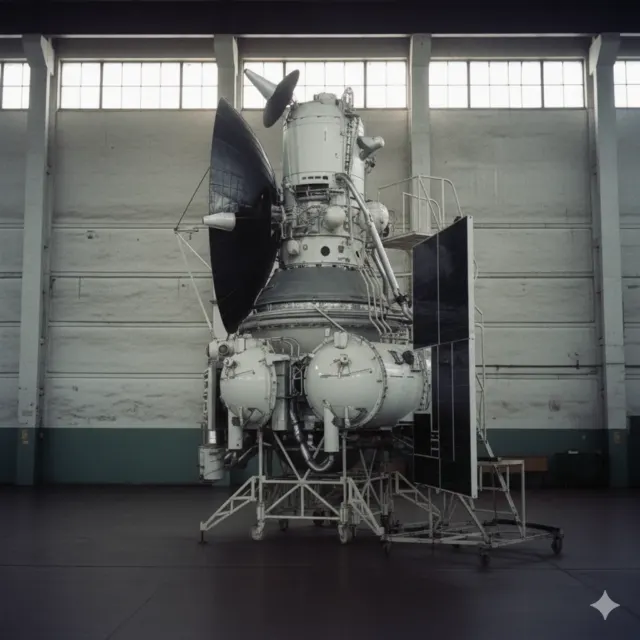
Launched by the USSR in 1973 aiming to orbit Mars. Due to an onboard computer failure (chip degradation), the retrorockets failed to fire for orbital insertion. The spacecraft performed an unplanned flyby on February 10, 1974, at 1,844 km, returning images and detecting the night-side ionosphere of the planet for the first time.

Orbiter
Failed · orbital failure
OKB-1

Kosmos 419

The Soviet Kosmos 419 mission, launched on May 10, 1971, was an attempt to be the first Mars orbiter. It failed in Earth orbit when the Blok D upper stage failed to ignite. The cause was a programming error: the ignition timer was set for 1.5 years instead of 1.5 hours. It re-entered the atmosphere two days later.

Orbiter
Failed · launch failure
NASA

Mariner 8

Mariner 8 (NASA), launched on May 9, 1971, was intended to be the first spacecraft to orbit Mars. However, the mission failed catastrophically during launch. The Centaur upper stage of the Atlas-Centaur rocket suffered an uncontrolled oscillation, leading to a premature engine shutdown. The spacecraft failed to reach orbit and fell into the Atlantic Ocean.

Orbiter
Failed · launch failure
OKB-1

Mars 1969B

The Mars 1969B mission (USSR), internally designated M-69 No.522, was an attempt to send a heavy orbiter to Mars, launched on April 2, 1969. It failed catastrophically and instantly at liftoff when a first-stage engine of the Proton-K rocket failed, causing the vehicle to crash back onto the launch pad and explode.

Orbiter