
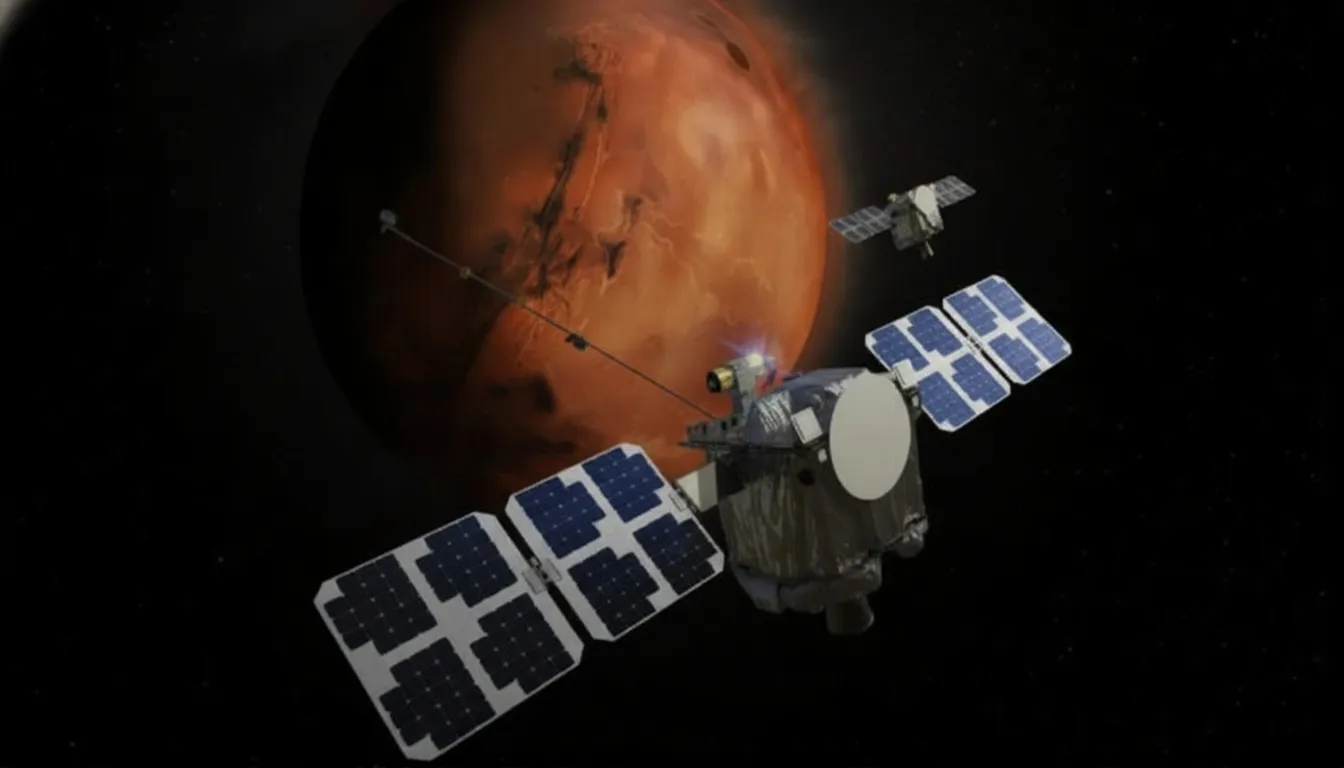


Technical Analysis of the ESCAPADE Blue Mission (SIMPLEx-4A)
- Mission Designation: ESCAPADE Blue
- Operating Agency: NASA and UC Berkeley (Space Sciences Laboratory)
- Launch Date: November 13, 2025 (20:55:01 UTC)
- Launch Vehicle: New Glenn rocket (NG-2 configuration)
- Launch Site: Launch Complex 36 (LC-36A), Cape Canaveral, Florida
- Current Status: En route (Cruise phase and loiter orbit at L2)
- Investigate the hybrid magnetosphere and Martian space environment using stereo observations.
- Analyze the interaction between the solar wind and local crustal magnetic fields.
- Quantify the escape rate of ions and electrons from the Martian upper atmosphere.
- EMAG (Escapade MAGnetometer): Magnetometer developed by NASA's Goddard Space Flight Center to measure and quantify Mars' magnetic field.
- EESA (Escapade ElectroStatic Analyzers): Ion and electron electrostatic analyzers built by UC Berkeley to observe suprathermal flows originating from the solar wind and the upper atmosphere.
- ELP / mNLP (Escapade Langmuir Probe Suite): Langmuir probes (with participation from Embry-Riddle Aeronautical University) to measure thermal plasma density and solar wind environment properties.
- November 13, 2025: Successful launch from Cape Canaveral at 20:55:01 UTC.
- December 2025 - January 2026: Execution of trajectory correction maneuvers (TCM) to consolidate the loiter orbit at L2.
- September 2027: Planned Martian orbital insertion.
- Spring 2028: Expected start of the main science phase (with a nominal duration of 11 months).
1. Historical Context and Detailed Objectives
The ESCAPADE (Escape and Plasma Acceleration and Dynamics Explorers) mission represents a milestone in Martian exploration by employing a constellation of two twin spacecraft (Blue and Gold) to perform simultaneous stereo observations. The scientific gap it aimed to fill focused on the detailed understanding of Mars' hybrid magnetosphere and its direct interaction with the solar wind. Primary objectives centered on measuring how the solar wind impacts crustal magnetic fields and the planet's upper atmosphere, quantifying the physical mechanisms that drove the historical loss of much of its atmosphere and surface water.
Main Objectives:
2. Vehicle Architecture and Main Subsystems
Each twin spacecraft has a total mass of 535 kg (including approximately 370 kg of propellant) and a dry mass of 209 kg. Their outer dimensions with deployed panels reach 4.88 x 1.65 x 1.09 m (compared to 1.20 x 1.65 x 1.09 m in stowed configuration). The electrical system supplies about 260 W via fixed solar panels (with a nominal scientific power consumption of 128 W that can scale up to 288 W under aphelion conditions). Communications operate in X-band via a 50 cm high-gain antenna and additional medium- and low-gain antennas. Propulsion is entrusted to Rocket Lab HyperCurie bipropellant engines (capable of providing a velocity increment of over 2500 m/s) and a cold-gas nitrogen reaction control system (RCS).
3. Payload and Scientific Instrumentation
The scientific payload is designed to simultaneously measure plasma and magnetic fields at two points in Martian space:
4. Launch Vehicle and Trajectory
The launch took place aboard a New Glenn rocket (second flight of the platform, NG-2) from Launch Complex 36 (LC-36A) at the Cape Canaveral Space Force Station. Following the initial heliocentric injection, the mission incorporated a cruise phase with insertion into a loiter orbit at the Sun-Earth Lagrange point L2 in late 2025 and early 2026, with a gravity assist flyby of Earth scheduled for late 2026 before heading toward the final trajectory to Mars.
5. Timeline and Mission Phases
6. Results and Discoveries
As the mission is in its deep space transit and cruise phase, the technical team's efforts have focused on subsystem calibration and engineering checks following commissioning reviews. Primary scientific results regarding the Martian magnetosphere will be obtained once the Martian system is reached and the operational orbital phase begins.
7. Legacy and Significance
ESCAPADE represents a paradigm shift in planetary exploration through the use of low-cost missions under the SIMPLEx initiative, demonstrating the feasibility of simultaneous multi-spacecraft measurements to resolve fundamental unknowns about the climatic and hydrological evolution of the solar system's rocky worlds.