
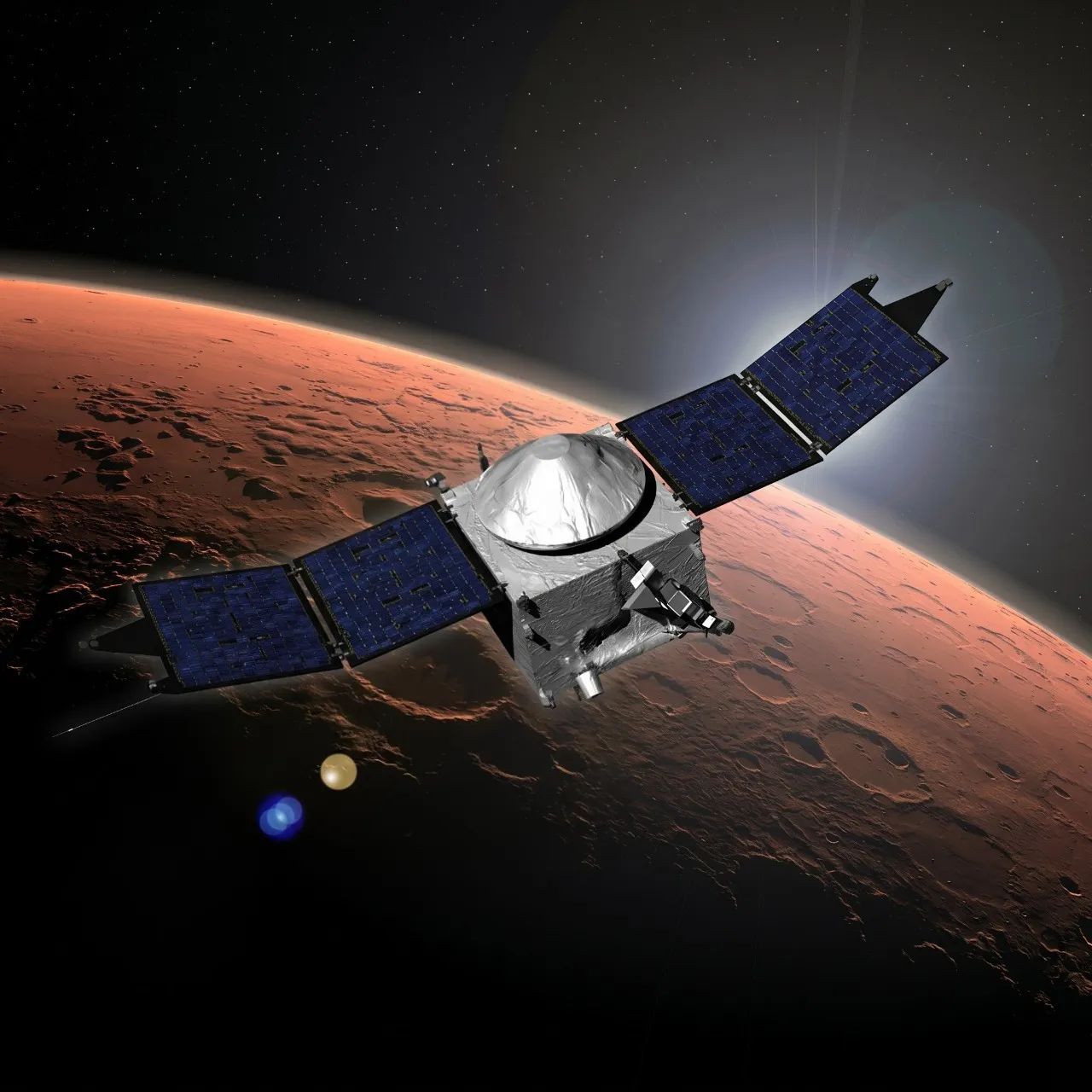


Official Names: Mars Atmosphere and Volatile Evolution (MAVEN)
Space Agency: NASA
Launch vehicle: Atlas V 401
Launch: November 18, 2013, 18:28 UTC
Orbital insertion (MOI): September 22, 2014, 02:24 UTC
Start of operations: November 16, 2014
Mission end: June 3, 2026
Final status: Inactive (attitude control loss on December 6, 2025)
1. Historical Context and Detailed Objectives
MAVEN was executed under the Scout program to determine the atmospheric escape rate of Mars. The objective was to quantify how solar wind erosion and UV radiation stripped away the dense atmosphere that allowed for liquid water in the Noachian. The mission sought to constrain volatile loss models through in-situ measurements of the ionosphere and thermosphere, correlating them with solar activity.
2. Vehicle Architecture and Main Subsystems
The orbiter used an aluminum and graphite cubic bus (125 kg dry mass). Power was supplied by two articulated solar arrays (12 m², 1,135-1,700 W). Attitude control relied on four reaction wheels and eight hydrazine thrusters (analogy: operation similar to the gyroscopes in an inertial sensor that compensate for external rotations via counter-torques). Communication was achieved via an X-band HGA and a UHF Electra radio for rover relay (data rates up to 2,048 kbit/s, equivalent to a low-latency local area network).
3. Payload and Scientific Instrumentation
- SWEA/SWIA: Electrostatic analyzers to characterize plasma density and temperature (analogy: an electromagnetic funnel that sorts particles by their energy).
- STATIC: Thermal ion spectrometer; uses a time-of-flight system to identify molecular masses (analogy: a molecular sieve that separates particles based on their velocity after acceleration).
- NGIMS: Quadrupole mass spectrometer for neutral composition analysis (1-150 Da).
- MAG/LPW/EUV: Fluxgate magnetometers, Langmuir probes for electron density, and photodiodes for solar irradiance.
- IUVS: Echelle spectrograph for UV emissions, critical for calculating H and D abundance (analogy: a high-resolution prism that decomposes light to detect specific isotopes).
4. Launch Vehicle and Flight Profile / EDL
The Mars Orbital Insertion (MOI) required a 33-minute 15-second main engine burn, reducing velocity by 1,230.5 m/s. In 2019, the orbit was adjusted via aerobraking, lowering the periapsis to 125 km. On December 6, 2025, after an occultation maneuver, the spacecraft entered an uncontrolled spin (attitude anomaly). The orientation imbalance prevented photovoltaic recharging, resulting in battery depletion and permanent loss of the telemetry link.
5. Operational Development and Scientific Results
Over 11 years, MAVEN mapped ionospheric response to space weather events, such as the 2017 solar storm. Isotopic fractionation data at the exobase, contrasted with SAM surface measurements, established that 66% of primordial argon was lost via sputtering. The mission allowed modeling Martian climate evolution from 3.8 Ga to the present.
6. Conclusion and Technical Legacy
NASA formalized the mission's conclusion on June 3, 2026. MAVEN's legacy lies in its characterization of planetary atmospheric erosion and its service as an interplanetary communications node, which maximized the scientific productivity of the Curiosity and Perseverance surface rovers.
Related
Missions
- 🛰️ Curiosity
- 🛰️ Perseverance
Events
- 📅 Launch of MAVEN 18 NOV 2013 · 18:28 UTC · SOL 34 OF CHRYSIO OF YEAR 32
- 📅 Launch of MAVEN 18 NOV 2013 · 18:28 UTC · SOL 34 OF CHRYSIO OF YEAR 32
- 📅 MAVEN Orbital Insertion 22 SEP 2014 · 02:24 UTC · SOL 36 OF KASEO OF YEAR 32
- 📅 Mars Arrival of MAVEN 22 SEP 2014 · 02:24 UTC · SOL 36 OF KASEO OF YEAR 32
- 📅 Start of MAVEN Science 16 NOV 2014 · 00:00 UTC · SOL 15 OF MANGALO OF YEAR 32
- 📅 MAVEN Loss of Control 6 DEC 2025 · 00:00 UTC · SOL 7 OF KASEO OF YEAR 38
- 📅 End of MAVEN Mission 3 JUN 2026 · 00:00 UTC · SOL 32 OF OLYMPO OF YEAR 38