


COSPAR Designation: 1960-F03 (Unofficial, cataloged by NASA as Mars 1960B / Marsnik 2)
Official Name: Korabl 5 (OKB-1 Internal Designation: 1M No. 2)
Responsible Space Agency: Soviet Union Space Program (OKB-1)
Launch Date and Time: October 14, 1960, at 13:51:03 UTC
EDL / Arrival Date and Time: Not applicable (Failure during ascent phase at T+290 seconds)
Landing / Impact Coordinates: Suborbital trajectory destroyed over Eastern Siberia, Russia
Launch Vehicle: Molniya 8K78 (Vector L1-5M)
Current Mission Status: Failed (Destroyed during launch)
1. Historical Context and Detailed Objectives
In the late 1950s, interplanetary space exploration became the next strategic vector for the OKB-1 Design Bureau, led by Chief Designer Sergei Korolev. Following the consolidation of access to low Earth orbit and the first lunar impacts, the Soviet government formalized the development of the Object 1M project on December 10, 1959. The scientific void this architecture intended to fill was absolute: there were no direct data regarding the Martian magnetosphere, the density of its atmosphere, interplanetary radiation in deep space, or the viability of plant life on its surface.
The primary objective of the Korabl 5 probe was to execute a planetary flyby at an approach distance between 5 000 km and 30 000 km from the surface of Mars to collect spectrographic and photographic data of the Martian environment. Secondary objectives encompassed the continuous analysis of the interplanetary medium by measuring solar wind, magnetic fields, and micrometeorite density throughout the heliocentric transfer trajectory.
2. Vehicle Architecture and Main Subsystems
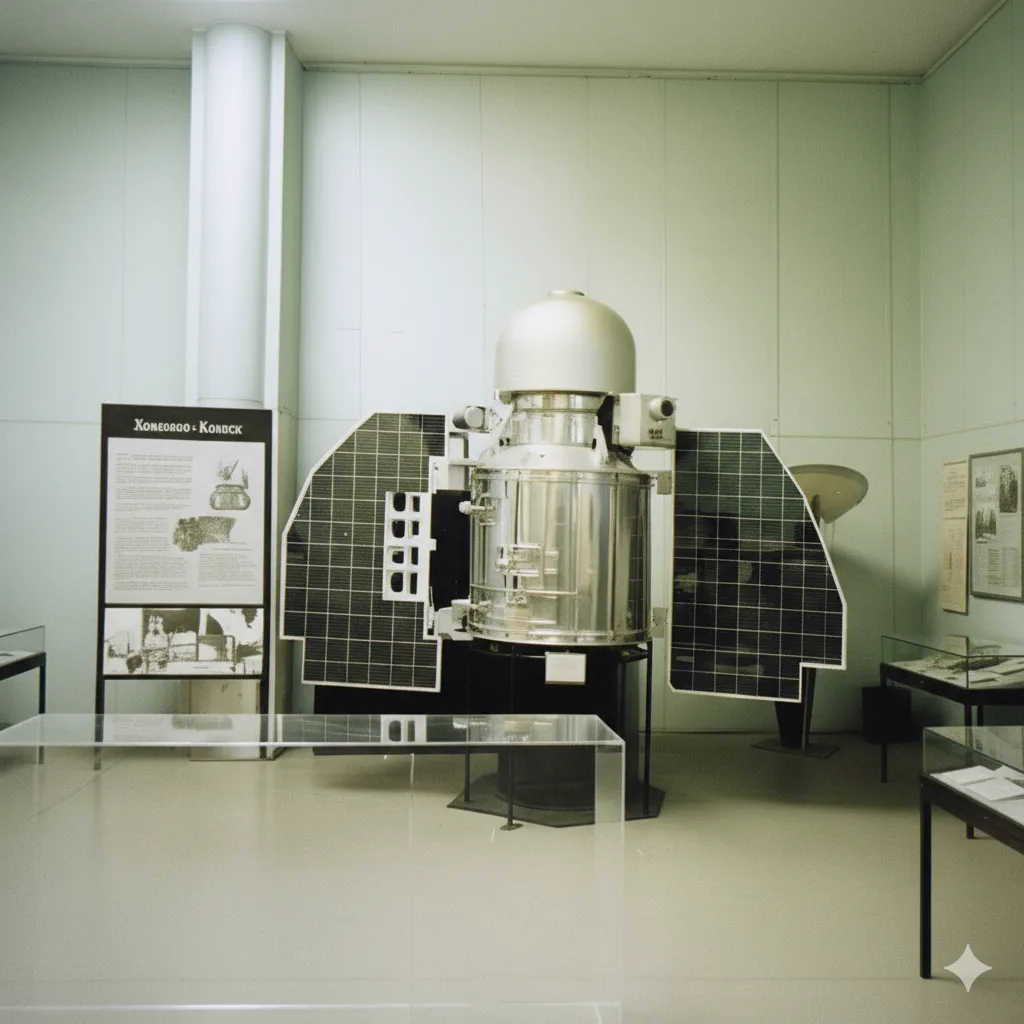
The Object 1M space platform utilized a standardized modular design shared with the 1VA Venus missions. The central structure consisted of a pressurized cylindrical container 1.05 m in diameter and 2.0 m in height. This orbital compartment housed the analog electronics and was sealed at a constant pressure of 1.2 atm with dry nitrogen. As an anchoring analogy, this pressurization system functioned identically to a modern car radiator, using gas in forced circulation by fans to homogeneously distribute the heat generated by internal components and prevent them from burning out in the vacuum of deep space.
The total launch mass documented by the Soviet program stood at 650 kg, including the interface adapter and propellant, while the net dry mass of the isolated vehicle was 480 kg. The power subsystem relied on two solar cell panels with a combined area of 2.0 m² coupled to a central silver-zinc battery. Active three-axis attitude control operated via internal gyroscopes, optical solar-stellar alignment sensors (referenced to Canopus or Sirius), and compressed nitrogen gas micro-thrusters. The telecommunications subsystem integrated decimetric band links (922.8 MHz for downlink and 770 MHz for uplink) through a 2.33 m diameter deployable mesh parabolic antenna, complemented by a centimetric band link (3 691.2 MHz) for bulk data downloads. Low-gain omnidirectional antennas served as telemetry backup without requiring specific orientation.
3. Payload and Scientific Instrumentation
Due to severe mass restrictions caused by the delay of the launch window, the original scientific payload was drastically reduced prior to liftoff, removing a 32 kg photographic television system and an infrared spectroreflectometer. The final integrated scientific instrumentation totaled a mass of 10 kg and consisted of the following equipment:
- Ultraviolet Spectrograph: Designed to analyze the gas profile and spectral lines of the upper Martian atmosphere.
- Gas-discharge Radiation Detector: Tasked with measuring the ionizing radiation flux present in interplanetary space.
- Cosmic Ray Counter: An internal sensor to quantify the impact of high-energy galactic particles.
- Fluxgate Magnetometer: A device mounted on a rigid boom to characterize the magnitude and orientation of magnetic fields.
- Ion Plasma Traps: Designed to record the density and temperature of the constituent ions of the solar wind.
- Micrometeorite Detector: Sensitive piezoelectric plates intended to measure the frequency of impacts and mechanical momentum of dust particles.
To understand the principle of the fluxgate magnetometer, one can imagine a wind instrument like a flute: just as air alters the sound inside the pipe, the presence of an external magnetic field alters the electrical current flowing through the magnetic cores of the sensor, allowing its intensity to be measured indirectly.
4. Launch Vehicle and Flight / EDL Profile
Trans-Martian injection required an escape velocity exceeding the capabilities of conventional rockets of that era, which necessitated the development of the four-stage Molniya 8K78 launch vehicle. The first two stages were based on the R-7A missile, consisting of four strap-on boosters (Blocks B, V, G, D) with RD-107 engines (a total thrust of 3 981.6 kN in vacuum) and a core sustainer stage (Block A) equipped with a 941 kN thrust RD-108 engine. The third stage (Block I) carried the 297.9 kN RD-0107 engine, and the fourth stage (Block L) integrated the 67 kN S1.5400 engine, designed to ignite in microgravity.
The planned flight profile demanded an initial insertion into a low Earth parking orbit (LEO) before igniting Block L. However, the mission experienced a catastrophic, unrecoverable anomaly during the ascent phase. At T+290 seconds from liftoff, following the nominal separation of Block A, the third-stage RD-0107 engine completely failed to start. Generating no thrust, the vehicle described a purely suborbital trajectory with a peak apogee of 120 km, re-entering ballistically into the dense atmosphere where it disintegrated due to aerodynamic heating and intense shear forces over Eastern Siberia.
5. Operational Development and Scientific Results
Given that the launch vehicle failed to place the upper stage and the probe into Earth orbit, the operational phase of Korabl 5 lasted zero seconds. No scientific data were obtained from the interplanetary medium or the planned Martian targets.
Post-failure telemetry analysis determined that the origin of the anomaly was thermal and related to mechanical insulation on the launch pad. A defective seal in the liquid oxygen (LOX) drain valve of Block I caused a continuous leak of the oxidant at -183°C, which dripped directly onto the fuel intake pipe. The T-1 military-grade kerosene inside the line has a freezing point between -45°C and -50°C. Extreme heat transfer reduced the local temperature below this limit, solidifying the kerosene into a dense wax matrix that completely blocked the turbopump rotor, preventing the ignition of the third-stage engine.
6. Conclusion and Technical Legacy
Despite the total loss of the vehicle, the failure dynamics of Korabl 5 provided critical engineering lessons for the development of Soviet aerospace technology. The investigation demonstrated the unfeasibility of bypassing dynamic thermal vacuum testing with actual cryogenic components prior to pad deployment.
The elastomeric and metallic seals of the Block I cryogenic couplings were completely redesigned to absorb thermal contraction. Likewise, the thermal control optimizations implemented in the RD-0107 engine led to the improved RD-0108 model, used to certify manned flights for the Voskhod program. Subsequently, the resolution of its combustion instabilities via structural baffles culminated in the RD-0110 engine, the standard third-stage powerplant of the Soyuz vehicle family that has operated with high levels of reliability for decades.
Related
Events
- 📅 Launch of Mars 1M No.2 (Marsnik 2) 14 OCT 1960 · 12:00 UTC · SOL 27 OF QUIRINO OF YEAR 3
- 📅 Launch of Mars 1M No.2 14 OCT 1960 · 12:00 UTC · SOL 27 OF QUIRINO OF YEAR 3
- 📅 End of mission: Mars 1M No.2 14 OCT 1960 · 12:05 UTC · SOL 27 OF QUIRINO OF YEAR 3
- 📅 Launch of Mars 1M No.2 (Korabl 5) 14 OCT 1960 · 13:51 UTC · SOL 27 OF QUIRINO OF YEAR 3
- 📅 End of mission: Mars 1M No.2 (Korabl 5) 14 OCT 1960 · 13:55 UTC · SOL 27 OF QUIRINO OF YEAR 3