
The Architecture of Mid-Air Deployment and the Leap Beyond Ingenuity
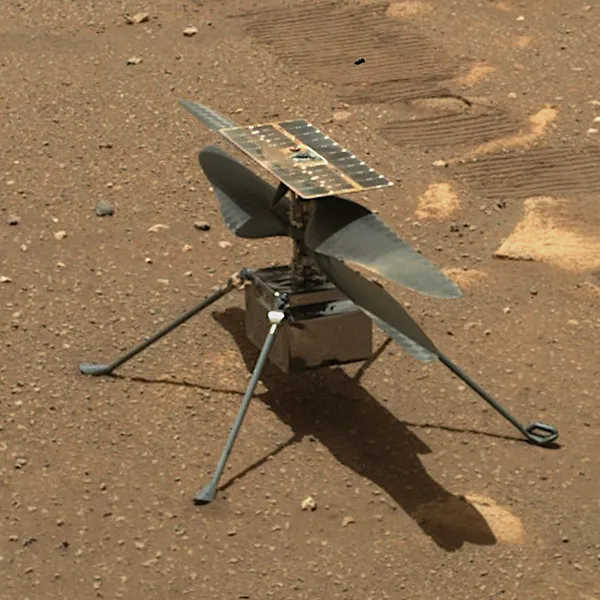
The fundamental abysm existing between the theoretical projections of aerodynamic exploration and the harsh operational reality of Mars weighs heavily upon the design of future planetary missions. Taking the historic success of the Ingenuity helicopter as an undeniable strategic turning point, the U.S. space agency has outlined the contours of the so-called SkyFall mission, slated for launch in 2028. Unlike traditional architectures where the aerial component depended umbilical-like on a parent rover for both interplanetary transit and telecommunications, SkyFall introduces a completely decentralized logistics paradigm. The interplanetary transport of the system will be handled by the Space Reactor-1 (SR-1) Freedom spacecraft, marking the adoption of nuclear electric propulsion (NEP) powered by fission energy.
Descent Dynamics and the Tyranny of the Martian Atmosphere
The core operational component of this ambitious architecture rests upon a trio of identical autonomous helicopters jointly developed by the Jet Propulsion Laboratory (JPL) and AeroVironment. Interestingly, early conceptual designs considered swarms of up to six units, but structural optimization studies reduced the fleet to three vehicles, each with an individual dry mass of 5 pounds (2.3 kilograms). The entry, descent, and landing sequence stipulates that the capsule will release the three craft at an altitude of approximately less than a mile—specifically around 3,300 feet or 1,000 meters—above the thin Martian atmosphere. Following mid-air separation and devoid of a conventional landing platform, the aircraft will engage their rotors to descend completely autonomously, a complex aerodynamic challenge designed to bypass the constraints of classical landing ellipses.
Subsurface Radar and the Search for Volatile Resources
To comprehend the magnitude of the scientific event, one must examine the payload these aircraft will carry during the spring of the northern mid-latitudes of Mars, preliminarily targeted between 30° and 45° N to avoid violent global dust storms. Each helicopter integrates optical and infrared cameras, thermal sensors, a radiation monitor, and a sophisticated fabric-based ground-penetrating radar (GPR) flexible antenna developed by JPL. This device, whose deployment tests successfully concluded in mid-2026, hangs beneath the fuselage without compromising landing stability, allowing the mapping of subsurface water ice deposits within the first meters of the regolith. Under this new architecture, aerial exploration ceases to be a mere technological demonstration exercise to become an indispensable analytical tool for planetary prospecting.
Related
Missions
- 🛰️ Ingenuity
Related news and articles
- 📰 The Martian Slingshot: How the Psyche Mission Leverages Gravity and Bureaucracy to Reach a Metal World 16 MAY 2026
- 📰 The Meridian of Precision: The Silent Adjustment of January 6, 2000 7 JAN 2026
- 📰 The Rebirth of Rosalind Franklin: Geopolitics, Martian Drills, and the Search for Subsurface Life 26 NOV 2025
- 📰 The Fallen Shield: How the ESCAPADE Mission Will Unveil Mars' Atmospheric Agony 14 NOV 2025
Marspedia terms
Enjoyed it? Keep exploring
Back to all news