
The Echo of a Lost Ocean
The study of Martian climate evolution constitutes one of the pillars of comparative heliophysics and confronts us with a desolate reality. Over 3.5 billion years ago, Mars was not the hyper-arid desert we now document with stoic patience. It possessed a dense atmosphere and surface liquid water, but lost its global dynamo—the internal magnetic shield driven by its core—as its depths cooled. Without this centralized protection, the relentless solar wind slowly stripped the planet of its gaseous envelope. However, Mars is not entirely defenseless; it retains magnetic anomalies crystallized in its crust. When interacting with solar radiation, a complex hybrid magnetosphere is formed. To understand this magnetic chaos, imagine a giant umbrella with broken ribs and patched fabrics; the wind does not bounce off cleanly but tangles in the holes, creating turbulent currents through which the atmosphere escapes silently into the deep void.
The Puzzle of Space and Time
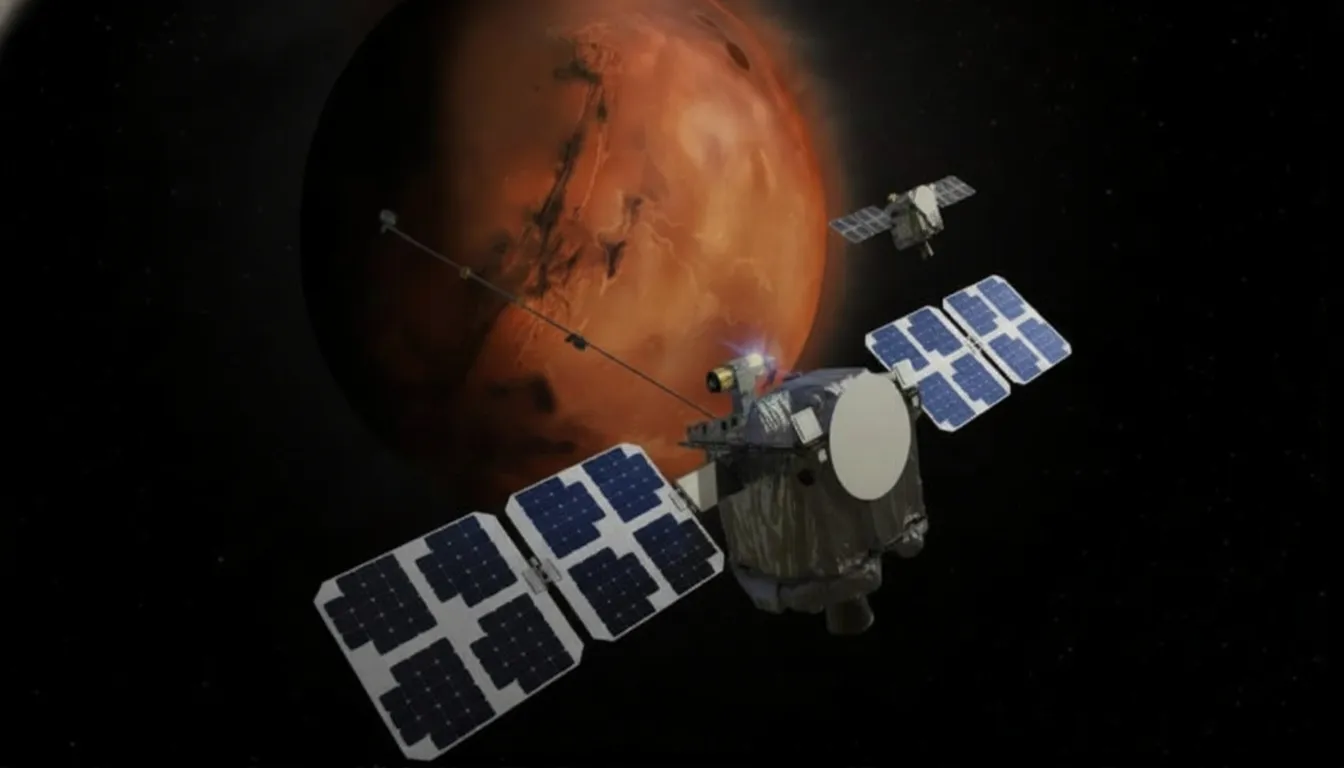
Historically, solitary, large-scale missions like MAVEN have collided with an insurmountable methodological limitation known as space-time ambiguity. When a single probe registers an abrupt drop in Martian plasma density, it becomes mathematically impossible to deduce whether the spacecraft just crossed an invisible physical boundary or if the planet's entire magnetic environment collapsed at that precise instant. It is exactly like driving down a dark road and, upon feeling a jolt, doubting whether the asphalt is broken—a condition of space—or if a microearthquake just occurred beneath the wheels—an event in time—. To definitively resolve this empirical deadlock, NASA has designed the twin Blue and Gold spacecraft of the ESCAPADE mission, which will fly in formation to measure the same fluctuations mere minutes apart, finally separating the where from the when.
Pragmatic Engineering and Bureaucratic Reality
Far from the usual sensationalism that surrounds the new space race, true exploration advances slowly, is highly bureaucratic, and remains conditioned by inflexible budgets. The ESCAPADE mission is the paradigm of this pragmatic reality, born under the umbrella of the SIMPLEx program and assuming a Class D risk classification. In practical terms, the government agency accepts a higher risk of systemic failure in exchange for using standardized commercial components, lowering the total cost to a meager 75 million dollars compared to the nearly 600 million of its predecessors. The two probes, built on Rocket Lab's sturdy Explorer platform, weigh just 535 kilograms each and are armed with advanced electrostatic analyzers and Langmuir probes. If one of the spacecraft were to suffer a catastrophic failure, the other would act as a simple but effective insurance policy, proving that in modern science economic redundancy is just as important as technical innovation.
An Orbital Dance Born of Delay
The path to the Red Planet rarely follows a predictable trajectory, and the demands of astrodynamics do not forgive delays. After losing its original ticket as a secondary payload, ESCAPADE was hastily reassigned to the massive New Glenn rocket. Curiously, its long-awaited liftoff in November 2025 suffered multiple postponements, including the direct impact of a severe G4-class geomagnetic storm; the poetry of a space weather mission paralyzed by space weather itself on the launch pad did not go unnoticed by the engineers. Due to these delays and fuel limitations, the probes could not fly directly to Mars and are currently orbiting patiently at the Lagrange Point L2. It will not be until November of this year, 2026, that they will drop back toward Earth to use our gravity as an immense cosmic slingshot, pointing their bows definitively toward Martian orbit. Thus, navigating bureaucracy, weather, and physics, humanity continues to unravel the mysteries of our celestial neighbors.
Related
Missions
- 🛰️ MAVEN
Related news and articles
- 📰 The Martian Slingshot: How the Psyche Mission Leverages Gravity and Bureaucracy to Reach a Metal World 16 MAY 2026
- 📰 The 153-Day Shortcut: Redefining Navigation to Mars 12 MAY 2026
- 📰 The Meridian of Precision: The Silent Adjustment of January 6, 2000 7 JAN 2026
- 📰 The Rebirth of Rosalind Franklin: Geopolitics, Martian Drills, and the Search for Subsurface Life 26 NOV 2025
Events
- 📅 Launch of the ESCAPADE Mission 13 NOV 2025 · 20:55 UTC · SOL 23 OF JUVENO OF YEAR 38
Marspedia terms
Enjoyed it? Keep exploring
Back to all news