
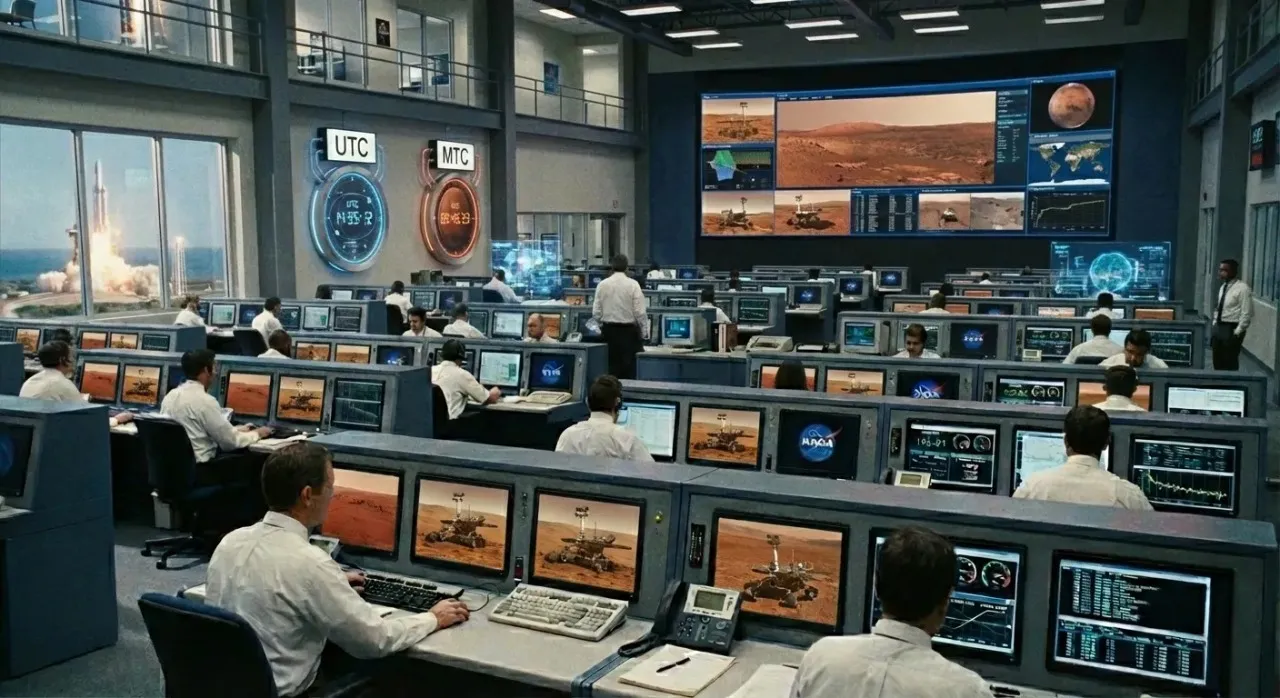
While the world was still dealing with the hangover of the millennium change, the true chronological revolution was taking place without cameras or official speeches at NASA's data terminals. January 6, 2000, was marked in scientific records not for a social gathering, but for being the moment when Earth and Mars time reached an almost absolute mathematical coincidence. This milestone was the culmination of years of analysis on the Red Planet's rotation, allowing Mars Coordinated Time —a sort of universal schedule for robots and future settlers— to finally have a solid starting point. Far from the media noise, this adjustment allowed space exploration to move away from estimates and enter an era of surgical precision.
The Airy-0 crater and the map correction
For a clock to work on another planet, we must first decide where the "kilometer zero" of its geography is. On Earth we use Greenwich, but on Mars, the responsibility lies with Airy-0, a crater barely five hundred meters in diameter. For decades, our view of this point was blurry due to the limitations of cameras from the 1970s, which generated an accumulated error in Martian mapping. Curiously, it was the arrival of laser technology in the late nineties that revealed our maps were shifted by about twenty arcseconds. This difference might seem insignificant in the vastness of the Martian desert, but for a probe descending at hypersonic speeds, twenty seconds represent the distance between a successful landing and a catastrophic collision —it is like trying to make a basket from across the city based on a map that places the hoop a couple of streets away from its actual location—.
Mean time versus solar elasticity
One of the greatest challenges of interplanetary chronometry is that Mars is not a punctual clock. Its orbit is notably elliptical, causing solar days to constantly change in duration throughout its year. To prevent flight computers from collapsing under this variability, scientists defined Mars Coordinated Time as a constant mean time. This system acts as an unshakeable metronome that ignores whether the actual sun is ahead or behind due to the planet's speed in space. Thanks to this mathematical abstraction, the Mars Sol Date was established, a continuous counter that simplifies mission logistics by avoiding the use of months or leap years that would only make sense on Earth —think of it as the millisecond counter on a professional stopwatch, which keeps advancing steadily regardless of whether the runner decides to speed up or slow down during the race—.
The invisible infrastructure of colonization
Progress in space exploration is a slow process, often buried under layers of technical bureaucracy and algorithm reviews. The invisible agreement of the year 2000 is the foundation upon which rovers like Perseverance walk today and upon which the Ingenuity helicopter flew. Without that synchronization on January 6, coordinating communications between Earth and Mars would be a chaos of accumulated time lags. This time system not only helps engineers know when to wake up a machine, but it will also be the standard governing the sleep and wake cycles of the first humans on the Red Planet. In the end, the conquest of Mars rests on these invisible foundations of logic and calculation, proving that before planting a flag, one must first learn to measure exactly when and where they are stepping.
Related
Missions
- 🛰️ Ingenuity
- 🛰️ Perseverance
Related news and articles
- 📰 The Martian Slingshot: How the Psyche Mission Leverages Gravity and Bureaucracy to Reach a Metal World 16 MAY 2026
- 📰 The Rebirth of Rosalind Franklin: Geopolitics, Martian Drills, and the Search for Subsurface Life 26 NOV 2025
- 📰 The Fallen Shield: How the ESCAPADE Mission Will Unveil Mars' Atmospheric Agony 14 NOV 2025
- 📰 The Era of Interplanetary Alliances: The Aeolus Mission and NASA's New Paradigm on Mars 24 JUN 2026
Enjoyed it? Keep exploring
Back to all news