
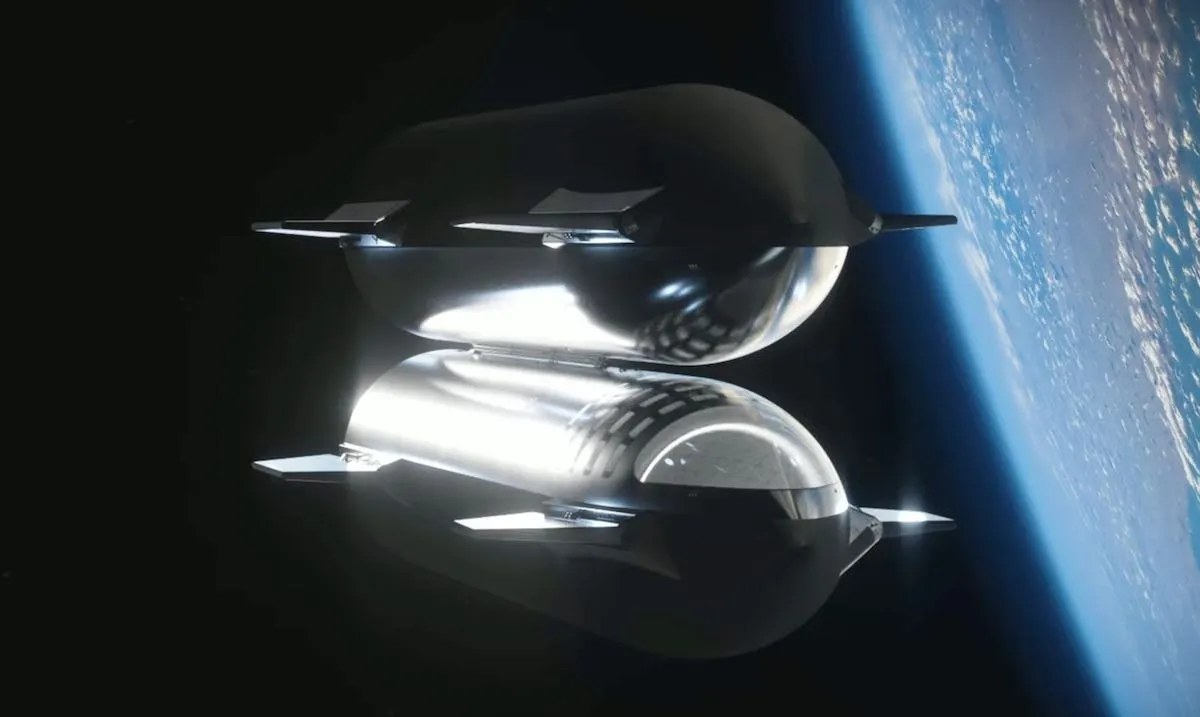
The long-term ambition of establishing a self-sufficient human presence on the fourth planet clashes head-on with the harsh reality of thermodynamics and orbital mechanics. Given Earth's immense gravity well, no current launch architecture is capable of injecting a Starship-class spacecraft directly toward the red planet while carrying more than 100 metric tons of payload. To overcome this physical obstacle, SpaceX's plan relies inexorably on mass replenishment in low Earth orbit, a complex logistical maneuver that has become the true technological bottleneck of modern interplanetary exploration.
The challenge of ship-to-ship propellant transfer
The most immediate and critical milestone to validate this strategy is the official demonstration of cryogenic propellant transfer between two independent vehicles docked in the space environment. Although previous tests simulated internal fluid movements between tanks of the same upper stage, the current challenge lies in transferring thousands of kilograms of liquid methane and liquid oxygen at temperatures dozens of degrees below zero. This process must deal with complex physical phenomena such as boil-off caused by thermal radiation, differential pressure in microgravity, and the dynamic instability of the fluid during transfer. Docking hardware tests and transfer systems have progressively matured in recent orbital operations, with an initial cycle of uncrewed test flights scheduled for the final months of 2026 acting as a prelude to the first formal demonstration of transfer between independent ships in early 2027.
Launch chronology and the postponement toward the 2028 window
This complex technological dependency has forced a readjustment of strategic exploration schedules. Although the possibility of an initial uncrewed cargo delivery taking advantage of the late 2026 planetary alignment window was initially considered, operational limitations in developing the thermal management system and the pace of flight tests have shifted realistic expectations. Thus, the first viable opportunity for launching heavy cargo interplanetary missions toward the Martian surface is now realistically positioned starting from the late 2028 or early 2029 window.
Institutional synergy between the Artemis program and Mars
Orbital refueling technology not only constitutes the fundamental pillar for future settlements on the red planet, but also acts as an essential prerequisite for crewed lunar landings under NASA's Artemis program. While the human landing system requires a high number of tanker flights to fill its depots in low Earth orbit, missions to Mars will demand scaling this operational cadence exponentially. The definitive resolution of the risks associated with large-scale cryogenic management will ultimately determine when the interplanetary transport architecture leaves behind the theoretical design phase to become an operational reality.
Related
Related news and articles
- 📰 The Price of Forcing the Way to Mars: Lights and Shadows of Chun Wang's Interplanetary Plan with Starship 30 MAY 2026
- 📰 Flight 12's Pause: Anatomy of a Technical Delay and Today's Window 22 MAY 2026
- 📰 Starship Flight 12: The Maturity of Block 3 and the Heart of Raptor 3 21 MAY 2026
- 📰 Mars in May 2026: Technical and Geopolitical Reality 2 MAY 2026
Marspedia terms
Enjoyed it? Keep exploring
Back to all news