
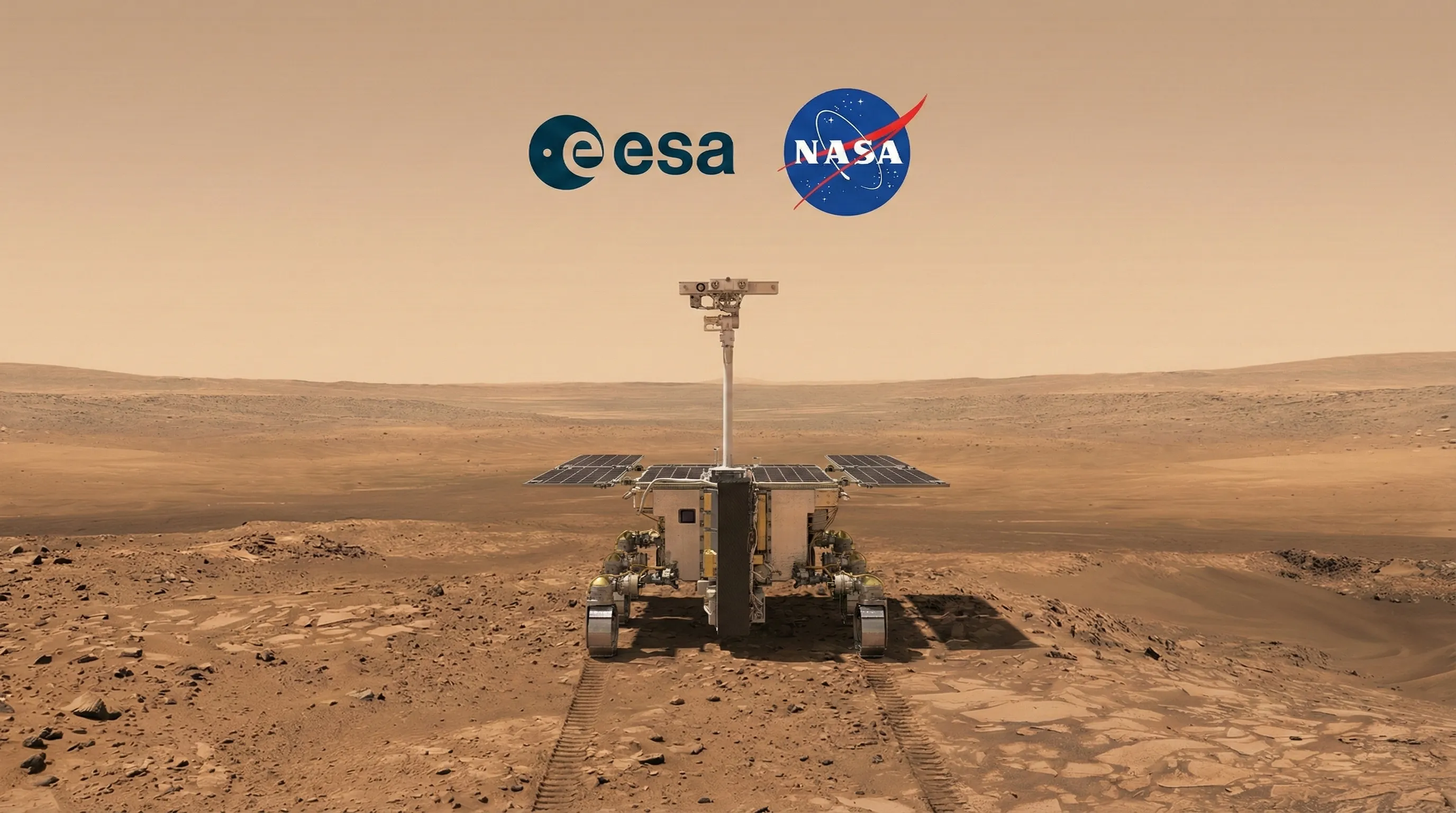
The Geopolitical Schism and the Bureaucratic Miracle
Interplanetary exploration never occurs in a political vacuum. When terrestrial geopolitics fractured decades of cooperation with Roscosmos in early 2022, the ambitious European ExoMars Rosalind Franklin mission stood at the edge of cancellation. The rover, an engineering marvel designed to hunt for biosignatures on Mars, was left orphaned without a rocket or a landing platform. However, space progress is a slow and bureaucratic giant, yet relentless. After years of agonizing redesigns, the recent CM25 Ministerial Council held in Bremen in November 2025 sealed a vital transatlantic pact, ensuring that Europe, backed by NASA's logistical muscle, will finally put its wheels on Oxia Planum by 2030.
Saving Rosalind Franklin demanded systemic reengineering under suffocating pressure. Upon losing the Russian Kazachok platform, a European consortium led by Thales Alenia Space and Airbus Defence and Space UK had to start with a blank canvas to build the new Entry, Descent, and Landing Module. Curiously, the rover's flight hardware was already finished, forcing engineers to design the spacecraft around an unalterable vehicle—a herculean challenge that drastically limited any creative freedom. Despite the technical feat, European coffers were faltering due to soaring costs. It was in Bremen where NASA confirmed its saving intervention through the ROSA project, providing a Falcon Heavy rocket, terminal braking engines, and the irreplaceable Radioisotope Heater Units. Without these nuclear batteries to keep the avionics warm during the freezing Martian nights, the mission would have perished in the offices before ever smelling the red dust.
Drilling the Past: The Science of the Subsurface
But why so much diplomatic and financial effort for this specific rover? The answer lies in chemical degradation. The surface of Mars is an oxidizing hellscape bathed in cosmic radiation and full of perchlorates that destroy any complex macromolecule. Rosalind Franklin is not here to scratch the surface; it is here to pierce it. Its multistage drill can penetrate up to two meters underground. Imagine the Martian surface as a piece of bread left out in the sun for months, dry and sterile on its outer crust; the European drill is the precise tool that will allow us to push past that ruin to reach the soft, protected crumb inside, where biological signatures from billions of years ago might remain intact. All this pristine material is extracted, crushed, and processed in the Analytical Laboratory Drawer, a sterilized environment acting as a miniaturized ultra-clean room to prevent the slightest terrestrial contamination.
Inside this biomechanical laboratory, MOMA stands out, an organic molecule analyzer capable of detecting traces at an astonishing concentration of up to ten parts per billion. To bypass the lethal perchlorates that would incinerate the native carbon upon heating, MOMA employs Laser Desorption Mass Spectrometry, firing ultrashort ultraviolet pulses. Think of this technique like a magic trick where an illusionist yanks a tablecloth away so fast that the dishes—in this case, the fragile organic polymers—remain intact and ready to be analyzed before the chemical fire devours them. Operating alongside MOMA are optical marvels such as the Raman Laser Spectrometer, strategically driven by Spanish institutions to X-ray the crystalline lattice of minerals, and the Enfys infrared spectrometer, which uses sophisticated mathematical deconvolution algorithms to recover faint signals that the instruments themselves blur.
A Realistic Horizon
The launch, scheduled for the last quarter of 2028, will insert the rover into the clay-rich region of Oxia Planum around November 2030. This landing will coincide with the start of Martian Year 41, a climatically mild season that will minimize the risk of global dust storms during the terrifying aerodynamic descent. Demystifying the usual sensationalist fervor, we must be clear that we will not find little green men or fossils of lost civilizations. What we will witness is the culmination of human resilience, a slow and complex dance of engineers, scientists, and diplomats who have managed to save the most sophisticated biological analytical vehicle ever built. We must wait with realistic caution, knowing that, in the hostile vacuum of space, every victory is always a small bureaucratic and technical miracle. Read you in the next interplanetary update, explorers!
Related
Related news and articles
- 📰 ExoMars and Parachute Sterilization: Technical Rigor to Avoid Contaminating Mars 1 MAY 2026
- 📰 Tianwen-3: The New Paradigm of Martian Exploration and Geopolitical Reconfiguration 6 MAY 2026
- 📰 Stratigraphic Continuity Between Oxia Planum and Mawrth Vallis: The Great Window into Mars' Habitable Past 27 JUN 2026
- 📰 The Martian Slingshot: How the Psyche Mission Leverages Gravity and Bureaucracy to Reach a Metal World 16 MAY 2026
Marspedia terms
Enjoyed it? Keep exploring
Back to all news