
Introduction to the Interplanetary Navigation Paradigm
Exploration of the outer reaches of the solar system demands absolute mastery of celestial mechanics, advanced propulsion, and infinite patience in the face of autonomous systems engineering. Far from cinematic sensationalism, space progress is slow, methodical, and riddled with bureaucratic protocols. However, one of the most formidable and illustrative events in modern interplanetary navigation has taken place during this week of May 2026, involving the National Aeronautics and Space Administration (NASA) Psyche probe. Meticulously programmed through years of theoretical simulations to execute a critical gravity assist on Friday, May 15, 2026, the spacecraft has begun its final approach to the Red Planet, passing at an altitude of just 4,500 kilometers above the Martian surface at an astonishing relative speed of 19,848 kilometers per hour.
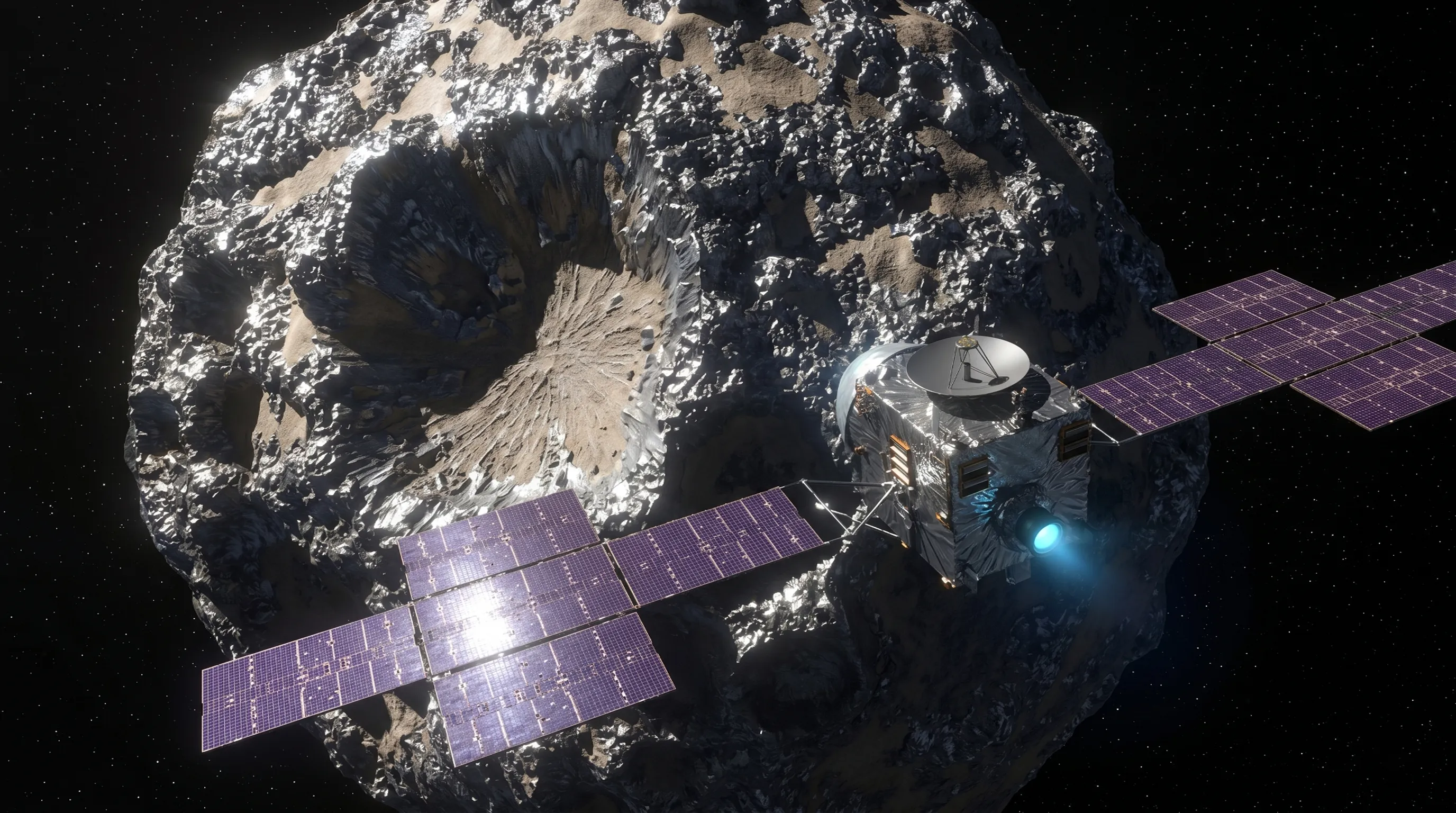
This planetary encounter is not a coincidence or a mere photo-op; it is the cornerstone that justifies the mission's architecture. Launched on October 13, 2023, aboard a SpaceX Falcon Heavy rocket from Florida, the Psyche spacecraft—whose launch mass exceeded 2,747 kilograms—has the eponymous asteroid 16 Psyche as its final destination. Located in the main asteroid belt, this M-class celestial body represents one of the most unusual objects in the solar system: it is theorized to be the exposed metallic core of an ancient planetesimal that lost its rocky mantle in the dawn of the solar system. To cross the 3.6 billion kilometers required and alter its orbital inclination without resorting to unfeasibly massive rockets, the mission was designed around this astrodynamical maneuver at Mars. By plunging into the planet's gravity well, the probe executes a slingshot effect to drastically increase its heliocentric velocity and save massive amounts of xenon propellant.
Astrodynamical Mechanics: The Physics of Angular Momentum Exchange
A gravity assist exploits the interaction between a spacecraft of negligible mass and a massive planet to alter the spacecraft's orbital energy without expending fuel. To understand the maneuver, we must separate the planetocentric frame from the heliocentric one. As Psyche enters Mars's sphere of influence, it falls into its gravity well, accelerating until it reaches its closest approach, or periapsis. From the strict perspective of Mars, the encounter is perfectly elastic; the spacecraft's arrival hyperbolic excess velocity, $v_{\infty}$, is identical in magnitude to its departure velocity. Mathematically, it is defined as $v_{\infty} = \sqrt{v^2 - \frac{2\mu}{r}}$, where $v$ is the spacecraft's velocity at a distance $r$ from the center of mass, and $\mu$ is the gravitational parameter. In the Martian frame, there is no net energy gain, only a directional change in the vector.
The paradigm shift occurs in the heliocentric frame. Imagine a skateboarder briefly grabbing onto a moving truck via a bungee cord; the skater is launched forward at high speed, while the truck suffers a microscopic deceleration. Upon leaving the Martian sphere of influence in a direction more aligned with Mars's orbit around the Sun, the spacecraft travels at an immensely higher heliocentric velocity. Navigation data stipulated that five days before the flyby, the spacecraft was traveling at 102,800 kilometers per hour relative to the Sun, and five days after the event, its speed would have increased to 104,900 kilometers per hour. This transfer of angular momentum, which slows Mars by a fraction of a trillionth of a millimeter per second, places the probe on the exact trajectory for its arrival at the asteroid in 2029.
Kinetic Preparation: Electric Propulsion and Operational Reality
The precision required to pass exactly 4,500 kilometers away after years of travel is nanometric. A minimal error would be exponentially amplified. This is where Psyche's solar electric propulsion (SEP) system comes into play. Unlike chemical rockets that offer violent explosions, Psyche uses Hall-effect thrusters that ionize and accelerate xenon gas. The thrust generated is physically miniscule—equivalent to the pressure of an AA battery resting on the palm of your hand—but it is constant and extremely efficient. To refine the trajectory, on February 23, 2026, the team ordered a correction that required 12 uninterrupted hours of firing; a reminder that in low-thrust orbital mechanics there is no immediacy, only meticulous anticipation.
Curiously, the entire maneuver in the vicinity of Mars must be executed blindly by ground operators. Due to the communication delay imposed by the speed of light and the complexity of operations during periapsis, the probe's flight computer manages its orientation and calibration routines completely autonomously, based on packaged commands validated weeks ago by engineers at the Jet Propulsion Laboratory.
Atmospheric Optics and the Martian Dust Torus
The flyby has transformed into a premier instrumental calibration platform. Because of the encounter's geometry, Psyche catches up to Mars from its night hemisphere, creating what is known as a high phase angle. When the cameras captured the planet in early May, Mars was not an illuminated red disk, but a thin crescent framed against space. This configuration causes sunlight to pass tangentially through the Martian atmosphere, undergoing forward scattering. Think of a dirty car windshield; the dust is barely noticeable at noon, but if you drive directly into a sunset, the entire glass glows blindingly. Similarly, this illumination highlights the Martian atmospheric aerosols, allowing the sensor's sensitivity to be calibrated.
Psyche's imager features specific filter wheels to analyze mineralogy; from clear broadband filters for navigation, to narrow filters for blue and green, as well as specific detectors around 495 nanometers designed to identify sulfides like oldhamite. In addition to calibrating these sensors against the Martian crust, the team will attempt a fascinating experiment: detecting the hypothetical circum-Martian dust torus. It is believed that continuous micrometeorite impacts on the small moons Phobos and Deimos kick up dust clouds trapped in Mars's gravity. Using prolonged exposure times in this privileged position, Psyche could definitively confirm this elusive, diffuse ring of silicates.
Nuclear Spectrometry in the Shadow of Mars
To decipher the ratio of metals to rocks on the asteroid in 2029, Psyche relies on its Gamma Ray and Neutron Spectrometer (GRNS). This device depends on a violent principle: galactic cosmic rays bombard celestial bodies, fragmenting their atomic nuclei in a spallation event. It's like launching a cue ball at full speed into a perfect triangle of billiard balls; the impact sends neutrons and gamma rays flying at specific frequencies that reveal the chemical identity of the struck material. For the high-purity germanium sensor to work, it must be kept permanently cryocooled.
During the hyperbolic pass, the enormous mass of Mars acts as a giant shield that temporarily blocks much of the incessant radioactive noise of the deep universe. Engineers watch as the background count rates of the detectors plummet, allowing them to calibrate the instrument's absolute zero and validate that the filtering algorithms work perfectly before facing the complex radiation chaos of the asteroid belt.
Shared Telemetry: The Martian Swarm
All this physical and scientific effort depends on our ability to measure it from Earth. Through the Doppler shift of the spacecraft's X-band radio waves, the Deep Space Network (DSN) detects velocity variations with microscopic accuracy, confirming that the gravitational transfer has been a geometric success. But Psyche does not perform this concert alone; it has had the collaboration of the densest robotic swarm in human history.
While Psyche analyzed the crescent of Mars, satellites like NASA's Mars Reconnaissance Orbiter or the European Space Agency's Trace Gas Orbiter simultaneously monitored the atmospheric density. At ground level, rovers like Perseverance and Curiosity took in situ measurements of radiation flux and meteorology. In real space exploration, there are no lone heroes; there is synergy, cross-referenced data, and overwhelming patience. Now, with its orbital vector modified and the assist confirmed, Psyche reactivates its thrusters to continue its silent, cold, and long journey toward a nascent world that promises to reveal the mysteries of planetary depths. A firm, slow, and rigorous step into the unknown.
Related
Missions
Related news and articles
- 📰 The Fallen Shield: How the ESCAPADE Mission Will Unveil Mars' Atmospheric Agony 14 NOV 2025
- 📰 The 153-Day Shortcut: Redefining Navigation to Mars 12 MAY 2026
- 📰 The Meridian of Precision: The Silent Adjustment of January 6, 2000 7 JAN 2026
- 📰 The Rebirth of Rosalind Franklin: Geopolitics, Martian Drills, and the Search for Subsurface Life 26 NOV 2025
Events
- 📅 Launch of Psyche 13 OCT 2023 · 14:19 UTC · SOL 24 OF HESPERO OF YEAR 37
- 📅 Mars Arrival of Psyche 15 MAY 2026 · 04:33 UTC · SOL 14 OF OLYMPO OF YEAR 38
- 📅 End of mission: Psyche 17 MAY 2026 · 00:00 UTC · SOL 16 OF OLYMPO OF YEAR 38
Marspedia terms
Enjoyed it? Keep exploring
Back to all news