
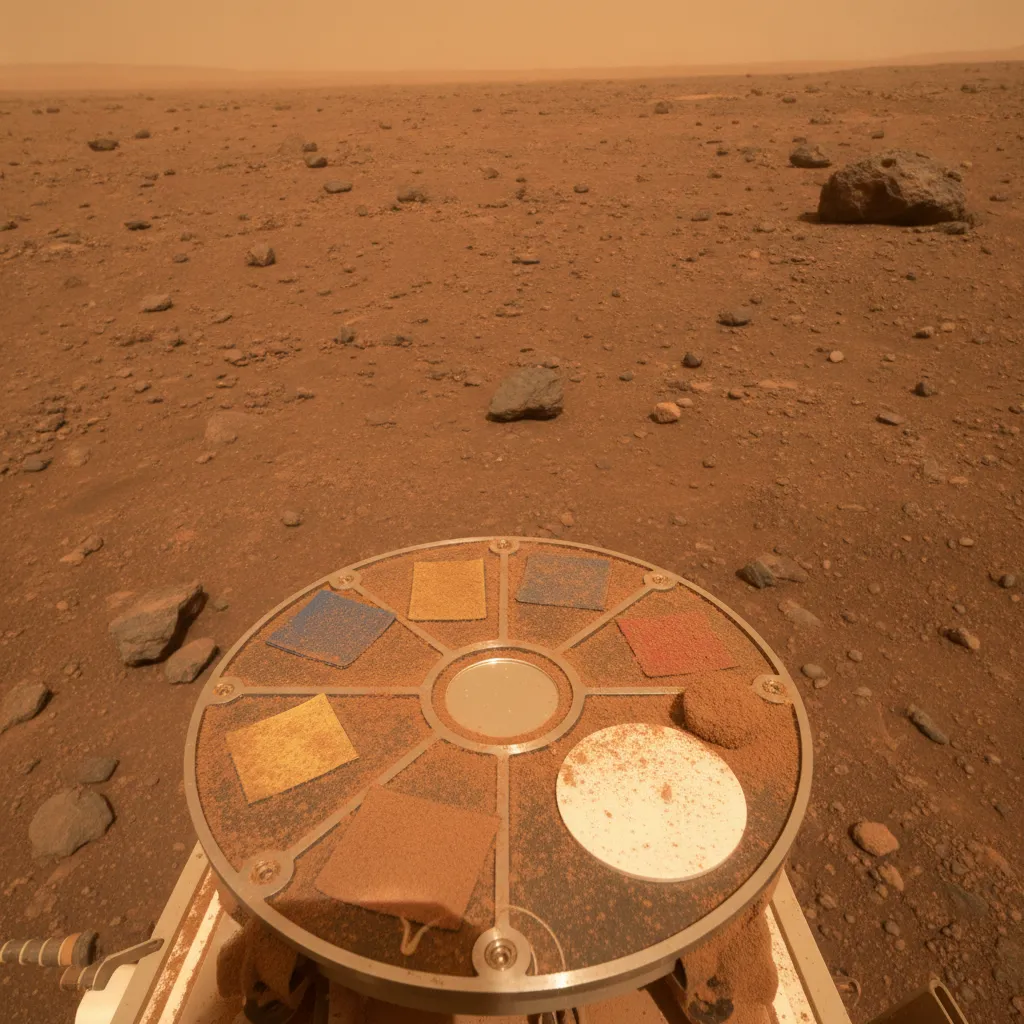
The exploration of the fourth planet requires facing in a systematic way an environment where physical and chemical conditions test the limits of materials science. When the Perseverance rover departed for Mars, it carried a series of spacesuit fabric fragments the size of a postage stamp, integrated into the calibration target of the SHERLOC instrument. The objective of this pioneering experiment was to expose various textile compounds—ranging from polycarbonate for visors and cut-resistant Vectran to Teflon and the complex Ortho-Fabric, which combines Nomex, Gore-Tex, and Kevlar—to the Martian outdoors. Although initial observations indicated that dust particles possess a rounded morphology due to persistent aeolian action—unlike the abrasive and angular nature of lunar regolith—the characterization carried out by the PIXL X-ray spectrometer has revealed technical complexities of considerable magnitude.
Toxic composition and microscopic granulometry
Detailed analyses confirm that the danger does not lie in the geometry of the grains, but in their microscopic size and complex chemical composition. Certain fractions of Martian dust present dimensions so small that they could be easily inhaled, reaching the bloodstream and even crossing the blood-brain barrier. Added to this concerning granulometry is a mineralogical matrix dominated by sulfur, iron compounds, and perchlorates, highly reactive elements that turn the planet's surface into a deeply hostile environment for human biology.
To understand the true dimension of this geochemical challenge, it is necessary to recall that perchlorates are not mere inert contaminants; under the dominant ultraviolet radiation on the Martian surface, these compounds acquire an extreme oxidizing capacity that compromises the structural stability of any organic material exposed for prolonged periods. The interplanetary architecture planned by NASA and other space agencies must necessarily contemplate this constant chemical aggression if it aspires to design habitats and life support systems with guaranteed durability on an operational scale.
The role of static electricity in adhesion
To understand the magnitude of the event and its logistical repercussion, researchers examined how materials interact with suspended particles. The data revealed that static electricity generated by atmospheric friction acts as a selective attraction mechanism according to charge and polymer type. Organic polymers such as Teflon demonstrated a high propensity to retain the finest particles, which remained adhered for years despite the rover's continuous activity.
Advanced engineering facing the Martian challenge
Far from falling into paralyzing alarmism, the scientific community approaches these findings as an indispensable roadmap for the technological development of interplanetary architecture. Detecting the vulnerability of fabrics allows for the planning of engineering solutions before human crews set foot on the red planet. Among the proposals already under study are cleaning systems based on liquid nitrogen jets—resembling industrial decontamination processes—or the design of self-cleaning spacesuits. Technological anticipation, backed by robotic missions such as Perseverance's, constitutes the only viable path to ensure that future human exploration successfully overcomes the barriers of the Martian environment.
Related
Missions
- 🛰️ Perseverance
Related news and articles
- 📰 Perseverance's Martian Marathon and the Silent Revolution of Autonomous Artificial Intelligence 20 JUN 2026
- 📰 SkyFall Mission: NASA to Deploy a Trio of Autonomous Helicopters in the Martian Atmosphere by 2028 3 NOV 2026
- 📰 The Architecture of Orbital Refueling: Starship's Crucial Step Toward Mars 2 NOV 2026
- 📄 The Heat of the Martian Desert: Are There Regions with Temperatures Suitable for Life on Mars? 30 OCT 2026
Marspedia terms
Enjoyed it? Keep exploring
Back to all news