
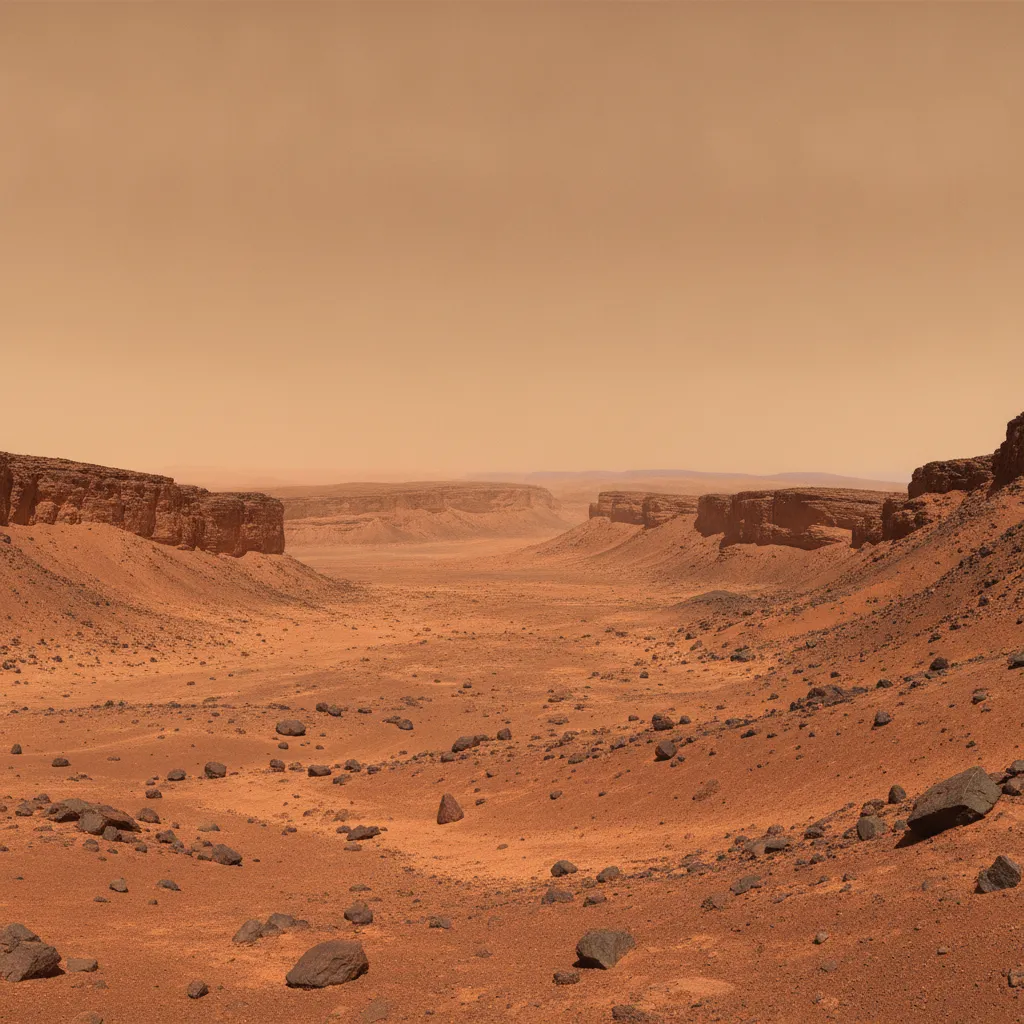
The exploration of the red planet is usually dominated by the image of a frozen world, a planetary desert where the thermometer plummets to levels incompatible with our biology. Are there really thermal refuges on Mars where mild temperatures allow for a less extreme habitability? To answer this question, we must move beyond climatic generalizations and delve into the complex physics of the Martian surface, an environment where the thin atmosphere and intense solar radiation sculpt a regime of violent contrasts that defies any terrestrial analogy.
The harsh reality of the global thermal gradient
To understand the temperature ranges on Mars, we must remember that the scarcity of a dense atmospheric blanket prevents the retention of heat received from the Sun. Unlike Earth, whose natural greenhouse effect acts as a constant thermal coat, Mars behaves as an inefficient radiator. During daytime hours, especially in equatorial regions and during the summer of the corresponding hemisphere, the surface can reach temperate values hovering around twenty degrees Celsius. However, as soon as the Sun sets on the horizon, the lack of a substantial gaseous mass causes an immediate thermal leak, dropping values drastically to over eighty degrees below zero at night.
This daily cycle represents a colossal challenge for any exposed organism or infrastructure. The daily thermal range is not a marginal phenomenon, but the prevailing norm across most of the globe. Extensive plains and high plateaus suffer this thermal lash relentlessly, turning the surface into a laboratory of thermal fatigue where materials and hypothetical microorganisms expand and contract in a perpetual loop.
Microclimates and the insulating role of subsurface regolith
Despite the severity of global averages, a rigorous analysis of Martian geography reveals the existence of certain enclaves where physical conditions moderate environmental rawness. Deep depressions, such as impact basins or the canyons of the Valles Marineris system, offer a slightly higher column of air above their floors, contributing to minimal retention of daytime heat. However, these variations remain insufficient to eliminate the nocturnal cold.
True thermal moderation is not found in the air, but beneath our feet. The Martian regolith, composed of fine mineral fragments and dust, functions as an extraordinarily effective thermal insulation. Just a few centimeters or meters deep, the daily thermal wave is completely attenuated, and temperatures stabilize around a constant average which, although cold—usually between fifty and sixty degrees below zero—lacks the violent fluctuations of the surface. It is in these subterranean niches, or in volcanic caves such as lava tubes, that physics offers a stable thermal refuge against the weather of the desert.
Brines and the freezing point paradox
To properly calibrate the biological potential of these thermal refuges, it is imperative to introduce a fundamental chemical factor: the hydrated salts and perchlorates detected in the Martian soil. Pure water freezes instantly under the barometric and thermal conditions prevailing across much of Mars, sublimating or shifting to a solid state without offering quarter. However, the presence of high concentrations of magnesium and calcium perchlorates in the regolith acts as a natural antifreeze of extraordinary potency. This physical-chemical phenomenon of freezing point depression allows saline solutions—known as brines—to remain in a liquid state at temperatures notably below zero degrees Celsius, approaching even sixty degrees below zero under specific pressure and saturation conditions.
Under this new perspective, the apparent dichotomy between a thermally uninhabitable desert and the hypothetical persistence of transient liquid water is resolved through a complex interaction between soil thermodynamics and local micro-orography. Although complex organisms would find survival impossible under this regime, the frontier of microbial habitability finds a fascinating field of study in these subsurface niches stabilized by salts. The architecture of future space exploration must therefore pivot not upon the surface exposed to the fury of the elements, but upon the discreet and silent stability of deep substrates, where the physics of the red planet offers a temporary truce to the implacable tyranny of its climate.
Related
Marspedia terms
Enjoyed it? Keep exploring
Volver al Blog