
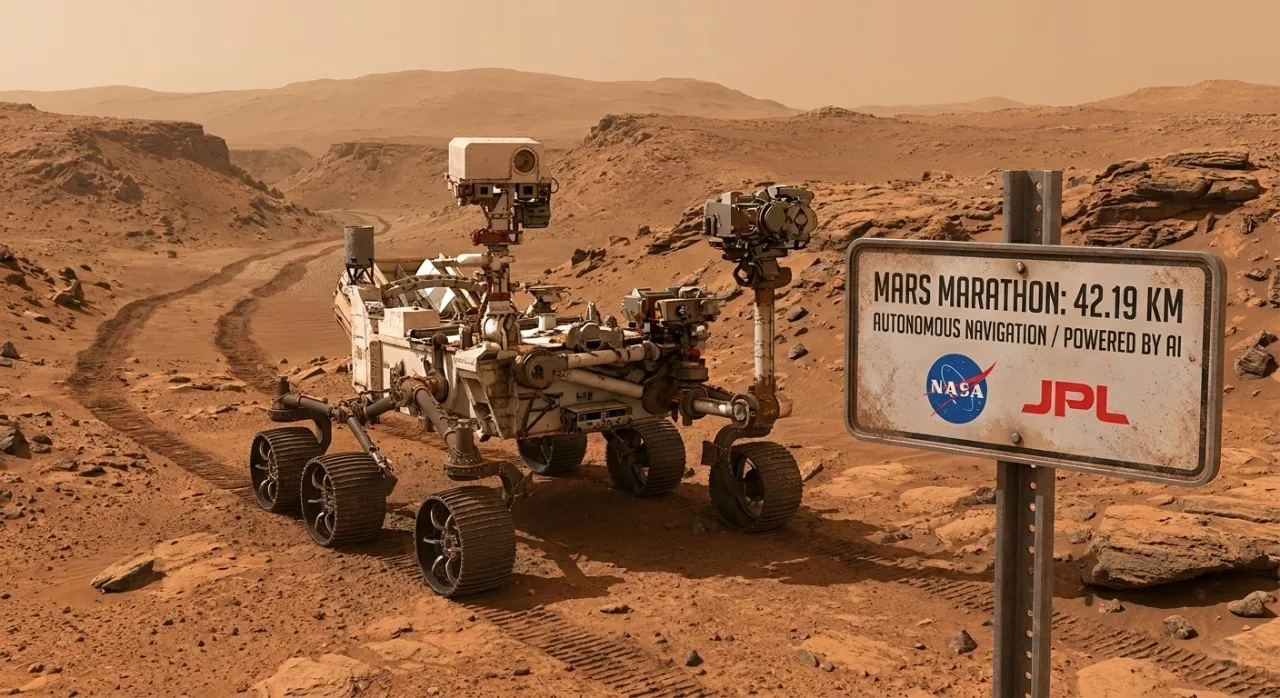
Completing a 42.19 km marathon on Mars is a historic milestone. The downside is that at a top speed of 0.18 km/h, taking over a decade to cross the finish line takes some of the epicness out of the final sprint.
Robotic space exploration has crossed an invisible frontier that redefines our relationship with interplanetary machines. On June 19, 2026, NASA's Perseverance rover officially completed a cumulative transit distance of 42.19 kilometers across the rugged and hostile surface of Jezero Crater. By surpassing the mythical length of an earthly marathon, this nuclear-powered rolling laboratory not only matched the iconic intermediate milestone of the legendary Opportunity rover but did so by shattering the clock. While its predecessor required more than eleven years of grueling manual planning from Earth to cover that specific mileage of its total journey —which would eventually close years later at a historic 45.16 kilometers—, Perseverance achieved the feat in just over five years. This quantum leap in exploration speed is not a matter of chance, but the result of a bold systems reengineering and the pioneering integration of generative artificial intelligence models into autonomous navigation beyond our planet.
The Anatomy of a Rolling Titan
To fully grasp the true impact of this achievement, it is worth looking under the hood of this engineering marvel with a dry mass of one thousand twenty-five kilograms. Traditionally, driving on Mars resembled an infuriating game of postal chess —due to a radio signal latency that oscillates between 4 and 24 minutes depending on the orbital alignment of the planets— where human operators at the Jet Propulsion Laboratory had to meticulously trace every step to avoid stranding the robot in a treacherous sand dune. Curiously, the solution involved redesigning the vehicle's locomotion with slightly larger wheels and forty-eight wavy treads to prevent premature wear from sharp rocks, but the real brain behind the change is the dedicated Vision Compute Element processor. Thanks to the Enhanced Autonomous Navigation algorithm, Perseverance applies the concept of thinking while driving, which eliminates constant stops to process three-dimensional maps and raises autonomous transits to over ninety percent of the total journey.
Artificial Intelligence and Digital Twins in the Red Desert
However, dodging local rocks is not enough if the general corridor of the day leads to a dead end. The real disruption came in December 2025, when the JPL team introduced the Claude vision and language models developed by Anthropic into their daily operations. This AI analyzes high-resolution orbital maps from the Mars Reconnaissance Orbiter and the stereoscopic perspective of the rover itself at once to translate the terrain into structured software commands. Space progress is an inherently risk-averse and bureaucratic environment, so no route suggested by artificial intelligence is sent directly to Mars. First, it passes through the SSim simulator, a high-fidelity digital twin on Earth that evaluates more than five hundred thousand telemetry variables to ensure the virtual chassis does not suffer from excessive torque or instability. In real operational tests in December 2025, this symbiosis allowed the rover to travel hundreds of meters in a single sol, cutting the daily preparation time at the control center in half.
Hacking the Past to Free the Scientific Future
The last major obstacle was odometric drift —the inevitable physical slippage of the wheels on sand that distorts the rover's true position and accumulated errors of over thirty-five meters in long transits—. To solve this in early 2026, engineers resorted to an ingenious exercise in technological recycling. They repurposed the computing infrastructure of the Helicopter Base Station, the electronic module that communicated with the now-inactive Ingenuity. This commercial microprocessor possesses a computational power one hundred times superior to the rover's aging main computer. Running the Mars Global Localization software, the system functions like a virtual GPS receiver that contrasts overhead maps in real time and pinpoints the vehicle with a millimetric precision of twenty-five centimeters in less than two minutes. Armed with this total navigation independence, Perseverance has launched into its fifth geological campaign on the Northern Rim with unprecedented speed, studying the planet's most primitive crust ejected billions of years ago. The lessons from this marathon are already being tested on Earth with prototypes like ERNEST, consolidating a new paradigm where exploring robots no longer wait for orders but instead choose their own path in the vastness of the cosmos.