
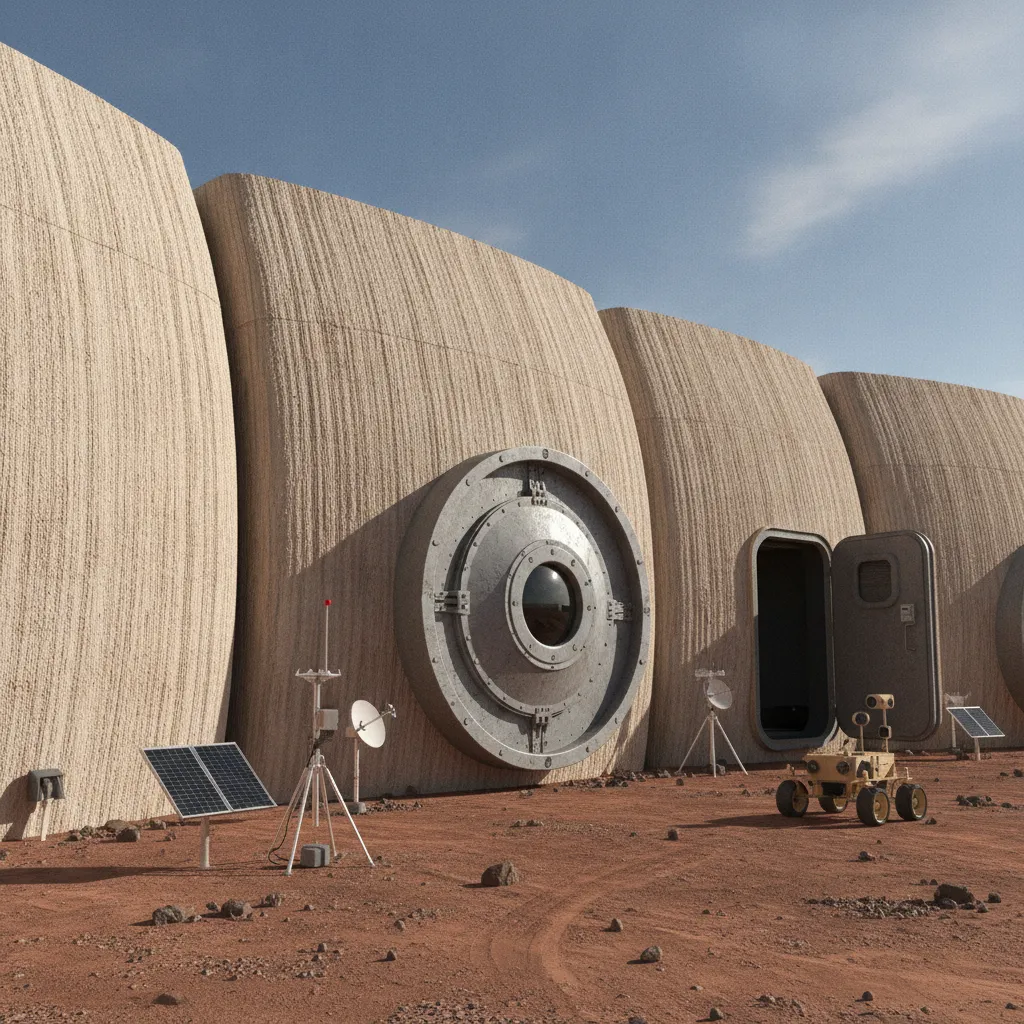
The architecture of interplanetary exploration demands not only colossal advances in propulsion systems and radiological shielding, but also a precise understanding of the psychological and physiological endurance of the human factor. At NASA's Johnson Space Center in Houston, the culmination of the second mission under the Crew Health and Performance Exploration Analog (CHAPEA) program marks a strategic turning point in preparing future crews bound for Mars. After 378 days of rigorous isolation inside a 1,700-square-foot 3D-printed habitat, the four volunteers—Ross Elder, Matthew Montgomery, Ellen Ellis, and James Spicer—are set to cross the threshold outward after more than a year without stepping into the real world.
The Tyranny of Isolation and Contingency Simulation
To comprehend the magnitude of this experiment, one must analyze the extreme conditions to which the crew has been subjected since entering the complex. For over twelve months, the participants have operated under the exact stressors future pioneers will face on the fourth planet: deliberate communication delays with the outside world, strict water and energy resource limitations, and a constant regimen of habitat maintenance, simulated spacewalks, and hydroponic farming. Curiously, the greatest threat to a long-duration mission rarely lies in the mechanical failure of a critical subsystem, but rather in cognitive degradation derived from prolonged confinement and operational monotony. Biometric and performance data collected by flight specialists will allow aerospace physicians and psychologists to refine behavioral life support protocols.
Resource Optimization for the Lunar and Martian Horizon
The relevance of CHAPEA transcends the strict Martian scope, establishing itself as a fundamental testbed for sustainable surface operations under the Artemis Accords. Optimizing food system design, efficient crew time management, and mitigating congestion on Deep Space Network bandwidth are critical variables that find their most reliable validation in this terrestrial analog. While the space agency prepares public coverage of the volunteers' egress, the true scientific labor begins now: the exhaustive analysis of petabytes of data regarding human resilience in the face of deep space's relentless solitude.
Related
Related news and articles
- 📰 ESCAPADE Prepares its Mars Trajectory Resumption After a Unique Orbital Loiter Phase 21 OCT 2026
- 📰 The Era of Interplanetary Alliances: The Aeolus Mission and NASA's New Paradigm on Mars 24 JUN 2026
- 📰 Perseverance's Martian Marathon and the Silent Revolution of Autonomous Artificial Intelligence 20 JUN 2026
- 📰 The Strategic Shift Toward the Moon Base Reconfigures ESA's Alliances With NASA 15 JUN 2026
Marspedia terms
Enjoyed it? Keep exploring
Back to all news