
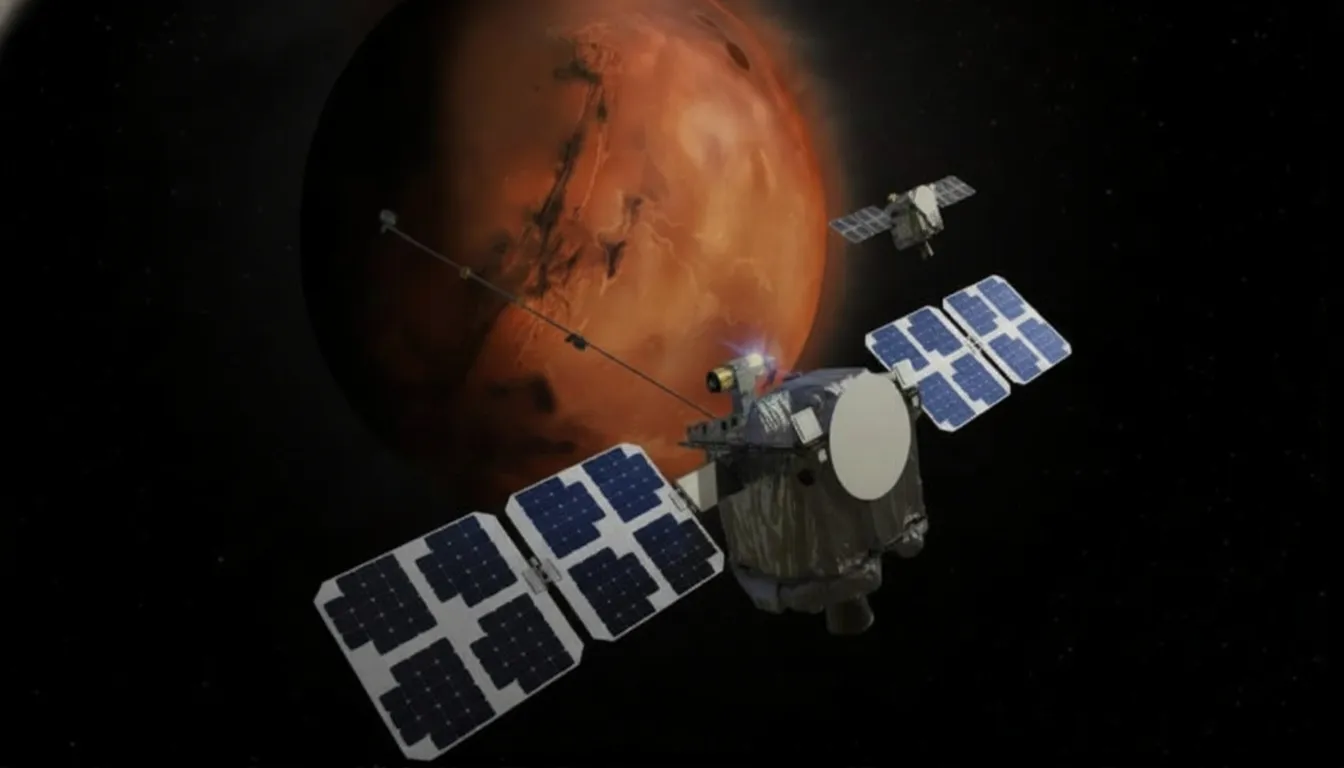
Low-cost interplanetary exploration has inaugurated a new operational paradigm in which launch constraints no longer mandate the premature cancellation of missions, but rather intricate orbital mechanics maneuvers. Having missed the direct transfer window in the fall of 2024 due to delays in heavy-lift launcher readiness, NASA's ESCAPADE mission—conducted under the SIMPLEx program with a stringent development cost cap of 78.5 million dollars—adopted an unorthodox solution. Its twin platforms, named Blue and Gold, were sent into outer space on November 13, 2025, aboard the inaugural NG-2 flight of Blue Origin's New Glenn launcher from pad LC-36A at Cape Canaveral. Since then, neither probe has remained grounded; instead, they have traversed an extended loiter orbit toward the vicinity of the Sun-Earth L2 Lagrange point, between 1.5 and 3.2 million kilometers away, calibrating their instrumentation and studying the terrestrial magnetotail while awaiting proper planetary geometry.
The November 2026 Oberth Maneuver
The strategic turning point for this interplanetary tandem will materialize in November 2026. At that moment, both ESCAPADE spacecraft will converge back toward Earth to execute a powered gravity assist. By diving deep into Earth's gravity well, the vehicles will fire their bipropellant engines—fueled by monomethylhydrazine and dinitrogen tetroxide—to leverage the Oberth effect and convert orbital energy into the definitive trans-Mars injection. Although investigators at UC Berkeley have targeted the window of November 7–9, 2026, for these perigee passes, NASA has yet to issue consolidated final ephemerides, as escape burns will take place independently for each probe with an offset timeline. This burn will test the propulsion margins of platforms whose 535-kilogram individual wet mass consists of 60% propellant, yielding a total velocity change capability exceeding 2,500 m/s.
Miniaturized Architecture for Martian Plasma Dynamics
Manufactured by Rocket Lab on the Explorer bus and measuring a compact 1.20 by 1.65 meters when stowed, Blue and Gold carry an instrument suite tailored to understand how the solar wind stripped Mars of its early atmosphere and surface liquid water. Equipped with Goddard-supplied magnetometers, electrostatic analyzers, and Langmuir probes, the twin orbiters will disentangle spatial variations from temporal fluctuations within the induced Martian magnetosphere for the first time. For deep space communications, they rely on X-band radios and 50 cm high-gain antennas tracked simultaneously by NASA's Deep Space Network using multiple spacecraft per aperture techniques, supported by commercial ground stations.
En Route to 2027 Orbital Insertion
Following a ten-month interplanetary transit from their terrestrial flyby, arrival at Mars is scheduled for September 2027. The insertion architecture aims to place both spacecraft into an elliptical orbit at a 60-degree inclination, featuring a 160 km periapsis and an apoapsis between 7,000 and 10,000 kilometers. Once past the inevitable radio blackout imposed by Martian solar conjunction, the probes will initiate an eleven-month primary scientific campaign divided into two phases: a leader-follower configuration to monitor short-term variations, followed by a dissociated campaign sampling different magnetospheric altitudes. The exact propellant margin remaining after orbital synchronization remains the final technical uncertainty, determining whether this frugal mission can extend its science operations beyond its baseline timeline.
Related
Related news and articles
- 📰 The Fallen Shield: How the ESCAPADE Mission Will Unveil Mars' Atmospheric Agony 14 NOV 2025
- 📰 The Era of Interplanetary Alliances: The Aeolus Mission and NASA's New Paradigm on Mars 24 JUN 2026
- 📰 Perseverance's Martian Marathon and the Silent Revolution of Autonomous Artificial Intelligence 20 JUN 2026
- 📰 The Strategic Shift Toward the Moon Base Reconfigures ESA's Alliances With NASA 15 JUN 2026
Marspedia terms
Enjoyed it? Keep exploring
Back to all news