
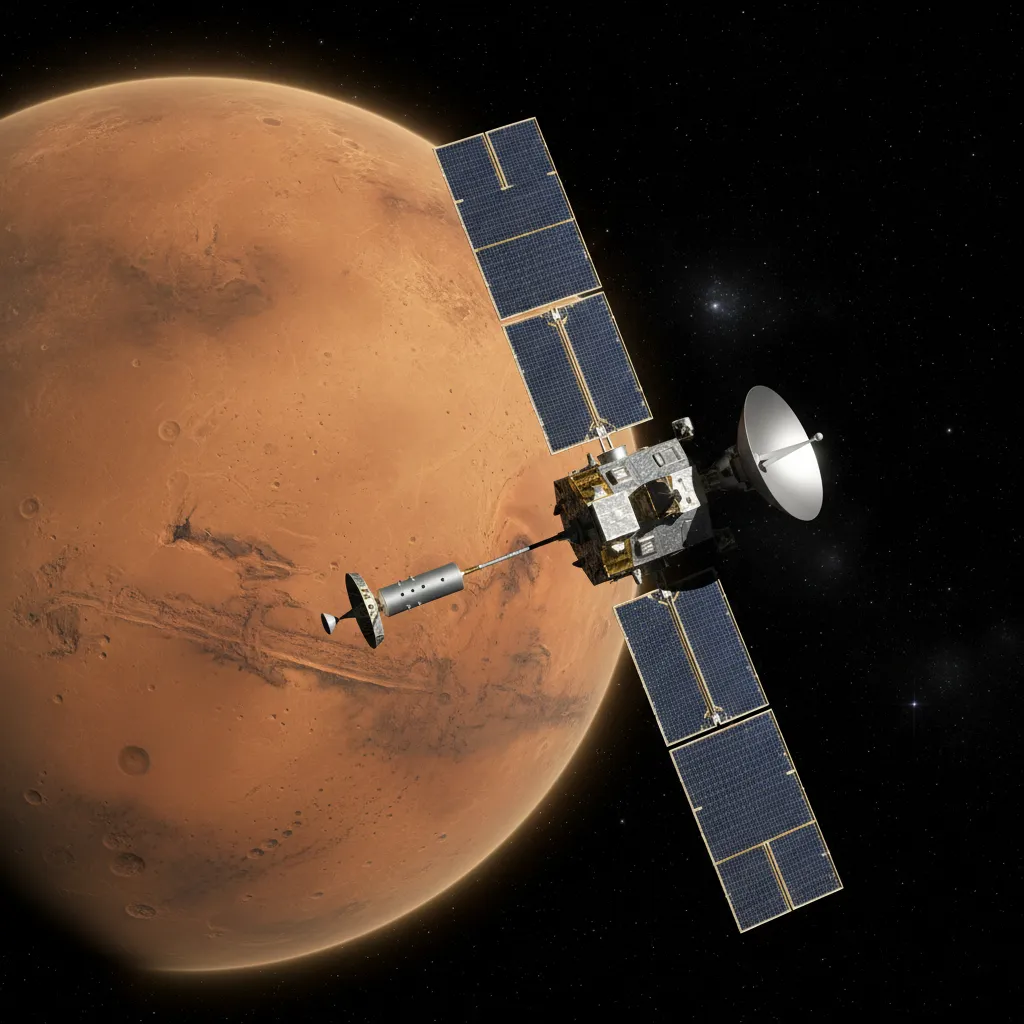
Modern space exploration is often measured by the audacity of its descents and the complexity of its rovers, but the true backbone of our planetary knowledge lies in the silent perseverance of orbital observation. On the vast chessboard of Martian exploration, few missions embody this resilience with as much precision as the 2001 Mars Odyssey orbiter, a spacecraft engineered under the canons of robust design that has vastly surpassed any initial operational expectation. Curiously, what began as an effort by NASA to recover from the painful failures of the 1990s—such as the Mars Climate Orbiter disaster—has transformed into the longest-running active mission in history around another world.
The Architecture of an Orbital Sentinel
To understand the technical success of Odyssey, one must look back at its launch on April 7, 2001, aboard a Delta II rocket from Cape Canaveral. The spacecraft's architecture prioritized simplicity and redundancy over extreme experimentation, a decision that would ultimately shield it against the implacable radiation environment of deep space. Equipped with key instruments such as the Gamma Ray Spectrometer (GRS) and the Thermal Emission Imaging System (THEMIS), the probe soon fulfilled its primary objective: mapping the global abundance of chemical elements and minerals, with a special focus on the distribution of subsurface hydrogen that confirmed vast reservoirs of water ice.
A Vital Communications Relay for the Surface Fleet
Beyond its undeniable geological value, Odyssey's strategic role has evolved to become the critical communications node for the entire international network at Mars. For more than two decades, the orbiter has served as a fundamental relay link for data transmissions between surface rovers and landers—from Spirit and Opportunity to Curiosity and Perseverance—and receiving stations on Earth. In an environment where latency and orbital geometry impose severe operational constraints, Odyssey's ability to ensure a steady flow of information has redefined the rules of interplanetary logistical support, proving that support infrastructure is just as crucial as major exploration milestones.
Operational Twilight and the Legacy of an Era
With propellant reserves for attitude control slowly dwindling after so many years of corrective maneuvers, the mission enters its final stretch with the same discretion that has marked its trajectory. Managing the remaining fuel forces controllers to stretch every gram of hydrazine, artificially prolonging a service life that is already written into the annals of astronautics. The legacy of 2001 Mars Odyssey is not limited to its terabytes of scientific data on the planet's mineralogical composition; it represents above all the realization that methodical, conservative engineering remains the most valuable asset when it comes to conquering the deep space frontier.
Related
Missions
Marspedia terms
Enjoyed it? Keep exploring
Back to all news