
We reach May 2026 under a Martian sky that, far from becoming simpler, has turned into a complex chessboard where the laws of physics often clash with those of economics. The exploration of the fourth planet has transcended the romanticism of the early rovers to enter a phase of structural redefinition. The old 1967 Outer Space Treaty —that document born to prevent the Cold War from moving to the stars— now faces pressure from the Artemis Accords, which already count 64 allied nations following the recent incorporation of Morocco. This new legal architecture seeks to establish safety zones and normalize the use of in-situ resources, something that has generated evident friction with the bloc led by China and Russia, who defend a more restrictive interpretation of international law.
The harsh reality of the Mars Sample Return mission
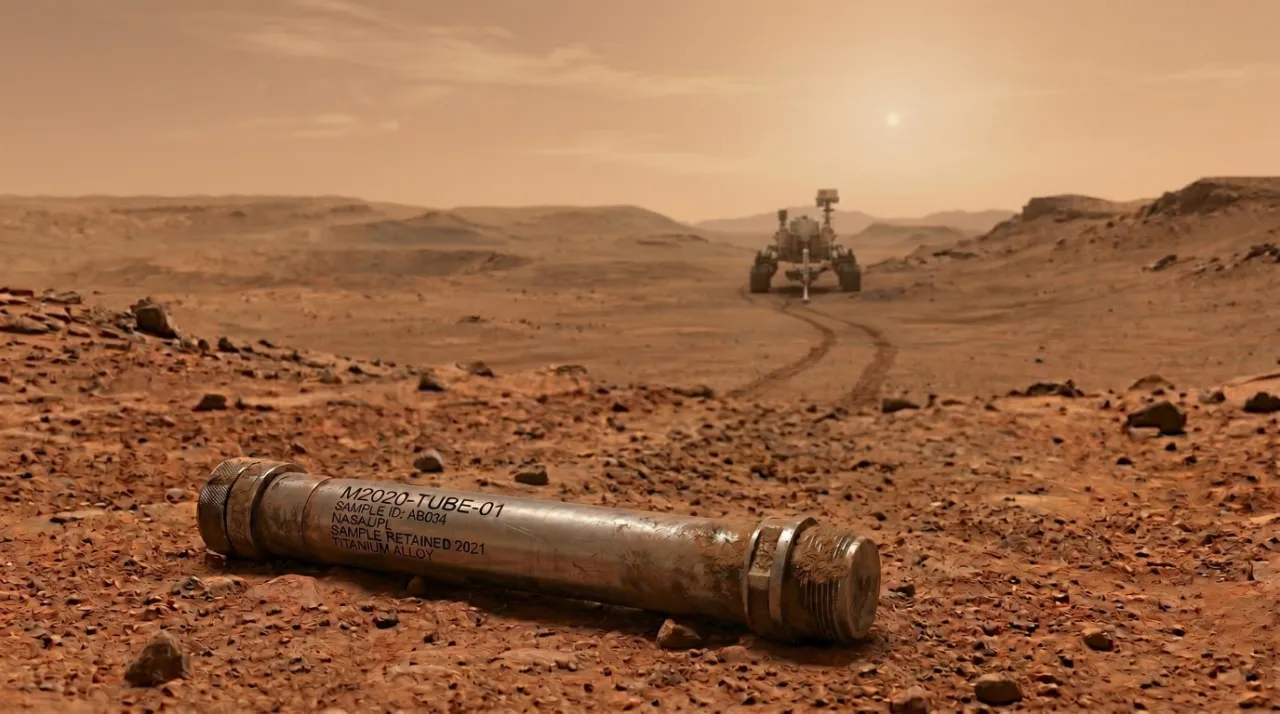
Human ambition has hit a budgetary wall with the Mars Sample Return (MSR) mission. What was supposed to be a historic collaboration between NASA and ESA to bring back rock cores collected in Jezero Crater is currently in a mandatory technical pause. With a cost projection approaching 11 billion dollars and a return date that has dangerously slipped toward the 2040s, the US Congress has demanded a total redesign. Curiously, this paralysis has forced the European Space Agency to rethink its Earth Return Orbiter as a possible atmospheric study mission, proving that in space nothing is lost, only transformed by bureaucratic necessity. Bringing samples back from Mars is, in essence, like trying to organize a relay race where the runners are on different continents and the baton is a capsule that must be captured in mid-flight at thousands of miles per hour; if a single runner runs out of funds, the race stops.
The progress of Asian powers and the aerobraking technique
While the West recalibrates its finances, China's National Space Administration (CNSA) moves forward with enviable determination toward its Tianwen-3 mission. Its approach is much more direct: a single massive launch to collect and return, avoiding the mission fragmentation that has hindered NASA. Meanwhile, India's ISRO has consolidated the design of its Mangalyaan-2, focusing its efforts on mastering aerobraking. This technique, vital for heavy missions, can be understood with a simple analogy: it is like sticking your hand out of a car window at high speed; the air resistance pushes your hand back with force. Spacecraft use the thin Martian atmosphere in the same way, using it as a natural brake to save tons of fuel that would otherwise be impossible to transport.
Starship and the efficiency of Methalox fuel
In the commercial sector, SpaceX has shown that the road to Mars is paved with calculated trials and errors. Following the milestones of catching the booster with the launch tower arms, the company has had to admit that the 2026 launch window will not be used for cargo missions to the red planet. The focus has shifted toward the HLS lunar program, but the development of the Raptor engine remains the key. These engines use Methalox —methane and liquid oxygen— for a very practical reason that we can compare to a domestic kitchen. Traditional kerosene is like a wood fire that leaves soot and black residue everywhere; methane, on the other hand, is like a natural gas stove that burns with a clean flame, allowing engines to be reused again and again without the need for deep cleaning. Furthermore, methane can be manufactured on Mars, allowing future settlers to literally live off the land.
Science in Jezero Crater and terrestrial applications
Despite the logistical difficulties, the Perseverance rover continues to deliver fascinating data, such as the recent leopard spots in the Cheyava Falls area. These formations suggest chemical reactions that, on Earth, are closely linked to microbial life. However, scientific realism forces us to remember that this evidence consists only of potential biosignatures; without analysis in terrestrial laboratories, we cannot claim victory. The technology developed for these missions is already filtering into our society: from water recycling systems with 98% efficiency that help in areas of extreme drought, to 3D printing of housing inspired by the use of Martian dust. At the end of the day, the race to Mars is not just about conquering a red desert, but about learning to manage scarcity on our own planet, while we wait for humanity to overcome its financial barriers to claim its heritage among the stars.
Related
Missions
- 🛰️ Perseverance
Related news and articles
- 📰 Tianwen-3: The New Paradigm of Martian Exploration and Geopolitical Reconfiguration 6 MAY 2026
- 📰 The Price of Forcing the Way to Mars: Lights and Shadows of Chun Wang's Interplanetary Plan with Starship 30 MAY 2026
- 📰 Flight 12's Pause: Anatomy of a Technical Delay and Today's Window 22 MAY 2026
- 📰 Starship Flight 12: The Maturity of Block 3 and the Heart of Raptor 3 21 MAY 2026
Marspedia terms
Enjoyed it? Keep exploring
Back to all news