
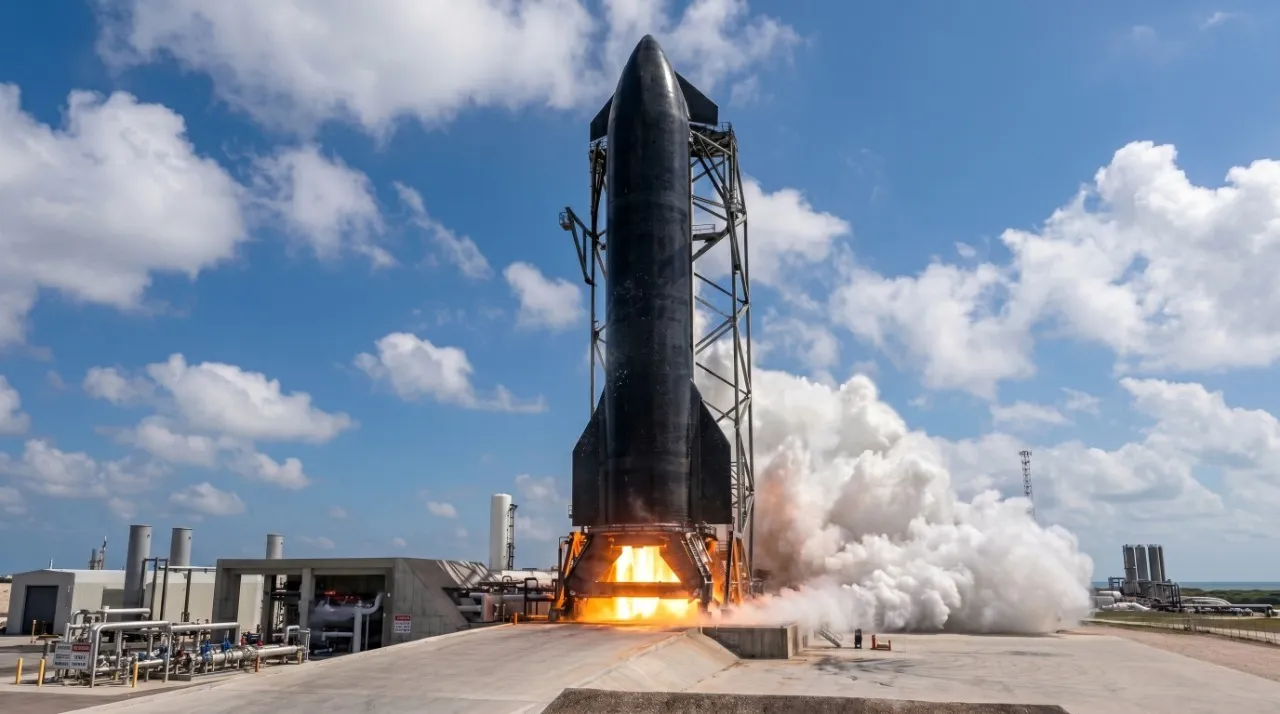
The development of SpaceX's Super Heavy Starship launch system is not a science fiction movie, but a titanic—and often tedious—battle against physics, thermodynamics, and government bureaucracy. Today, Thursday, May 21, 2026, global attention is focused on the twelfth test flight, an event that marks a before and after in the race to the Moon and Mars. Far from the media sensationalism that often floods the internet, this launch represents the empirical validation of the Block 3 architecture, a comprehensive reengineering designed to withstand the most extreme stresses imaginable and maximize orbital payload capacity.
Space Bureaucracy and Operational Realism
To understand the true magnitude of this flight, it is necessary to demystify the overenthusiasm with a realistic smile. The progress of space exploration is, by its very nature, methodical and slow. Rescheduling the launch window does not equate to failure, but rather to an exhaustive calibration process of autonomous avionics and ground support systems. Operating from the newly inaugurated Orbital Launch Pad 2 requires complying with the relentless scrutiny of the Federal Aviation Administration; obtaining that license is not a mere formality, but a mathematical demonstration that the vehicle is safe for civil airspace in the face of any structural contingency.
Pure Thermodynamics and the Raptor 3 Cycle
The most overwhelming technical leap of Flight 12 lies in the Raptor 3 engine, a true beast of engineering that implements an intricate full-flow staged combustion cycle. To grasp this level of complexity, let's use an everyday anchoring analogy: it is like trying to inflate two giant balloons at the same time using your lungs and diaphragm at maximum capacity, ensuring that not a single molecule of air escapes in the process. By fully gasifying both liquid methane and oxygen before the final ignition, the engine operates with virtually no fluid loss, drastically reducing thermal fatigue. Furthermore, engineers have embedded all external plumbing directly into the chassis, eliminating its previous chaotic appearance and creating a much more resilient system against the acoustic inferno of liftoff.
The Heat Shield and Orbital Inquisition
The fundamental risk of the mission lies in Ship 39's hypersonic reentry, where the fuselage must face temperatures exceeding 1,400 degrees Celsius. Here, the spotlight falls on the more than 18,000 porous silica ceramic tiles. It is vital to understand that the deep black color of this coating is not an aesthetic toasted finish, but rather an extremely serious technical heat shield designed to withstand zero-ablation friction. Curiously, the flight team has deliberately ripped off one of these valuable tiles from the belly of the ship to measure live the damage caused by anomalous heat vortices. To assess this damage, two modified Starlink satellites will be released into orbit to act as floating inspection cameras, scanning the black ceramic shield before the brutal descent toward the Indian Ocean.
Future Perspectives and Final Reflection
This flight does not seek aesthetic perfection, but rather to push the steel structure to its elastic breaking limit. It signifies the definitive abandonment of conceptual prototypes to embrace the massive industrial standardization required by NASA's Artemis program. Every risky maneuver will translate into terabytes of data that will forge the path to true planetary colonization. It has been an immense pleasure to dissect this fascinating engineering milestone with you; the reality of science is always more thrilling than fiction. See you in the next orbit!
Related
Related news and articles
- 📰 Flight 12's Pause: Anatomy of a Technical Delay and Today's Window 22 MAY 2026
- 📰 The Price of Forcing the Way to Mars: Lights and Shadows of Chun Wang's Interplanetary Plan with Starship 30 MAY 2026
- 📰 Project Apex: The Physical and Financial Reality Behind SpaceX's Mega-IPO in 2026 8 MAY 2026
- 📰 Mars in May 2026: Technical and Geopolitical Reality 2 MAY 2026
Marspedia terms
Enjoyed it? Keep exploring
Back to all news