
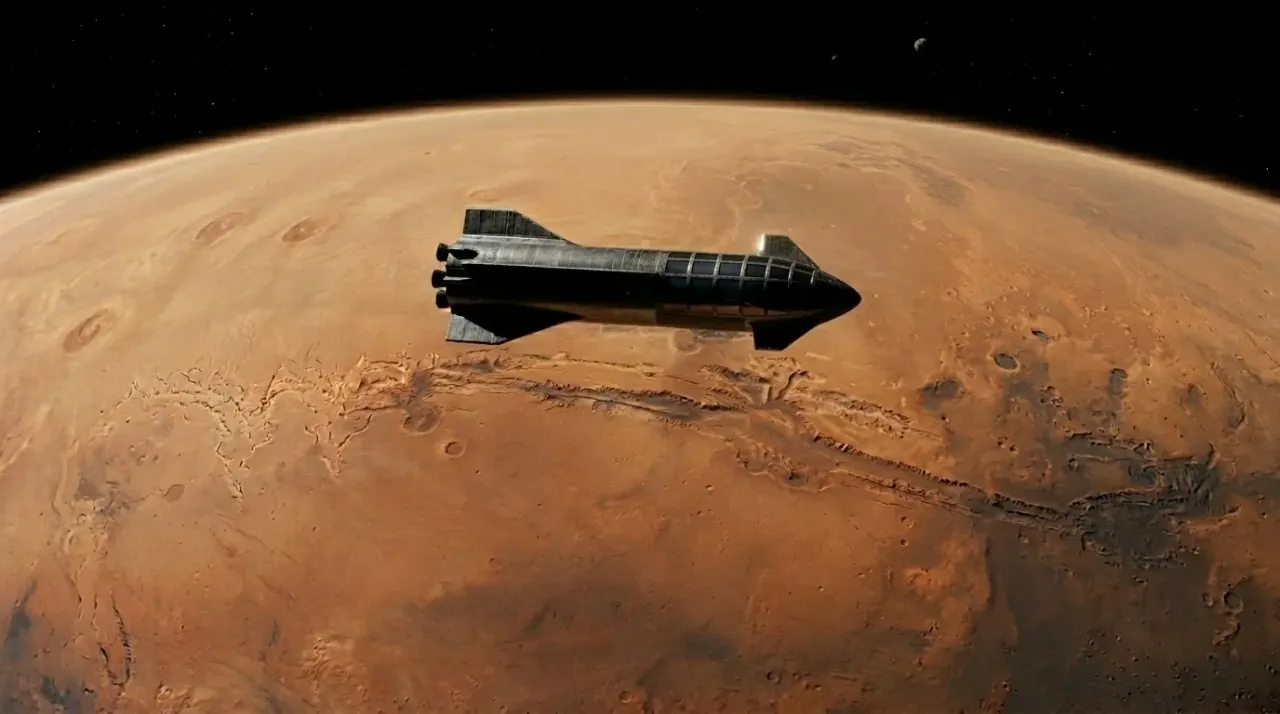
The space exploration landscape is undergoing an unprecedented transformation where private actors no longer merely complement government agencies, but aim to set the pace for humanity's arrival on other worlds. The unexpected announcement of SpaceX's first crewed interplanetary exploration mission—a two-year Mars flyby funded and commanded by cryptocurrency entrepreneur Chun Wang—has shaken the foundations of the aerospace sector. While state powers concentrate their efforts and defense budgets on the lunar south pole, this project seeks to keep the Red Planet on the active commercial engineering roadmap. However, the spectacular nature of the announcement contrasts with an inescapable reality: progress in deep space is slow, expensive, and firmly tied to the laws of physics and bureaucracy.
The cryptocurrency commander and the polar precedent
Born in Tianjin in 1982 and a global citizen following his departure from China, Chun Wang embodies a unique profile of space patron. Co-founder of one of the largest Bitcoin mining pools, Wang has decided to liquidate part of his wealth to force technological advancement. His experience is not zero. In the spring of 2025, he commanded the historic Fram2 mission aboard a Crew Dragon capsule. That flight not only broke records by entering a retrograde polar orbit with an inclination of 90.01 degrees, but also served to conduct peculiar scientific experiments, such as growing mushrooms in microgravity. Curiously, upon returning to Earth, the crew refused immediate medical assistance to personally evaluate gravity readjustment. Although some academics dismissed the flight as an elaborate publicity stunt, the experience provided crucial data on polar radiation and atmospheric reentry logistics.
Raptor 3 and the harsh lessons of Flight 12
The viability of this interplanetary journey depends entirely on the Starship V3 architecture and its new Raptor 3 engine. This propulsion system is a masterpiece of simplification, eliminating exposed shielding and plumbing. To understand it simply, engineers have moved from an engine filled with complex pipes to a compact, clean piece, similar to how modern car engine blocks integrate components that previously required external connections. Despite these thrust improvements, Test Flight 12 on May 22, 2026, made it clear that the path to full reliability is tortuous.
During the launch from Texas, the ship's second stage demonstrated excellent adaptive capacity after suffering engine failures during ascent, while also validating a revamped heat shield that withstood the hellish plasma temperatures during reentry. The real problem lay with the massive Super Heavy booster. During the return maneuver, the guidance system made an orientation error and exposed one of its grid fins directly to the hot exhaust flow. This caused a violent sloshing of fuel inside the tanks—an effect similar to water sloshing inside a bucket that is moved abruptly—which caused the pumps to suck in gas instead of liquid methane. The result was an uncontrolled impact against the ocean and the subsequent opening of an investigation by the Federal Aviation Administration, temporarily grounding flight licenses.
The three invisible walls of deep space
Overcoming low Earth orbit to send humans to Mars involves solving three colossal challenges that currently only have answers on paper. The first is the reentry speed. Returning directly from Mars means hitting Earth's atmosphere at speeds of up to 12.5 kilometers per second, enduring a thermal flux twenty times greater than that of a low Earth orbit return. Without deep space braking propulsion systems that require thousands of tons of extra fuel, current silica tiles would simply not hold up.
The second wall is radiation. A two-year journey would expose the crew to cosmic radiation doses that far exceed the recommended safety limits for an astronaut's entire professional career. Blocking these particles requires heavy shielding based on hydrogen-rich materials such as polyethylene or water, surrounding the cabins like a bunker, which adds massive dead weight to the ship. Finally, life support represents an extreme maintenance challenge. Although the International Space Station recycles almost all of its water, it does so thanks to constant replacement parts sent from Earth. On a Martian journey, any failure in filters or chemical reactors must be completely autonomously resolved by the crew, in a quiet environment free of mechanical vibrations to prevent cognitive decline during prolonged isolation.
Stock market strategy and tensions with NASA
The announcement of this ambitious private mission is no coincidence in SpaceX's calendar. With an Initial Public Offering planned for June 2026, the company needs to demonstrate to institutional investors that Starship has a real commercial deep-space market that justifies its massive market valuation. However, this aggressive commercial agenda generates deep tensions with NASA's Artemis program. The government agency has invested billions of dollars in Starship's lunar variants and looks askance at how engineering resources are diverted toward long-range private projects, even adjusting funds due to previous delays in cryogenic propellant transfer testing.
Chun Wang's proposal works in practice as a powerful indirect funding engine to perfect Starship's rapid reusability. Although limitations in heat shields, radiation protection, and life support systems suggest that this crewed flyby will not happen in the short term, the attempt itself accelerates the technology needed so that, in a not-too-distant future, the Martian voyage ceases to be a science fiction dream.
Related
Related news and articles
- 📰 Starship Flight 12: The Maturity of Block 3 and the Heart of Raptor 3 21 MAY 2026
- 📄 Is Starship Realistic? SpaceX's Plan to Colonize Mars Under Scientific Scrutiny 14 JUL 2026
- 📰 Flight 12's Pause: Anatomy of a Technical Delay and Today's Window 22 MAY 2026
- 📰 Project Apex: The Physical and Financial Reality Behind SpaceX's Mega-IPO in 2026 8 MAY 2026
Marspedia terms
Enjoyed it? Keep exploring
Back to all news