
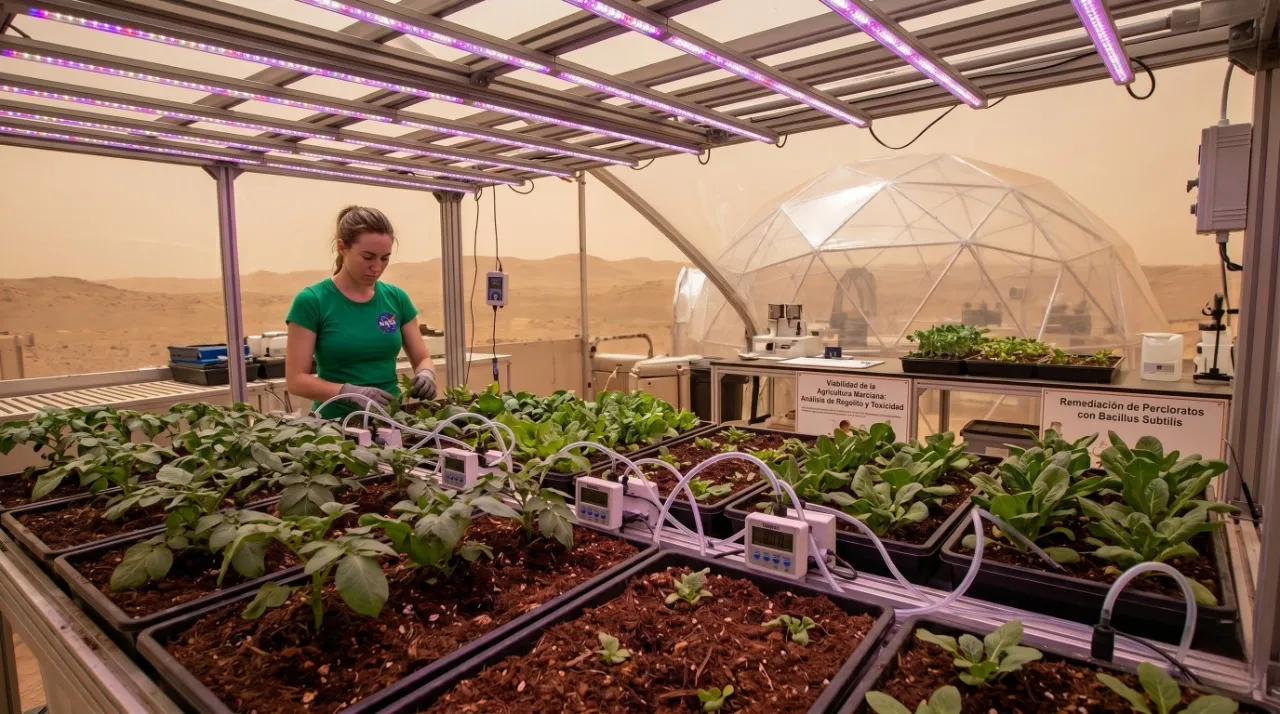
The idea of transforming the inhospitable Martian soil into a greenhouse capable of feeding future colonists is one of the most fascinating pillars of space exploration. However, the gap between cinematic survival narratives and scientific reality is vast. Is farming on Mars using in-situ resources truly viable? To answer this key astrobiology question, we must understand that Martian regolith is not soil, but a purely inorganic, sterile, and deeply hostile substrate for life as we know it.
The Geochemical Trap of Perchlorates
Unlike Earth's fertile fields —which throb with organic matter and billions of microorganisms—, the surface of Mars is saturated with highly toxic substances. Curiously, space mission analyses confirmed that between 0.5% and 1.0% of the global regolith weight is composed of perchlorate salts, mainly calcium and magnesium. To understand their danger, let us imagine these salts as a powerful industrial disinfectant that systematically destroys vital functions. In humans, they block the thyroid gland; in plants, they annihilate chlorophyll and drastically restrict root growth, causing 100% mortality in less than two weeks.
To make matters worse, the presence of perchlorates dissolves surrounding minerals, releasing highly mobile heavy metals such as lead, arsenic, and cadmium. Lacking clays or organic matter to act as a buffering shield —a chemical sponge to trap toxins—, the water in Martian soil becomes a poisonous broth. Bringing this raw regolith inside a habitat, happily mixing it with water and human waste without prior decontamination, would not generate a viable potato patch; it would cause an agricultural catastrophe and immediate chemical poisoning for the crew.
Closed-Loop Remediation Strategies
For Martian agriculture to stop being a fantasy, engineering must develop biological and thermal cleansing systems. One option is thermal decomposition, a method that heats the regolith to 470 degrees Celsius to break down perchlorate into harmless chlorides and oxygen gas, though the energy cost of processing tons of soil is astronomical. The most elegant and sustainable alternative relies on microbial bioremediation. Certain terrestrial bacteria genetically modified with key perchlorate reductase and chlorite dismutase enzymes can clean the substrate in a regenerative way.
Once purified, the soil must "come to life" through a process of biological weathering. Various experiments show that co-composting regolith with treated organic biomass induces visible mineral wear under the microscope, releasing essential nutrients such as calcium and magnesium. However, this biological miracle requires time. Creating a fertile arable layer and a stable rhizosphere —the active interaction zone between roots and microbes— demands years or decades of controlled cycles, shattering the idea of improvising a fertile crop in just a week.
Thermodynamics and Hypobaric Greenhouses
The physical constraints of Mars impose another colossal challenge. With a global mean temperature of minus sixty-three degrees Celsius and an atmospheric pressure representing less than one percent of Earth's, liquid water would boil or freeze instantly. To maintain the hydraulic stability of plants, pressurized structures are mandatory. Maintaining Earth's pressure in an inflatable structure would generate unbearable tensile stress on materials, which is why science favors hypobaric greenhouses operating at a fraction of terrestrial pressure.
The ideal material for these domes is ethylene tetrafluoroethylene, an advanced plastic film that weighs a fraction of conventional glass yet superbly resists ultraviolet radiation and extreme cold. Due to Mars's great distance from the Sun, the available natural light is equivalent to a cloudy winter day on Earth. Curiously, to maintain healthy plant metabolism, these transparent domes must be complemented by optimized violet-spectrum LED lighting arrays, powered by compact nuclear reactors that also warm the rhizosphere to prevent hydroponic systems from freezing.
Dust and Biological Limits
Martian dust represents the final, invisible obstacle. Composed of ultra-fine, sharp silicates, this dust acts identically to quartz in Earth miners, damaging lung tissue when reacting with internal moisture. Its careless manipulation inside a closed habitat would cause severe chemical pneumonia. Furthermore, plants transported from Earth face hormonal dormancy issues and reproductive cycles that cannot be mathematically bypassed, although reduced gravity does not pose an impediment thanks to the autonomy of plant growth hormones.
The path toward self-sufficiency on the red planet reminds us that life is a phenomenon of subtle chemical and geological balance. By attempting to sow in other worlds, we understand the incalculable value of the delicate biological machinery we take for granted in our own home, a lesson that will define the future of our species as a multiplanetary civilization.
Related
Related news and articles
- 📄 Valles Marineris: The Tectonic Scar That Rewrote the History of Mars 11 JUN 2026
- 📄 How Global Dust Storms Darken the Planet Mars 9 JUN 2026
- 📄 The Martian Colossus: Why Is Olympus Mons the Largest Volcano in the Solar System? 7 JUN 2026
- 📄 The Ninety-Day Paradox: The Unexpected Triumph of Human Engineering on the Martian Plains 3 JUN 2026
Marspedia terms
Enjoyed it? Keep exploring
Volver al Blog