
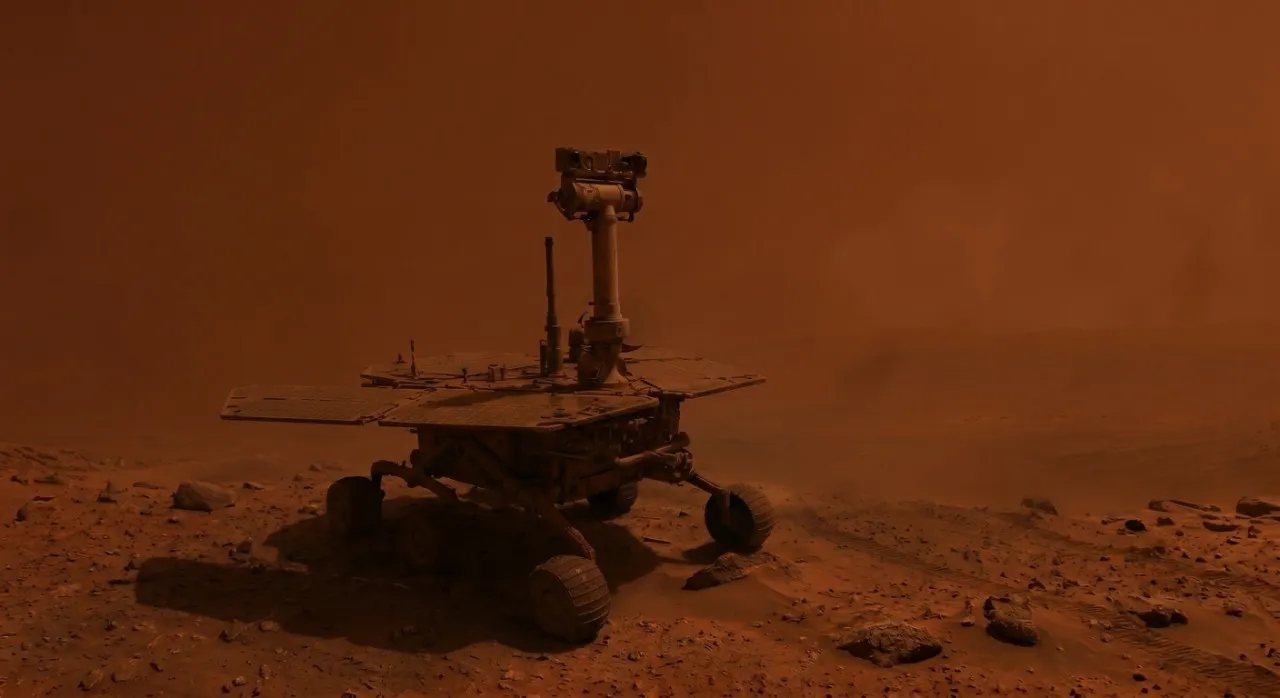
The atmosphere of Mars is one of the most dynamic and rigorous environments in the solar system. Despite its extreme thinness—equivalent to a meager layer representing just 0.6% of Earth's atmospheric pressure—it is the stage for planetary-scale meteorological phenomena capable of completely altering the planet's thermal balance. Among these phenomena, global dust storms represent the most extreme manifestation of the interaction between the Martian surface, solar radiation, and atmospheric dynamics. Curiously, these events not only transform the reddish landscape into a perpetual twilight but also define the success or failure of our robotic exploration technology.
Physics of sediment transport in thin air
To understand how a storm rises on a planet with almost no air, we must imagine a subtle balance of forces. The Martian atmosphere is mainly composed of carbon dioxide (95.3%). Although its density is incredibly low, the transport of sand and dust is highly active thanks to the planet's low gravity, which is roughly one-third of Earth's. It is as if dust grains on Mars weigh three times less, making it easier for the wind to carry them with minimal effort.
The climate of Mars is strongly influenced by the high eccentricity of its orbit. This variation causes the incident solar radiation to fluctuate by up to 30% throughout the Martian year. The period of maximum insolation occurs during late spring and summer in the southern hemisphere. During this seasonal window, the heating of the ground and the lower atmosphere reaches its peak, inducing intense thermal convection currents that facilitate dust suspension. Lifting these particles in a low-density environment requires winds ranging between 50 and 115 kilometers per hour. Although these speeds may seem characteristic of a terrestrial hurricane, the low density of the Martian air means that the dynamic pressure exerted on objects is extremely small. A 100-kilometer-per-hour wind on Mars would not knock an astronaut down; it would feel like a gentle breeze, albeit filled with fine, abrasive dust.
The feedback loop that envelops a world
The trigger that transforms a series of regional storms into a global event is a radiative-dynamic feedback loop. During the southern spring, the carbon dioxide ice accumulated in the southern polar cap sublimates massively upon exposure to solar radiation, raising the global surface pressure by up to 20%. Local winds act as the primary drivers of dust lifting, creating dust devils and gigantic structures known as dust towers. These structures act as true atmospheric elevators that can propel dust to altitudes exceeding 40 kilometers.
Once airborne, the dust directly absorbs incoming solar radiation, heating the surrounding air. This heating intensifies global thermal gradients and the strength of surface winds, which in turn lifts even more dust. Curiously, this self-sustaining loop accelerates the spread of the phenomenon, allowing geographically separated storms to merge and encircle the planet in a matter of weeks. This process presents a critical collateral consequence: dust towers also transport water vapor into the upper atmosphere. Exposed to ultraviolet radiation on a world devoid of a protective magnetic field, water molecules dissociate, accelerating the escape of hydrogen into outer space and explaining the historical loss of Martian oceans.
Self-limitation mechanisms and the end of the storm
Global storms are transient phenomena that harbor the seeds of their own destruction. Paradoxically, the mechanism that halts the storm is intrinsically linked to its own intensity. As dust completely blankets the planet's atmospheric envelope, optical depth increases exponentially, blocking virtually all direct sunlight. Deprived of light, the ground stops heating abruptly.
This thermal behavior drastically reduces the temperature gradient between the ground and the upper air. Without this thermal instability, daytime convection shuts down almost completely. As the updrafts feeding the system with fresh dust cease, the storm loses its dynamic engine and begins a long decay phase that can last for months, dominated by passive gravitational sedimentation where particles slowly fall back to the surface.
The collapse of solar-powered explorers
Reliance on photovoltaic energy represents a critical vulnerability on Mars. During the great global meteorological event of 2018, atmospheric opacity reached unprecedented levels. NASA's Opportunity rover is the most documented example of how a global storm can annihilate a robotic platform. As the sky darkened, daytime sunlight was reduced to a dim twilight, making it impossible for its panels to recharge the lithium-ion batteries.
The true mortal danger for the rover lay not in the lack of electricity to move, but in the loss of thermal control during the frigid Martian winter. To survive temperatures that drop below minus one hundred degrees Celsius, the rover needed to actively generate heat. Although it featured passive radioisotope heater units, these were insufficient without the primary electrical heaters. As the storm dragged on, the batteries completely discharged and suffered irreversible structural damage from freezing, preventing the electrical system from ever sustaining an operational voltage when the skies finally cleared.
A similar fate befell the Chinese rover Zhurong in 2022. Despite featuring a sophisticated passive system based on n-undecane—a phase-change material that stores latent heat during the day to release it at night—the accumulation of static dust on its thermal windows and solar arrays blocked solar radiation. The Martian dust, electrostatically charged by wind friction, acted as an opaque blanket that prevented the rover from reaching the minimum power levels required for automated reactivation.
The nuclear alternative and the human future
In contrast to the bleak record of solar explorers, platforms utilizing nuclear power systems have demonstrated near-total immunity to the effects of dust. The Curiosity and Perseverance rovers utilize a Multi-Mission Radioisotope Thermoelectric Generator. This device harnesses the natural alpha decay of plutonium to generate constant heat, converted into electricity via solid-state thermocouples using the Seebeck effect. A sophisticated pumped fluid system distributes this residual heat throughout the chassis, keeping the electronics within a benign range and ensuring continuous operability regardless of how dark the sky becomes.
The analysis of these dynamic phenomena yields critical conclusions for future human exploration. The viability of photovoltaic technology for a crewed settlement will be restricted to equatorial regions, and even then, it will require massive secondary storage systems—such as hydrogen production and hydrolysis—to survive months of global darkening. Curiously, the presence of astronauts will offer an invaluable operational advantage: the ability to manually clean solar array surfaces, removing the electrostatically charged dust that buried our robots. However, to guarantee survival against the atmospheric forces of Mars, the design of the first permanent habitats will mandatory require hybrid architectures where nuclear energy acts as the unshakeable pillar of life.
Related
Missions
- 🛰️ Curiosity
- 🛰️ Opportunity
- 🛰️ Perseverance
- 🛰️ Zhurong
Related news and articles
- 📄 The Mars Farming Challenge: Why Space Agriculture Is More Complex Than Science Fiction 25 JUL 2026
- 📄 Valles Marineris: The Tectonic Scar That Rewrote the History of Mars 11 JUN 2026
- 📄 The Martian Colossus: Why Is Olympus Mons the Largest Volcano in the Solar System? 7 JUN 2026
- 📄 The Ninety-Day Paradox: The Unexpected Triumph of Human Engineering on the Martian Plains 3 JUN 2026
Marspedia terms
Enjoyed it? Keep exploring
Volver al Blog