
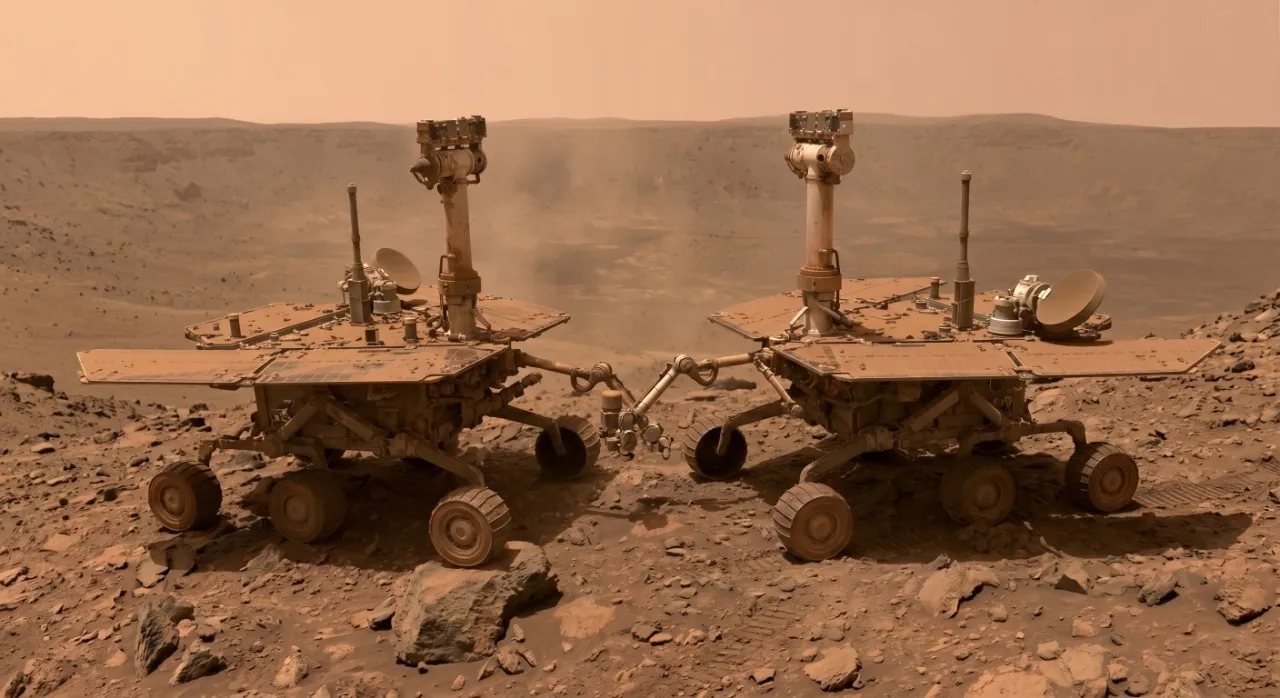
The exploration of the cosmos harbors stories where technical reality far exceeds the most optimistic forecasts of science fiction. In the annals of astronautics, few milestones shine as brightly as the interplanetary odyssey of the twin rovers Spirit and Opportunity. Originally conceived to survive a minimum of ninety Martian days on the inhospitable surface of the red planet, these tireless robotic explorers shattered all predictive models of technological degradation. Spirit operated for more than two thousand sols —the term used to designate days on Mars—, multiplying its programmed lifespan twentyfold before succumbing to the cold in two thousand and ten. For its part, Opportunity continued its journey for nearly fifteen Earth years, traveling more than forty-five kilometers until a titanic global dust storm shut down its systems in June two thousand and eighteen. How is it possible that machines designed for a three-month mission extended their legacy for fifteen years? The answer to this fascinating enigma lies not in mere fortune, but in a bold design philosophy, a superb ability to adapt software millions of kilometers away, and, curiously, in the unexpected complicity of Martian meteorology itself.
The Philosophy Behind Lifespan
There is a common misunderstanding when evaluating the nominal duration of a space probe, interpreting the deadlines set by agencies as a preprogrammed technological obsolescence. In the rigorous practice of aerospace engineering, determining a baseline mission of ninety days responds to strict criteria of success probability under extreme environmental conditions. To ensure that such a complex vehicle maintains a ninety-nine percent statistical confidence of survival, engineers must size and integrate components whose mean time between failures far exceeds that threshold. Designing a structure calculated to withstand exactly three months would mean accepting an intolerable risk of premature catastrophic failure. Think of a conventional automobile engine: it is designed with such a high safety margin that, with proper maintenance, it can operate optimally for decades, vastly outperforming the minimum warranties offered by the manufacturer at the dealership.
Furthermore, the risk profile of an interplanetary mission is heavily concentrated in its initial stages. The violent launch, the transit through the vacuum of space, the hyperbolic atmospheric reentry, and the rough impact cushioned by airbags expose the hardware to brutal peaks of acceleration and mechanical fatigue. Once this true dynamic ordeal is overcome and the vehicles are stabilized on the regolith, the operating environment becomes mostly static. From that moment on, wear and tear responds to progressive long-term processes, primarily governed by the severe thermal fluctuations between the Martian day and night. To mitigate these risks within a limited mass budget, Jet Propulsion Laboratory engineering prioritized vital systems. They protected the most delicate electronic components inside the warm electronics box —a sort of super-insulated thermos designed to retain internal heat— and rejected the installation of active cleaning systems for the solar arrays. Adding mechanical wipers or compressed gas ejectors would have taken weight away from scientific instrumentation and, paradoxically, would have introduced new critical failure points due to the infiltration of the extremely fine and abrasive Martian silica dust.
The Vital Breath of Martian Whirlwinds
Despite the robustness of the hardware, mission planners assumed that the accumulation of atmospheric dust on the photovoltaic decks would dictate the irreversible end of the project. Based on empirical data from previous misiones, a constant dust deposition rate of zero point three percent per day under normal conditions was projected. Under this linear model, it was calculated that available electrical power would inexorably decline within a few months, preventing the powering of internal heaters and causing the death of systems by freezing. However, the Martian atmosphere held an ace up its sleeve that completely transformed the energy balance of the mission. In late two thousand and four, Earth operators detected abrupt and unexpected increases in the rovers' electrical generation during the night. That miraculous phenomenon was cataloged as a cleaning event.
Curiously, local wind dynamics proved to be the best ally of the silicon cells. The direct passage of low-pressure vortices, popularly known as dust devils, along with air currents channeled by the rugged topography of the craters, acted as a natural duster of extraordinary efficacy. To understand the physics of these phenomena, we can imagine the accumulation of dry leaves and dust on the hood of a parked car; a gust of wind or the slipstream of another moving vehicle is enough to clean the surface instantly. These cleaning events repeatedly allowed the solar panels to recover generation capacities close to the initial values of the mission. Thanks to these providential currents, Opportunity was able to extend its scientific march year after year, defying the linear predictions of terrestrial mathematical models.
Topographic Navigation Against the Winter
Despite the invaluable help of the wind, rover survival required millimetric planning due to the eccentricity of Mars' orbit and the tilt of its axis. These factors give rise to climatic seasons that last nearly twice as long as those on Earth, characterized by frigid winters with low insolation in the southern hemisphere, the region where both vehicles operated. During the winter solstice, the Sun barely rises above the northern horizon, drastically reducing light capture and dropping environmental temperatures below minus one hundred degrees Celsius. Lacking independent motors to steer the solar arrays autonomously, mission controllers developed an ingenious navigation strategy based on the topography of the terrain.
This technique consisted of planning forward trajectories by taking advantage of relief irregularities, forcing the rovers to park exclusively on north-facing slopes during the harshest months. By physically tilting the vehicle's chassis toward the direction of the equatorial line, the angle of incidence of solar rays on the photovoltaic cells was minimized, maximizing the daily energy generated to power the internal survival heaters. This topographic adaptation maneuver was vital for Opportunity on the escarpments of the craters that marked its route. Regrettably, the absolute dependence on mobility to achieve an appropriate thermal angle sealed the tragic fate of its twin, Spirit. After suffering severe electromechanical failures that disabled several of its wheels, Spirit became trapped in May two thousand and nine in an unstable deposit of fine iron sulfate sand. Unable to maneuver into a favorable tilt before the onset of winter, the rover remained immobilized in a flat orientation. Energy dropped below operational minimums, causing mechanical stresses from thermal contraction in the microelectronics that silenced the vehicle forever in March two thousand and ten.
Digital Surgery Millions of Kilometers Away
Keeping these sophisticated scientific tools operational also required constant reinvention by software engineering teams. Unlike satellites orbiting the Earth, onboard computers on Mars must manage prolonged autonomy due to communication latency, which fluctuates between four and twenty-two minutes depending on the relative distance between both planets. When hardware began to falter due to the relentless passage of time, digital creativity took over. Toward the end of Opportunity's operational life, the non-volatile Flash memory began to experience critical parity errors due to physical wear accumulated in the silicon cells after far exceeding their projected write cycles. The rover suffered recurrent episodes of amnesia, forgetting the scientific guidelines loaded for the day and forcing continuous reboots of the main computer.
Faced with irreversible physical degradation of the storage medium, the technical team made a bold decision: reprogram the operating system to work exclusively on volatile RAM. Given that this type of memory loses all information when the vehicle shuts down its main systems to enter deep hibernation during the frigid Martian night, the operational profile mutated completely. A contingency protocol was established that required packaging and transmitting to Earth all scientific information collected during the day before nightfall, using orbiting satellites as relays. This brilliant software reconfiguration completely bypassed the damaged storage hardware, gifting humanity three additional years of invaluable geochemical discoveries.
The Legacy in the Rocks and the Interplanetary Tomorrow
The scientific return of this prolonged endurance transformed our understanding of the Martian past. Equipped with rock abrasion tools and precision spectrometers, Spirit and Opportunity unveiled the geological chronicles written in the interplanetary soil. While Spirit discovered deposits of pure opaline silica linked to ancient hydrothermal activity and volcanic fumaroles, Opportunity located the famous gray hematite spherules and gypsum veins that betray the ancestral presence of stable liquid water with a neutral pH and low salinity. Together they demonstrated that early Mars was not only a dynamic and humid world, but that it harbored stable, temperate environments that would have been thermodynamically habitable for extremophile microorganisms similar to those inhabiting geothermal fields on Earth.
The definitive loss of Opportunity in two thousand and eighteen, buried under the darkness of a colossal global dust storm that raised atmospheric opacity to unprecedented levels, marked the end of an era, but not the oblivion of its lessons. The vulnerability of photovoltaic power prompted a paradigm shift in the design of successor misiones, such as Curiosity and Perseverance, which replaced solar panels with multimission radioisotope thermoelectric generators powered by the thermal decay of plutonium. Likewise, traction wear issues forced a complete redesign of the tribology of the aluminum wheels, incorporating elastic titanium spokes and reinforced geometries to withstand wind-sharpened rocks.
The epic of the MER rovers transcends mere technical excellence to become a powerful testament to the human spirit. Those ninety days projected on a design board were transformed, through the ingenuity and audacity of our species, into fifteen years of uninterrupted exploration on the cosmic frontier. As we gaze upon the silent tracks these robotic emissaries left upon the red sands, we see not only the triumph of systems engineering, but the prologue to our own destiny. Real science, stripped of artifice, shows us that the limits of our tools are malleable when accompanied by the passion to understand the unknown, paving the way for the day when the first human steps relieve the metallic tracks on the plains of Mars.
Related
Missions
- 🛰️ Curiosity
- 🛰️ Opportunity
- 🛰️ Ingenuity
- 🛰️ Perseverance
Related news and articles
- 📄 The Mars Farming Challenge: Why Space Agriculture Is More Complex Than Science Fiction 25 JUL 2026
- 📄 Valles Marineris: The Tectonic Scar That Rewrote the History of Mars 11 JUN 2026
- 📄 How Global Dust Storms Darken the Planet Mars 9 JUN 2026
- 📄 The Martian Colossus: Why Is Olympus Mons the Largest Volcano in the Solar System? 7 JUN 2026
Marspedia terms
Enjoyed it? Keep exploring
Volver al Blog