
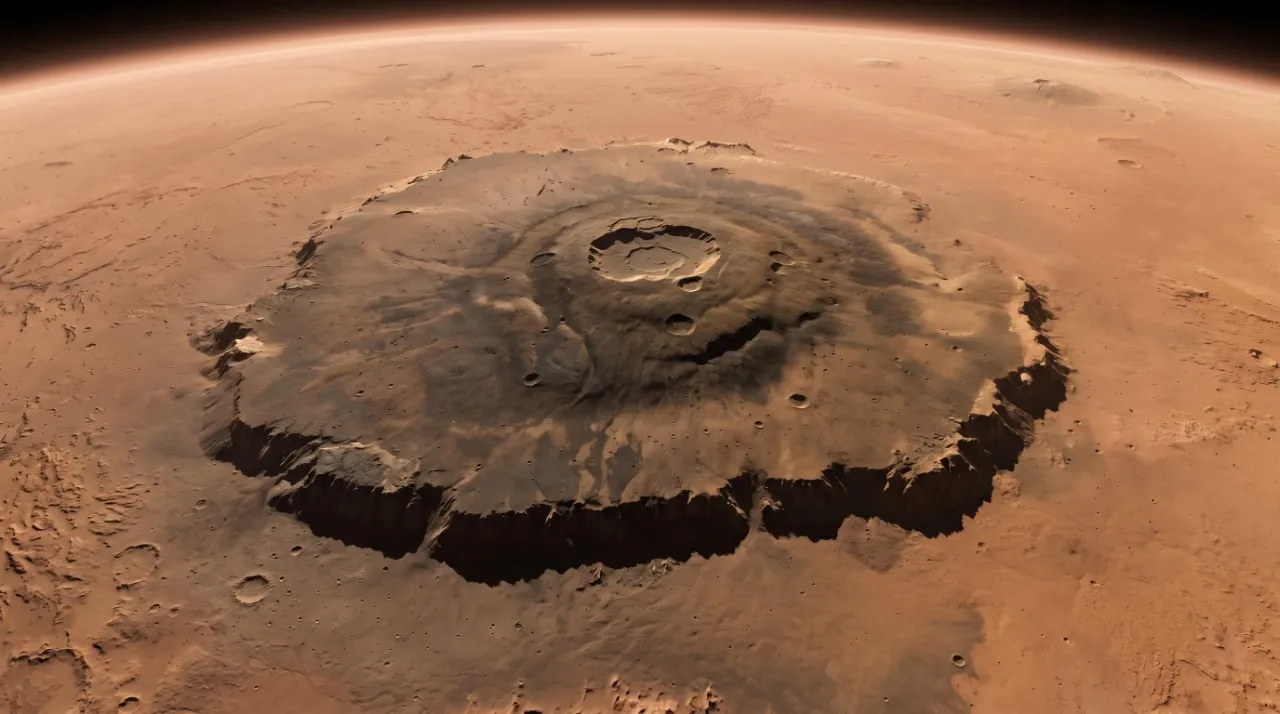
Imaging a mountain that breaks all the geographical limits of our planet seems like the plot of a science fiction novel. However, in our cosmic neighborhood, such a structure is a reality made of stone and basalt. Olympus Mons —or Mount Olympus— stands on the Martian plains as the largest identified volcano in the solar system. If we wonder how a planet significantly smaller than Earth could host such an disproportionate colossus, the answer leads us on a fascinating journey through physics, geology, and the deep history of the Red Planet, revealing an astonishing evolutionary divergence between both worlds.
A titan that dwarfs the maps
To measure Olympus Mons, terrestrial parameters fall short. This structure is classified as a shield volcano, a type of volcanic building characterized by extremely gentle slopes that average a gradient of just five percent. Curiously, if we were standing on its slope, the incline would be so slight that we would not even have the sensation of climbing a mountain; it would look like an infinite horizon rising gently into the sky —like an immense circus tent stretched out for miles—. But its absolute dimensions are titanic. The summit of the volcano rises more than twenty-one kilometers above the Martian reference level, which means it surpasses Mount Everest's elevation two and a half times.
The real astonishment comes when looking at its base. The diameter of its structure ranges between six hundred and seven hundred kilometers, delimiting a surface area of approximately three hundred thousand square kilometers. This footprint on the ground is equivalent to the territorial extension of countries like Italy or the Philippines. At its peak opens a complex of nested calderas eighty-five kilometers long, formed by six collapse craters that originated sequentially when the underlying magma chambers emptied in massive eruptions. Delimiting this colossal lava cake stands an abrupt basal scarp —a belt of cliffs that reaches heights of up to ten kilometers—, a unique geological feature that has no parallel on Earth and keeps the scientific community excited.
The secret: a stagnant lid against mobile plates
The discrepancy in scale between the volcanoes of Earth and Mars lies in their respective internal engines. Earth possesses a lithosphere fragmented into mobile tectonic plates that move continuously —acting as a geological conveyor belt—. When a hotspot in the mantle breathes magma toward the Earth's surface, the upper plate moves, causing the supply of molten rock to be geographically intercepted over time. This distributes the material into a linear chain of individual and small volcanoes, as exemplified by the Hawaiian archipelago. No terrestrial volcano can remain positioned over its energy source long enough to accumulate colossal volumes.
Mars, on the contrary, is ruled by a tectonic regime of a stagnant lid, that is, a lithosphere made of a single undivided plate. Lacking an active continental drift, the portion of the crust located above the magma plume remained immobile in a fixed position for hundreds of millions of years. All the magmatic production was extruded continuously and uninterruptedly through the same feeder conduits, piling lava flow upon lava flow on a single focused point. It is the equivalent of leaving a pastry bag squeezing fixedly on a single spot of the plate instead of moving it drawing a line.
Gravity, viscosity, and the enigma of the great cliff
To this static supply, two essential physical allies are added: the low Martian gravity and the absence of aggressive erosion. With a gravity that is almost a third of Earth's, the weight of the building is distributed differently, preventing the volcano from suffering a premature basal plastic collapse and allowing it to grow to its theoretical height limit on an extraordinarily rigid crust. The lavas of Olympus Mons, composed of iron-rich basalt, were not extreme fluids; scientists estimate they possessed a moderately high viscosity. Their kilometric length was not because they ran like water, but due to extraordinarily high and sustained effusion rates that saturated the terrain through a protective network of channels and lava tubes.
On the other hand, the enigmatic ten-kilometer-high basal scarp keeps an open debate. The hypothesis of volcanic spreading proposes that the cliff is the product of tectonic deformations and colossal landslides caused by the structure's own weight. However, an alternative and highly suggestive theory argues that Olympus Mons could have been, some three thousand eight hundred million years ago, a gigantic volcanic island in an ocean that flooded the northern hemisphere of Mars. When the burning magma came into contact with cold liquid water, a sudden cooling would have occurred, sculpting a perimeter cliff identical to what is observed on Earth islands like the Azores.
A latent giant facing the future
We often think of Mars as a geologically dead world, but data from impact crater counts tell a different story. Although the volcanic province began to take shape four billion years ago, the lava flows covering the northwestern flank show impact-free surfaces whose dates range between one hundred fifteen million and just two million years old. On the cosmic time scale, two million years is the equivalent of a blink. This conclusively demonstrates that the colossus is not necessarily extinct, but in a state of latent lethargy, biding its time until a new episodic eruptive phase.
Olympus Mons stands as the most eloquent testimony of what happens when the forces of a planet concentrate on a single, eternal point in space. Understanding the secrets printed on its basaltic slopes is not only about deciphering the thermal and tectonic history of Mars, but also about understanding the limits of habitability and planetary evolution in our corner of the universe. Real science invites us to look at this titan not only with awe for its dimensions, but with the deep conviction that the answers to the great Martian enigmas wait patiently engraved on its colossal stone cliffs.
Related
Related news and articles
- 📄 Valles Marineris: The Tectonic Scar That Rewrote the History of Mars 11 JUN 2026
- 📄 The Mars Farming Challenge: Why Space Agriculture Is More Complex Than Science Fiction 25 JUL 2026
- 📄 How Global Dust Storms Darken the Planet Mars 9 JUN 2026
- 📄 The Ninety-Day Paradox: The Unexpected Triumph of Human Engineering on the Martian Plains 3 JUN 2026
Marspedia terms
Enjoyed it? Keep exploring
Volver al Blog