
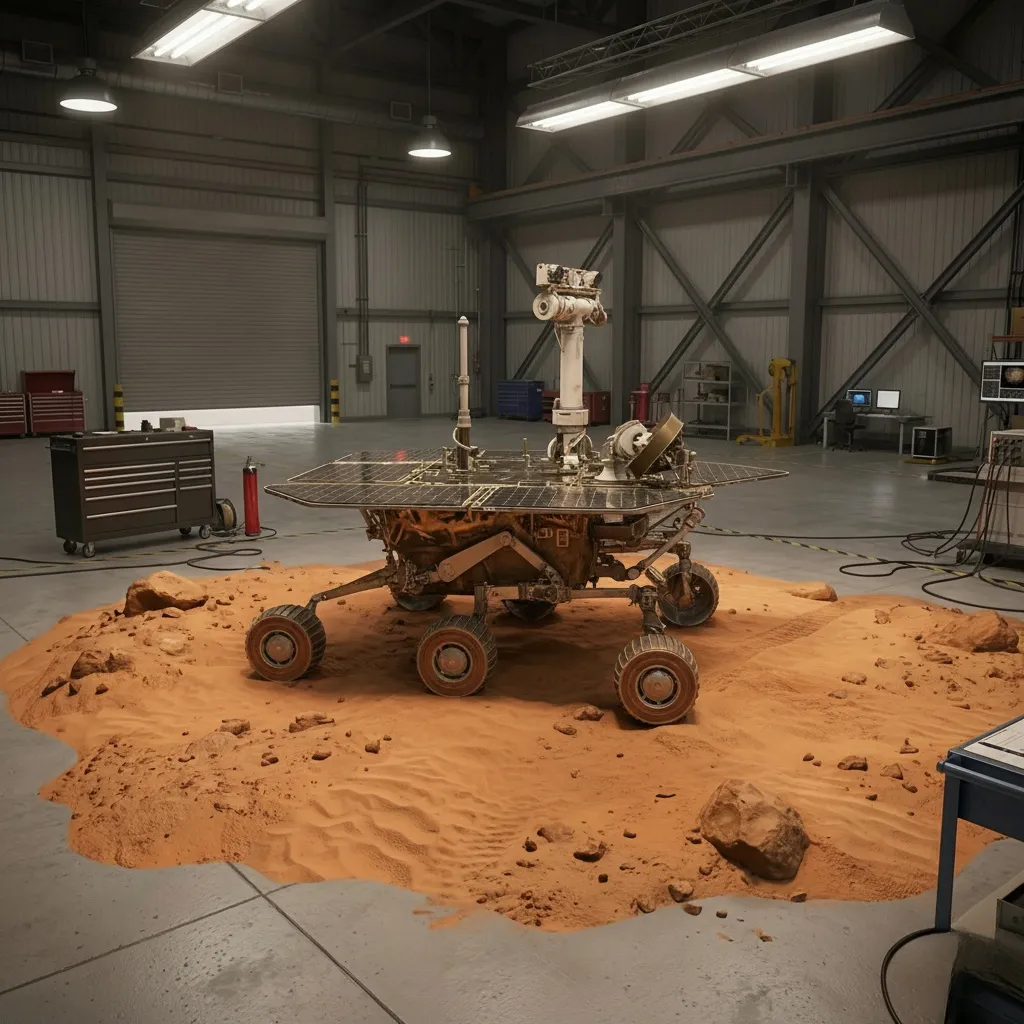
Spirit
The Spirit rover (MER-A) explored Gusev Crater starting in 2004. Outlasting its 90-day mission, it operated until 2010. Its discovery of pure silica deposits proved ancient hydrothermal systems, transforming our understanding of Mars' watery past and its potential habitability.
Agency

Country

Type
Rover
Status
Launch
June 10, 2003
Technical Analysis of the Mars Exploration Rover A (Spirit) Mission
- Mission Designation: Spirit (MER-A)
- Operating Agency: NASA / Jet Propulsion Laboratory (JPL)
- Launch Date: June 10, 2003
- Landing Date: January 4, 2004
- Landing Site: Gusev Crater, Mars
- Launch Vehicle: Delta II 7925-9.5
- Mission Status: Concluded (2011)
1. Mission Objectives
The Spirit mission was designed to serve as a robotic geologist on the Martian surface, aiming to determine the planet's climatic and geological history. Its primary objectives included:
- Searching for and characterizing rocks and soils that provide clues to past water activity.
- Investigating the nature of geological processes that shaped the local terrain and influenced its chemistry.
- Extracting mineralogical data to interpret the environmental conditions under which the rocks formed.
- Validating observations made by orbiters (Mars Odyssey and Mars Global Surveyor) at the surface scale.
2. Probe Specifications (MER Platform)
The Spirit rover represented a technological leap from Pathfinder, utilizing a sophisticated mobile platform protected by a descent module and airbags.
- Mass: 185 kg (rover only).
- Dimensions: 1.5 m in height, 2.3 m in width, and 1.6 m in length.
- Power: Triple-junction solar panels generating up to 140 watts per sol, stored in two lithium-ion batteries.
- Mobility: Rocker-bogie suspension system with six wheels, each with its own motor, allowing movement over rugged terrain and slopes of up to 45 degrees.
- Communications: High Gain Antenna (HGA) for direct Earth link and Ultra High Frequency (UHF) antenna for relay through orbiters.
3. Scientific Instrumentation
The scientific instrument suite, known as the Athena Payload, included:
- Panoramic Camera (Pancam): Two high-resolution stereoscopic cameras for terrain mapping.
- Miniature Thermal Emission Spectrometer (Mini-TES): To identify minerals through their thermal signatures.
- Alpha Particle X-Ray Spectrometer (APXS): Located on the robotic arm for elemental chemical analysis of rocks.
- Mössbauer Spectrometer (MB): To examine the mineralogy of iron-bearing rocks.
- Microscopic Imager (MI): High-resolution camera to view fine details in rocks and soil.
- Rock Abrasion Tool (RAT): A drill to remove the weathered surface of rocks and expose fresh material.
4. Launch Vehicle
Spirit was launched from Space Launch Complex 17A at Cape Canaveral Air Force Station. The Delta II 7925 vehicle utilized:
- A Thor XLT first stage assisted by nine Graphite-Epoxy Motors (GEM) boosters.
- A Delta-K second stage.
- A Star 48B solid propellant third stage for trans-Martian injection.
5. Scientific Discoveries and Result
- Gusev Crater Geology: While the floor was initially covered by volcanic basalt, Spirit found rocks altered by water within the Columbia Hills.
- Home Plate and the Major Discovery: Spirit discovered nearly pure opaline silica deposits (90% concentration). This finding indicated the past existence of hot springs or fumaroles, suggesting an environment that was once habitable.
- Carbonates: The detection of magnesium-iron carbonate in the "Comanche" outcrop confirmed that Mars had a thick, wet CO2 atmosphere in the remote past.
- End of Mission: In April 2009, Spirit became trapped in a soft sand bed named "Troy." Due to loss of mobility and poor solar orientation during the winter, contact was lost on March 22, 2010.
6. Technical Conclusion
Spirit operated for 6 years, 2 months, and 19 days, exceeding its nominal 90-day lifespan by more than 25 times. The mission demonstrated the robustness of the MER design and provided the first definitive evidence of active hydrothermal environments on ancient Mars, shifting the exploration focus toward the search for ancient microbial habitats.
Mission Milestones
Launch
Sol 36 of Nilo, Year 26
208 days
of travel
Arrival at Mars
Sol 15 of Utopo, Year 26
Operations Start
Sol 15 of Utopo, Year 26
2208 sols
of operations