
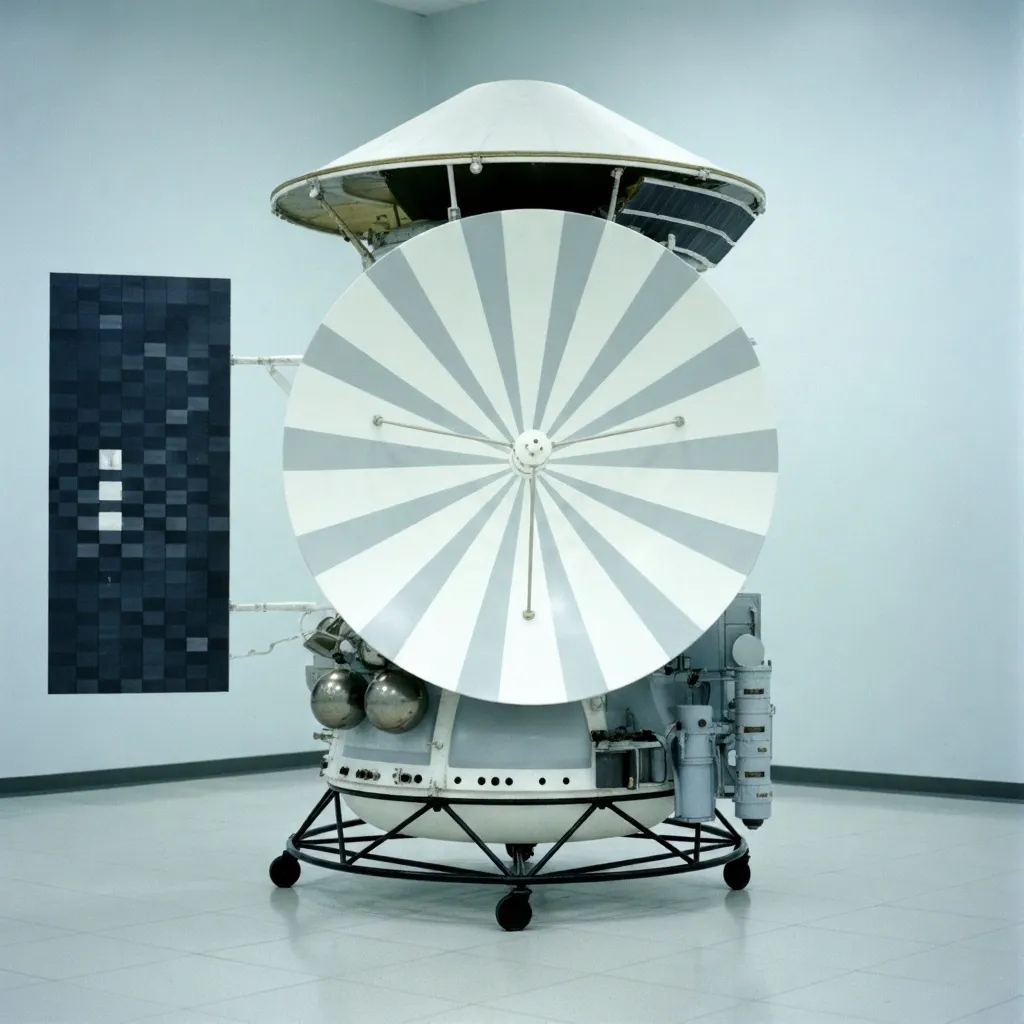
Mars 6
Launched on August 5, 1973, the Mars 6 mission consisted of a flyby bus and a lander. On March 12, 1974, the lander separated and entered the atmosphere, transmitting in-situ data for the first time for 224 seconds. However, contact was abruptly lost at the moment of retrorocket activation, resulting in a high-speed impact, likely due to the degradation of electronic components.
Agency

Country

Type
Lander
Status
Launch
August 5, 1973
Technical Analysis of the Mars 6 Mission
- Mission Designation: Mars 6
- Internal Designation (USSR): 3MP No.50P
- Operating Agency: Ministry of General Machine Building (MOM) / NPO Lavochkin
- Launch Date: August 5, 1973, 17:45:48 UTC
- Launch Vehicle: Proton-K / Blok D
- Launch Site: Baikonur Cosmodrome, Site 81/23
- Status: Successful Flyby / Landing Failure (Surface Impact)
1. Mission Objectives
Mars 6 was part of the "second wave" of the 1973 launch window (along with Mars 7), specifically designed to deploy a lander, unlike the Mars 4 and 5 orbiters. Its primary objectives were:
Engineering and Operations:
- Perform a Mars flyby with the spacecraft "bus" to relay data to Earth.
- Execute a direct atmospheric entry and soft landing in the Margaritifer Terra region.
- Test autonomous descent systems and parachutes in the Martian atmosphere.
Scientific:
- Obtain the first direct (in-situ) data of Martian atmospheric pressure, temperature, and chemical composition during descent.
- Analyze the physical and chemical properties of the Martian soil after landing.
- Study interplanetary plasma and cosmic rays during the cruise phase.
2. Spacecraft Specifications (3MP Platform)
The 3MP configuration differed from the 3MS orbiters by replacing the main fuel tanks with a heavy descent module.
- Launch Mass: 3,260 kg.
- Lander Mass: 635 kg.
- Architecture:
- Flyby Bus: Provided power, navigation, and communications during cruise.
- Descent Module: A spherical capsule protected by a conical heat shield and parachute system.
- Power: Solar panels on the main bus powering chemical batteries; the lander relied on internal batteries after separation.
- Propulsion: Trajectory correction system on the bus and solid-fuel retrorockets on the lander for final braking.
3. Scientific Instrumentation
The payload was divided between the flyby bus and the landing capsule:
Flyby Bus (Coast Stage):
- Magnetometer: For measuring interplanetary magnetic fields.
- Plasma and Cosmic Ray Detectors: Solar wind study.
- Micrometeoroid Detectors: Cosmic dust analysis.
Lander:
- Atmospheric Sensors: Thermometer and barometer for descent profiles.
- Accelerometer and Radio Altimeter: For descent control and density data.
- Mass Spectrometer (Bennett Analyzer): To determine atmospheric gas composition.
- Surface Instruments: Designed for soil analysis (not used due to failure).
4. Failure Analysis and Results
The Mars 6 mission managed to reach Mars but suffered a critical failure in the final phase, common to the troubled 1973 series.
- Arrival and Separation: On March 12, 1974, at a distance of 48,000 km from Mars, the lander successfully separated from the bus.
- Atmospheric Entry: The capsule entered the atmosphere at 09:05:53 UTC. The parachute deployed correctly, slowing the craft from 5,600 m/s to 600 m/s.
- Data Transmission: During descent, it transmitted data for 224 seconds. This was the first time direct data was received from the Martian atmosphere. However, a large portion of this data was unintelligible due to chip degradation in the onboard computer (2T312 transistor issue).
- The Final Failure: At 09:11:05 UTC, at the moment scheduled for the final retrorocket ignition for soft landing, all contact was lost.
- Root Cause: It is presumed that the control system, affected by corrosion of defective chips, failed to activate the retrorockets or did so incorrectly, causing the spacecraft to crash at high speed into the surface (coord. 23.90°S 19.42°W).
- Scientific Legacy: Despite data corruption, the recovered information erroneously suggested a high concentration of argon in the atmosphere, which influenced the design of NASA's future Viking landers.
5. Technical Conclusion
Mars 6 is considered a partial success. Although it failed in soft landing and surface operation, it achieved the complex feat of navigation, atmospheric entry, and telemetry transmission during descent. The mission confirmed the lethality of the manufacturing defect in Soviet electronic components of that era, which doomed almost the entire 1973 fleet, but provided crucial first in-situ data for Martian atmospheric models.
Mission Milestones
Launch
Sol 13 of Ravo, Year 10
218 days
of travel
Arrival at Mars
Sol 2 of Curioso, Year 11