
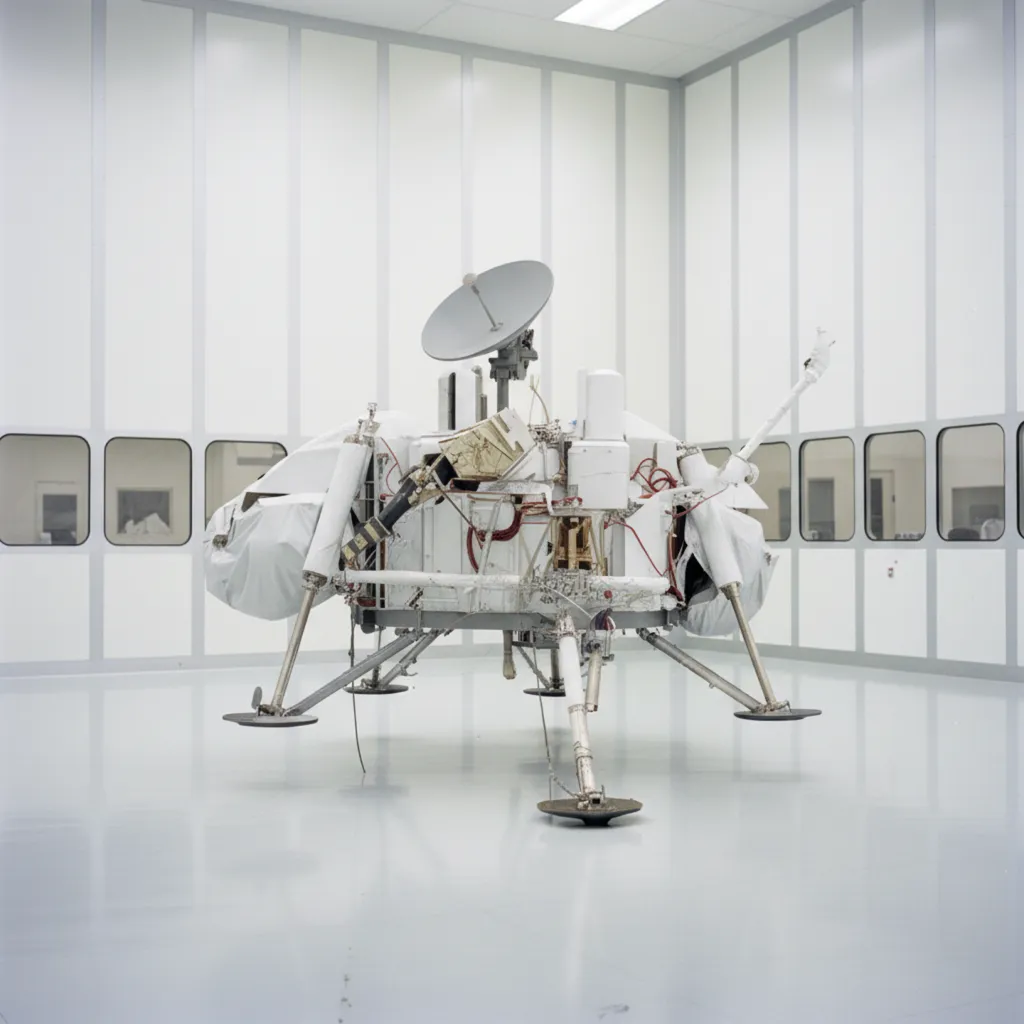
Viking 2 Lander
The Viking 2 Lander touched down in Utopia Planitia on September 3, 1976. It operated for 1281 sols, far exceeding its planned 90-day lifespan, until battery failure on April 11, 1980. It was the first mission to photograph seasonal water frost on the Martian surface and to successfully operate a seismometer on the planet, in addition to conducting controversial biological experiments.
Agency

Country

Type
Lander
Status
Launch
September 9, 1975
Technical Analysis of the Viking 2 Mission (Lander Component)
- Spacecraft Designation: Viking Lander 2 (VL2)
- Honorary Designation: Gerald Soffen Memorial Station
- Operating Agency: NASA (Langley Research Center / JPL)
- Launch Date: September 9, 1975
- Landing Date: September 3, 1976
- Landing Site: Utopia Planitia (47.64°N 225.71°W)
- End of Mission: April 11, 1980
- Landing Mass: ~572 kg
1. Mission Objectives (Surface Segment)
The Viking 2 Lander had the primary goal of conducting the most comprehensive in situ analysis of Mars to date, focusing on three pillars:
- Search for Life: Execute biological experiments to detect metabolic activity in the soil.
- Environmental Characterization: Measure atmospheric composition, daily meteorology, and elemental soil composition.
- Geophysics: Detect seismic and magnetic activity.
2. Spacecraft Specifications (Lander)
The lander design prioritized sterility and energy autonomy.
- Power: Two SNAP-19 Radioisotope Thermoelectric Generators (RTGs) fueled by plutonium-238. They generated ~70 W continuously, allowing for night-time and winter operations, unlike solar panels.
- Structure: Hexagonal aluminum body with three landing legs equipped with crushable honeycomb shock absorbers.
- Communications: High-gain parabolic antenna (S-Band) for direct link to Earth and UHF antenna for link with orbiters.
- Guidance and Control: Radar altimeter and terminal descent radar, along with a monopropellant hydrazine descent propulsion system (12-nozzle engines to disperse exhaust and minimize soil disturbance).
3. Scientific Instrumentation
Lander 2 carried a payload of highly sophisticated instruments:
- Biology Package (GEX, LR, PR): Three miniature laboratories to incubate soil samples with nutrients. The Labeled Release (LR) experiment showed initial positive results, but the lack of organics detected by the GCMS led to interpreting the results as oxidative chemistry.
- GCMS (Gas Chromatograph - Mass Spectrometer): Designed to identify organic molecules. It found no native organic compounds, only cleaning residues and terrestrial contaminants, a key result that contradicted the biological findings.
- Seismometer: Unlike Viking 1 (whose seismometer failed to uncage), Viking 2's seismometer functioned correctly. It was sensitive but mounted on the lander body, making it susceptible to wind noise.
- XRFS (X-Ray Fluorescence Spectrometer): For elemental analysis of rocks and regolith.
- Meteorology Station: Wind and temperature sensors on a deployable boom.
- Facsimile Cameras: Two cameras capable of taking 360-degree panoramas, stereo, and color images.
4. Specific Scientific Results
Lander 2 provided unique data due to its more northerly location (Utopia Planitia) compared to Viking 1:
- Water Detection (Frost): During the second Martian winter, Viking 2 cameras photographed a layer of water frost covering the red soil, confirming the presence of H2O on the surface.
- Seismology: Recorded vibrations caused by wind and one possible seismic event (marsquake), although wind interference made confirming tectonics difficult.
- Soil Chemistry: The XRFS confirmed the soil was rich in iron, silicon, and sulfur, consistent with weathered basalts and the presence of sulfates.
5. Failure Analysis/End of Mission
The Viking 2 Lander demonstrated exceptional longevity, far exceeding its original design.
- Duration: Operated for 1281 Martian sols (approximately 3 years and 7 months).
- Cause of End: The mission ended on April 11, 1980, due to the failure of its rechargeable nickel-cadmium batteries, which could no longer store the energy generated by the RTGs.
6. Technical Conclusion
The Viking 2 Lander remains one of the greatest successes in aerospace engineering. Its ability to land autonomously and perform complex in situ biological analysis has not been matched by many subsequent missions. Although the question of life remained unresolved, the meteorological and chemical data from Utopia Planitia formed the basis of our modern understanding of Mars as a chemically active and seasonally dynamic planet.
Mission Milestones
Launch
Sol 13 of Tharso, Year 11
332 days
of travel
Arrival at Mars
Sol 3 of Isido, Year 12
Operations Start
Sol 29 of Isido, Year 12
1280 sols
of operations