Mars 1969A
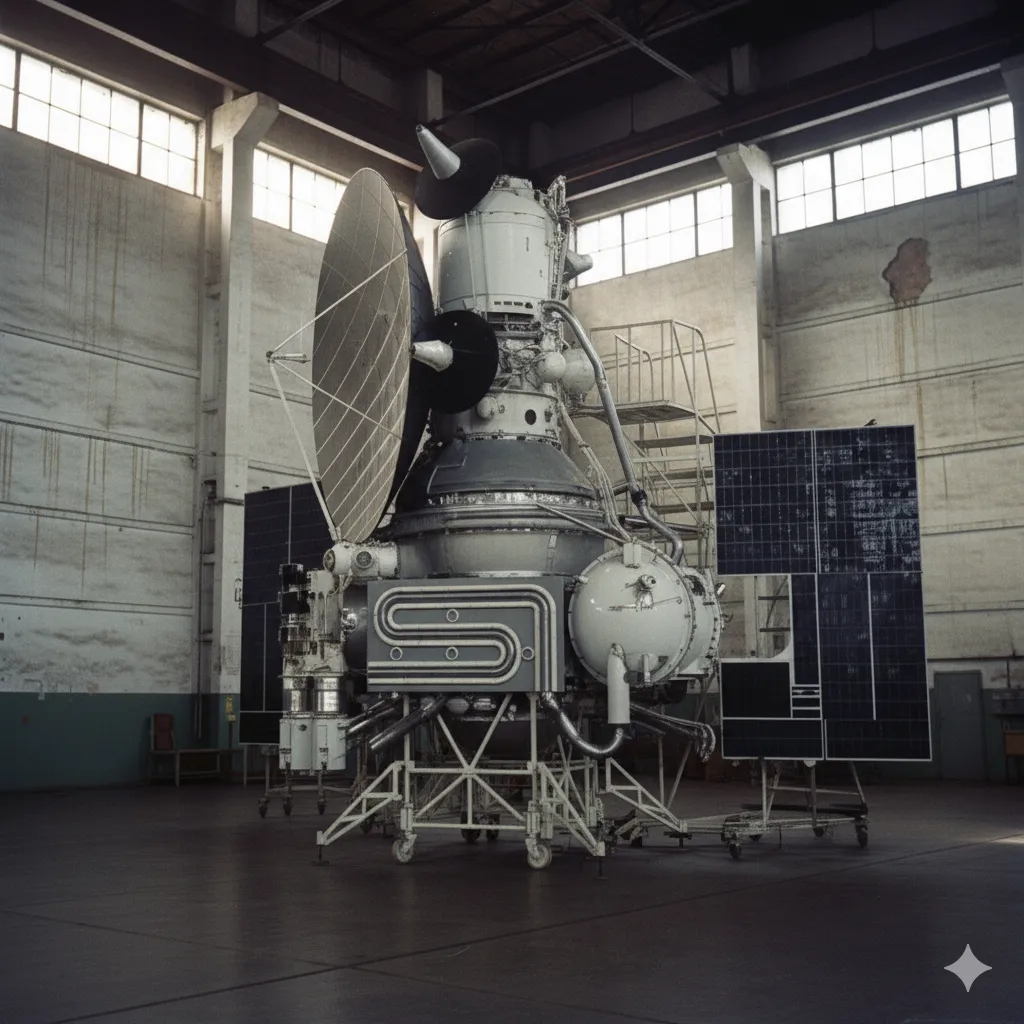
The Soviet Mars 1969A (2M No.521) mission was an ambitious attempt to place a heavy orbiter of nearly 5 tons into Mars orbit using the new Proton-K rocket. However, the mission failed catastrophically during launch on March 27, 1969. A failure in the third stage's turbopump rotor caused a fire and the vehicle's disintegration , with debris falling in the Altai Mountains.
Agency
Country

Type
Orbiter
Status
Launch
March 27, 1969
Technical Analysis of the Mars 1969A Mission
- Mission Designation: Mars 1969A (Western Designation)
- Internal Designation (USSR): Mars 2M No.521 (M-69 No.521)
- Operating Agency: USSR Academy of Sciences (Design by NPO Lavochkin)
- Launch Date: March 27, 1969
- Launch Vehicle: Proton-K / Blok D (8K82K / 11S824) [cite: 60, 272]
- Launch Site: Baikonur Cosmodrome
1. Mission Objectives
Mars 1969A was the first Soviet attempt to use its new heavy-lift vehicle, the Proton, for an interplanetary mission. The primary objective was to place a massive, second-generation orbiter around Mars to perform a comprehensive study of the planet.
Engineering:
- To validate the Proton-K launch vehicle and the Blok D upper stage for interplanetary escape trajectories.
- To test the new, heavy spacecraft platform (Type 2M) in deep space.
- To establish the first artificial satellite of Mars.
Scientific:
- To obtain high-resolution images of the Martian surface for mapping.
- To study the composition and structure of the Martian atmosphere.
- To measure surface temperature and thermal properties.
- To investigate Mars's magnetic field and radiation environment.
2. Spacecraft Specifications (2M Platform)
The 2M (M-69) platform represented a significant leap in mass and capability compared to the earlier 'Mars' and 'Zond' series probes.
- Total Mass: Approximately 4,850 kg (nearly 5 tons), including fuel for orbital insertion.
- Architecture: A large cylindrical bus containing the main avionics, thermal control, and propulsion systems, with large deployable solar arrays.
- Attitude Control: Three-axis stabilization system (sun sensors, star trackers, and gyroscopes) and reaction control thrusters.
- Propulsion: A main liquid-propellant engine specifically designed for the Mars Orbit Insertion (MOI) maneuver.
3. Scientific Instrumentation (Planned)
The large mass of the probe allowed for a much more robust instrument suite than previous missions, including:
- Imaging System: A set of cameras (telephoto and wide-angle) to photograph the surface.
- Infrared Radiometer: To measure surface and atmospheric temperatures.
- Spectrometers (UV and IR): To analyze atmospheric composition, searching for water vapor, ozone, and carbon dioxide.
- Magnetometer: To search for an intrinsic planetary magnetic field.
- Radiation and Cosmic Ray Detectors: To characterize the near-Mars space environment.
4. Launch Vehicle (Proton-K / Blok D)
This launch marked the debut of the Proton rocket for missions beyond Earth orbit. The Proton-K (8K82K) was a three-stage vehicle, supplemented by a fourth (Blok D) escape stage designed for ignition in Earth orbit.
5. Launch Failure Analysis
The mission ended prematurely due to a catastrophic failure of the launch vehicle[cite: 61, 272].
- Initial Sequence: The launch from Baikonur began nominally. The Proton's 1st and 2nd stages performed correctly, carrying the payload and third stage to high altitude.
- Failure Event (T+438 seconds): The failure occurred during the operation of the Proton's third stage.
- Root Cause: Post-flight investigations identified the cause as a catastrophic failure in the third stage engine. Specifically, an unbalanced turbopump rotor within the main engine (RD-0210/0211) disintegrated due to high operational stresses.
- Failure Result: The turbopump failure led to a loss of thrust and a massive fire in the engine compartment. The vehicle lost control, broke apart structurally, and exploded.
- Impact: The Mars 1969A spacecraft and the Blok D upper stage were destroyed before reaching Earth orbit. Debris from the vehicle rained down over the Altai Mountains in the Soviet Union.
6. Technical Conclusion
Mars 1969A was a launch failure[cite: 61, 272]. The mission never had the chance to begin its interplanetary journey. The failure was attributed to a manufacturing or design flaw in the Proton's third-stage turbopump. This event highlighted the ongoing reliability problems with the new Soviet launch vehicles[cite: 61]. A second attempt with an identical spacecraft (Mars 1969B) would fail even more spectacularly just days later[cite: 65, 66].
Mission Milestones
Launch
Sol 23 of Korolo, Year 8