
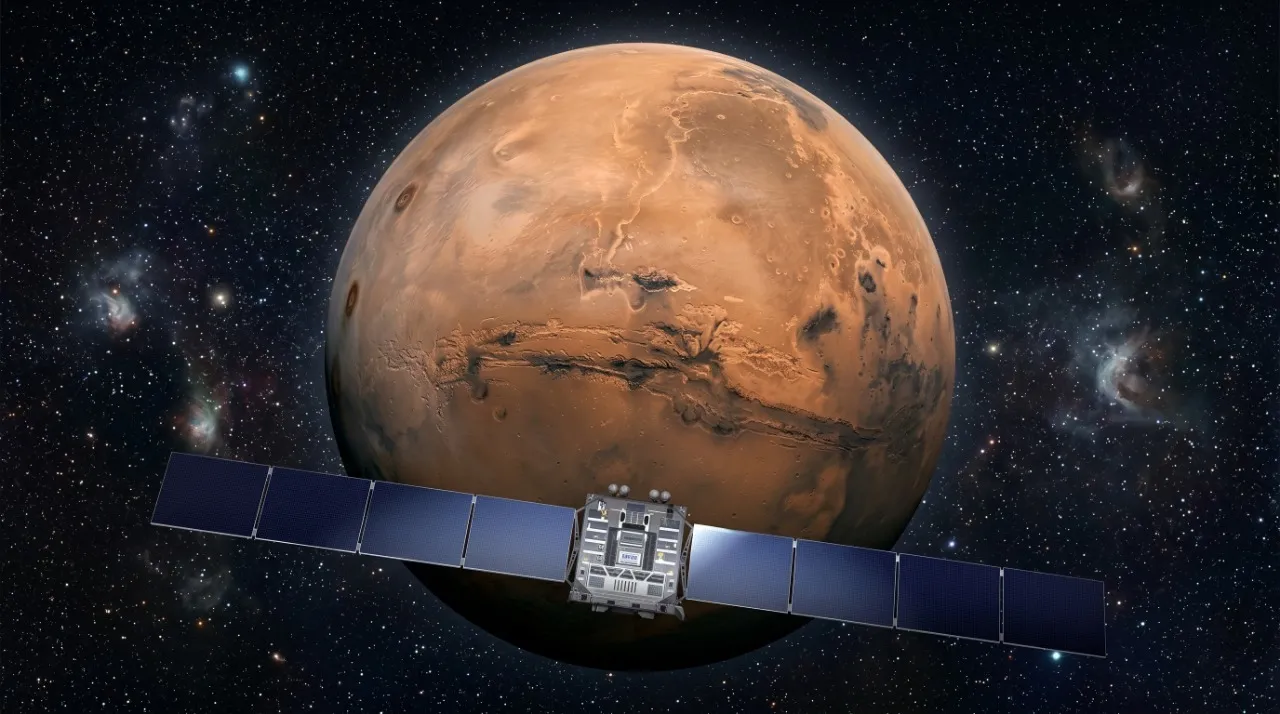


COSPAR Designation: 2028-AEO01 (Projected)
Official Name: Aeolus Meteorological Mission
Responsible Space Agency: NASA (Ames Research Center) in a public-private partnership with Relativity Space
Launch Date/Time: 2028 launch window (Exact UTC pending launch pad assignment)
EDL / Orbital Insertion Date/Time: 2028 (Exact UTC subject to final interplanetary injection trajectory)
Landing Site / Coordinates: Not applicable (Strictly orbital mission; low functional Martian orbit insertion)
Launch Vehicle: Terran R (Relativity Space)
Current Mission Status: In development phase, subsystem integration, and payload validation
1. Historical Context and Detailed Objectives
The comprehensive characterization of the Martian atmosphere represents one of the most complex and urgent challenges for the viability of long-range crewed exploration. Historically, robotic orbital platforms sent to the Red Planet have studied atmospheric components in a partial, uncoordinated, and independent manner. The operational landscape became critical at the end of 2025, when NASA officially declared the conclusion of the MAVEN mission following a catastrophic anomaly on December 6 that caused a total loss of communications. Upon emerging from a scheduled occultation behind Mars, telemetry signals captured by the open-loop receivers of the Deep Space Network (DSN) revealed that the spacecraft was in safe mode and spinning at an abnormally high angular velocity. This caused the complete drain of its batteries before communications could be re-established, forcing NASA to formally declare the end of the mission on June 3, 2026. This incident left the agency with the aging Mars Reconnaissance Orbiter (MRO) and Mars Odyssey as the only operational orbital relay assets, functioning considerably beyond their original design lifetimes.
The fundamental objective of the Aeolus mission is to obtain the first global, integrated, and daily meteorological database of Martian winds, temperatures, dust storms, and clouds simultaneously. The acquisition of high spatial and temporal resolution atmospheric data is a prerequisite to mitigate the extreme risks associated with the entry, descent, and landing (EDL) phases of heavy-tonnage spacecraft. The Martian atmosphere presents a physical paradox: it is dense enough to induce severe aerodynamic heating on the spacecraft structures during hypersonic entry at interplanetary escape velocities, yet it is too thin to allow effective braking using exclusive traditional friction parachutes. This physical condition forces the design of sophisticated active propulsive deceleration systems that require precise knowledge of the air density gradient.
The primary objectives of the mission include continuous three-dimensional mapping of horizontal wind vectors and thermal profiles from the surface up to an altitude of 60 kilometers. As secondary objectives, the mission seeks to monitor the dynamics of local dust storms before they evolve into a global scale, evaluate the net solar radiation balance on the Martian regolith, and act as an advanced high-speed telecommunications node for contemporary and future surface missions.
2. Vehicle Architecture and Primary Subsystems
The physical platform of the Aeolus orbiter, designed and built by Relativity Space under a standardized commercial architecture, features an estimated dry mass of 2,200 kilograms, optimized for insertion into Martian orbit. The main propulsion system utilizes a set of redundant hypergolic engines for trajectory correction maneuvers (TCM) and final orbital insertion. Thermal control combines the use of passive radiators with an active resistance thermal heating system to protect critical subsystems from the extreme thermal fluctuations of the Martian environment.
Electrical power generation is ensured by two steerable high-efficiency photovoltaic solar array wings that provide a constant operational wattage of 3.5 kilowatts at Mars' orbital distance, backed by a high-capacity lithium-ion battery bank for eclipse phases. Attitude control is executed through a combination of high-precision star trackers, inertial measurement units (IMUs), and a set of four high-torque reaction wheels, complemented by cold gas thrusters for angular momentum desaturation.
The telecommunications subsystem represents a disruptive innovation by implementing a high-performance hybrid architecture. It will integrate laser-based high-speed optical transceivers for deep-space broadband links between Mars and Earth, enabling bit rates substantially higher than conventional radio frequency systems. For operational redundancy and cross-link communication with Martian surface assets, the spacecraft features high-power X-band and Ka-band radio frequency transmitters and receivers, compatible with delay-tolerant networking (DTN) protocols. Onboard data processing is managed by the Relay Data Center (RDC), a high-performance computing server system with radiation-tolerant processors running artificial intelligence algorithms for automated compression and prioritization of scientific data prior to transmission.
3. Payload and Scientific Instrumentation
The scientific payload of Aeolus is coordinated by NASA Ames Research Center and integrated into the orbiter platform. It consists of four optical and thermal sensors designed to operate simultaneously:
Doppler Wind and Temperature Sounder (DWTS-Ozone)
Developed by Global Atmospheric Technologies and Sciences (GATS), it is the primary instrument of the mission. It performs direct and simultaneous measurements of the horizontal wind vector and kinetic temperature in the Martian atmosphere from the surface up to altitudes of approximately 60 kilometers. Its physical operational principle is based on Gas Filter Correlation Radiometry (GFCR). It consists of a medium-wave infrared radiation imager coupled to static gas cells containing specific compounds (mainly nitrous oxide, N2O, and carbon dioxide, CO2) that act as a selective spectral scanning filter.
To understand the gas filter principle, imagine looking through tinted glasses that exactly block only the blue color of a specific marker; if the marker moves very fast, the shift in the tint of its light due to motion (Doppler effect) will cause the glasses to no longer block it perfectly, allowing its speed to be measured by the light that filters through. When observing the Martian atmospheric limb, the thermally emitted light from the gases undergoes a Doppler shift induced by the global physical movement of the air (winds) and broadening from the kinetic thermal energy of the molecules. By registering these variations and comparing them with the internal absorption of the gas cells, the thermal gradient and net wind speed are inferred. The focal plane sensor array is actively maintained at a cryogenic temperature of 80 Kelvin using a Stirling cycle cooler, while the front lens optics are cooled to 150 Kelvin.
Thermal Limb Sounder (TLS)
Developed in collaboration with Xiomas Technologies, this infrared sensor is designed to perform high-resolution vertical scans of the atmospheric limb. Its function is to generate detailed profiles of vertical temperature and monitor the spatial distribution, altitude, and optical density of suspended dust particles and clouds composed of water-ice crystals. It functions like a multi-layered optical thermometer slicing the atmosphere into vertical bands.
Surface Radiometric Sensor Package (SuRSeP)
Designed by Ames Research Center, this is a suite of broadband radiometric sensors that evaluates the net radiation balance of the Martian surface and the thermo-optical properties of the atmosphere. SuRSeP continuously measures how atmospheric suspended dust absorbs, refracts, and scatters incident sunlight, determining the thermal energy reradiated into space from the planet's regolith. Its principle is analogous to a weather station measuring the radiation index and air opacity during a day of thick haze or dense fog.
Wide-Field Context Camera (WFCC)
Also supplied by NASA Ames, this is a high-resolution wide-angle meteorological camera that captures full daily images of the planet's visible disk in visible and near-ultraviolet frequencies. The WFCC images act as a contextual reference layer allowing scientists to georeference the thermal and wind traces detected by the DWTS and TLS sensors, mapping the dynamic cycle of formation and dissipation of cloud fronts and local dust plumes. Its operation is equivalent to weather satellites that provide the global view of storm fronts on terrestrial television news.
4. Launch Vehicle and Flight / EDL Profile
The flight profile of the Aeolus mission requires the capabilities of the Terran R heavy-lift rocket, developed by Relativity Space. The Terran R is a two-stage, partially reusable heavy-lift launcher. Its first stage is powered by thirteen Aeon R engines burning liquid methane and subcooled liquid oxygen (methalox), generating a combined liftoff thrust of 3.5 million pounds of force (15,560 kilonewtons) at sea level. The second stage utilizes an Aeon V engine optimized for vacuum with 323,000 pounds of force (1,440 kilonewtons) of thrust. The Trans-Mars Injection (TMI) burn will be executed following the second-stage ignition, placing the Aeolus probe on an optimal energy transfer trajectory toward Mars during the 2028 orbital window.
The interplanetary cruise phase comprises an estimated timeline of six to eight months, during which scheduled trajectory correction maneuvers (TCM) will be conducted to refine the approach vector to the planet. Upon reaching the vicinity of Mars, the orbiter will execute a critical Mars Orbital Insertion (MOI) maneuver, firing its main propulsion system retrogradely to decelerate the vehicle and enter an elliptical capture orbit. Subsequently, the spacecraft will use controlled aerobraking techniques in the upper layers of the atmosphere or additional propulsive burns to circularize its trajectory until reaching the low functional design Martian orbit.
The deployment of the subsurface synthetic aperture radar antennas integrated into the orbiter will be performed immediately after orbital stabilization. Due to the critical risk of freezing and incomplete deployment of elastic booms (as historically occurred with the MARSIS radar on the Mars Express mission in 2005, which required selective solar orientation for controlled thermal expansion), the Aeolus bus incorporates advanced shape-memory materials and integrated active thermal heating systems to ensure the structural locking of its remote sensing components without mechanical failure.
5. Operational Development and Scientific Results
Since the mission is in a development phase prior to the 2028 launch, active operational data and in-situ geochemical or atmospheric results correspond to projected goals and payload calibration tests. The minimum operational commitment of the public-private partnership establishes a duration of one Martian year (approximately 687 Earth days) of continuous scientific observations.
The technology of the primary instrument, the DWTS, features a robust history of maturation and validation on Earth that backs its viability in the Martian environment. The GFCR sensor system was initially tested via high-altitude weather balloon flights and laboratory simulations led by Virginia Tech University in collaboration with the Laboratory for Atmospheric and Space Physics (LASP) and Brandywine Photonics. Subsequently, under NASA's nanosatellite program, low Earth orbit demonstration missions were executed: the TES-16/DWTS-A hardware validation mission in 2024 (a validation CubeSat with a single N2O gas channel), followed by the dedicated TES-17/DWTS-B scientific mission in 2025, which incorporated three infrared cameras and multiple gas cells to demonstrate continuous measurement of Earth's atmosphere between 20 and 200 kilometers of altitude both day and night. The success of these terrestrial and low-orbit campaigns guarantees the precision of stray-light filtering algorithms and the calibration of the optical sensors that will be used to map the thermal and dynamic cycles of carbon dioxide and dust on the Red Planet.
6. Conclusion and Technical Legacy
The Aeolus mission (2028) sets a precedent for structural transformation in the governance and execution of deep-space exploration. By breaking away from the traditional federal procurement model governed strictly by Federal Acquisition Regulations (FAR), a six-year Reimbursable Space Act Agreement is implemented. This paradigm transfers the responsibility for launch infrastructure, satellite bus design, and orbital relay services to private initiative through Relativity Space, allowing NASA to concentrate its fiscal and technical resources on the development of advanced scientific instrumentation at Ames.
The technical legacy of Aeolus will lie in the operational validation of high-capacity data centers and artificial intelligence processing in planetary orbit, as well as the demonstration of the Terran R heavy launcher in high-energy demand interplanetary missions. The continuous global meteorological database obtained by the instrument suite will mitigate critical uncertainties regarding Martian atmospheric density, establishing the essential empirical foundations for the design of propulsive deceleration systems and the success of future crewed missions in the current era.