
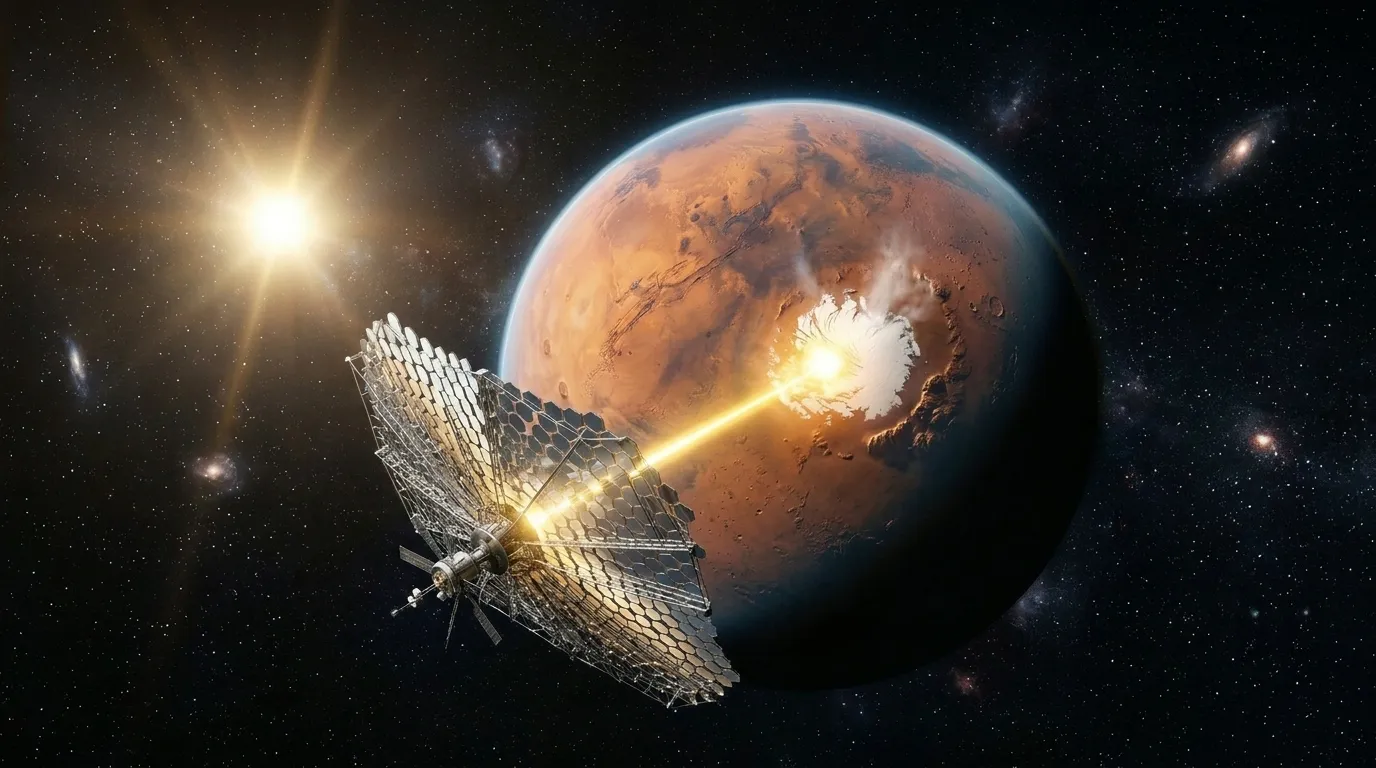
The great dream of space exploration is not limited to visiting other worlds, but to inhabiting them permanently. For decades, scientists and science fiction writers have looked toward our red neighbor, imagining a monumental process to alter its geography and climate. Is it really possible to terraform Mars to restore its ancient atmosphere and liquid water? The idea of transforming a cold, barren desert into an oasis teeming with life is fascinating. However, when we move from theoretical models to real physical data collected by space missions in recent decades, the harsh geological and atmospheric reality of Mars imposes giant scientific and engineering limits that demand an exhaustive analysis, free of all hasty fantasy.
The carbon inventory and the harsh reality of MAVEN
The first step for any terraforming attempt is to thicken the extremely thin Martian atmosphere, which currently barely reaches one percent of Earth's atmospheric pressure. To warm the planet and allow liquid water to flow on its surface again, an immense amount of greenhouse gases, mainly carbon dioxide, would need to be injected. Historically, it was thought that the Martian south pole and subsurface regolith minerals harbored massive reserves of frozen carbon that could be released through induced initial warming. However, measurements by NASA's MAVEN probe revealed a discouraging truth: most of the carbon Mars possessed in its youth is not trapped in the ground, but has been lost forever to deep space. Without a global magnetic field to act as a shield, solar wind has literally swept the Martian atmosphere for billions of years, continuously stripping the planet of its volatile components, a process equivalent to trying to fill a bucket full of holes with water.
Even if we managed to release every single molecule of carbon dioxide locked in the polar ice caps and the planet's rocks, the resulting atmospheric pressure would only reach seven percent of Earth's. Under these conditions, liquid water would still evaporate instantly at room temperature, and humans would still need pressurized suits to prevent their body fluids from boiling due to low pressure. Physics shows us that Mars lacks the basic raw material to warm itself naturally; it does not have enough carbon. Recreating a stable gas shield on the Red Planet would require importing volatile elements on such a colossal scale that it surpasses any foreseeable technology.
Thermal engineering: artificial global warming and asteroid bombardment
To solve the shortage of indigenous carbon, engineering methods at planetary scales have been proposed. One of the most studied theoretical alternatives is the synthesis of artificial super-greenhouse gases, such as chlorofluorocarbons (CFCs) or perfluorocarbons (PFCs). It would require building gigantic automated factories on the Martian surface to consume the fluorine and sulfur in the regolith to emit these gases into the atmosphere. The underlying idea is to create a greenhouse effect so powerful that it acts similarly to how a thick wool blanket retains body heat on a freezing winter night. These artificial compounds are thousands of times more efficient than carbon dioxide at trapping solar heat and would not damage a non-existent ozone layer, which would theoretically initiate controlled global warming capable of melting subsurface water ice.
Another even more extreme proposal contemplates the controlled bombardment of the Martian poles with asteroids rich in volatiles and water ice from the outer belt. This brute-force method —which resembles throwing giant snowballs into a boiling pot to increase its volume and temperature— would release trillions of tons of water vapor and gases into the atmosphere after the colossal thermal impacts. However, the energy required to redirect the trajectory of multiple celestial bodies and direct them with surgical precision toward Mars is unimaginable with our current resources. Furthermore, the massive bombardment would destroy Martian geography for centuries and fill the atmosphere with abrasive dust that would block sunlight, inducing a prolonged nuclear winter before achieving any effective warming.
The ethical dilemma of planetary protection and cosmic sovereignty
Beyond the colossal physical and engineering barriers, terraforming Mars raises profound philosophical and ethical questions related to planetary protection. The Committee on Space Research (COSPAR) maintains strict guidelines to prevent cross-contamination of other worlds with Earth microbes. If Mars harbors or has harbored any form of indigenous microbial life in its underground aquifers, the massive introduction of Earth life and the alteration of its planetary chemistry would cause an irreversible extinction of that native biosphere before we have had time to study it. Destroying a unique extraterrestrial ecology to adapt it to our biological needs would be equivalent to burning an ancient and irreplaceable archaeological library just to build a shopping mall in its place.
Curiously, this debate divides the scientific community into two opposing philosophical currents. Advocates of radical colonization hold that life has a moral obligation to expand beyond its terrestrial cradle to ensure its long-term survival in the face of cosmic catastrophes. From this anthropocentric perspective, Mars is a blank canvas waiting to be inhabited. On the contrary, supporters of cosmic preservation argue that planets possess an intrinsic value that we must respect, and that our responsibility is to act as guardians and scientific observers, not as dominators and shapers of the cosmic environment. The decision to terraform an entire world does not belong to a single generation or nation, but demands a global ethical consensus that humanity is still very far from achieving.
The limits of the temporal scale: multigenerational patience
Finally, we must understand that terraforming is not a process of instant gratification as shown in cinematic science fiction. Even in the most optimistic theoretical scenarios and using advanced climate engineering technologies, thickening the atmosphere, melting the permafrost, and allowing the growth of the first photosynthetic plants would require a continuous effort of several centuries, if not millennia. The human beings who initiate the first stages of artificial global warming will never see a blue sky over Mars, nor will they breathe its air without protective masks. It is a multigenerational engineering project that would require unprecedented political and economic stability in the history of our civilization.
Modifying an entire planet requires us to understand the vastness of deep time and abandon the rush that characterizes our modern society. Meanwhile, Mars will remain a red, cold, and fascinating desert, reminding us that space is not conquered with haste, but with rigor, patience, and a deep respect for the laws of physics and cosmic ethics. The true maturity of our species will be measured by our ability to study the cosmos without destroying it in the process. Until our next cosmic coffee chat, fellow explorers.
Related
Missions
- 🛰️ MAVEN
Related news and articles
- 📄 The Mars Farming Challenge: Why Space Agriculture Is More Complex Than Science Fiction 25 JUL 2026
- 📄 The Forgotten Sea: Did a Giant Ocean Really Exist in the North of Mars? 21 JUL 2026
- 📄 The Mars Launch Window: Why We Can't Travel to the Red Planet Whenever We Want 18 JUL 2026
- 📄 Is Starship Realistic? SpaceX's Plan to Colonize Mars Under Scientific Scrutiny 14 JUL 2026
Marspedia terms
Enjoyed it? Keep exploring
Volver al Blog