
Deep space exploration is often visualized through the prism of science fiction's free navigation, where spaceships ignite their engines and trace straight lines to their cosmic destinations. However, the reality of astrodynamics is far more restrictive and unforgiving. In the real world, interplanetary journeys are governed by gravity and solar geometry. Why can't we travel to Mars whenever we want and must wait for the planetary orbits to align? The answer to this celestial enigma does not depend on the raw power of our thrusters, but on the laws of orbital motion formulated by Johannes Kepler and applied to space engineering through very precise mathematical routes that determine when and how we can leave our Earthly home.
The physics of Hohmann transfer orbits
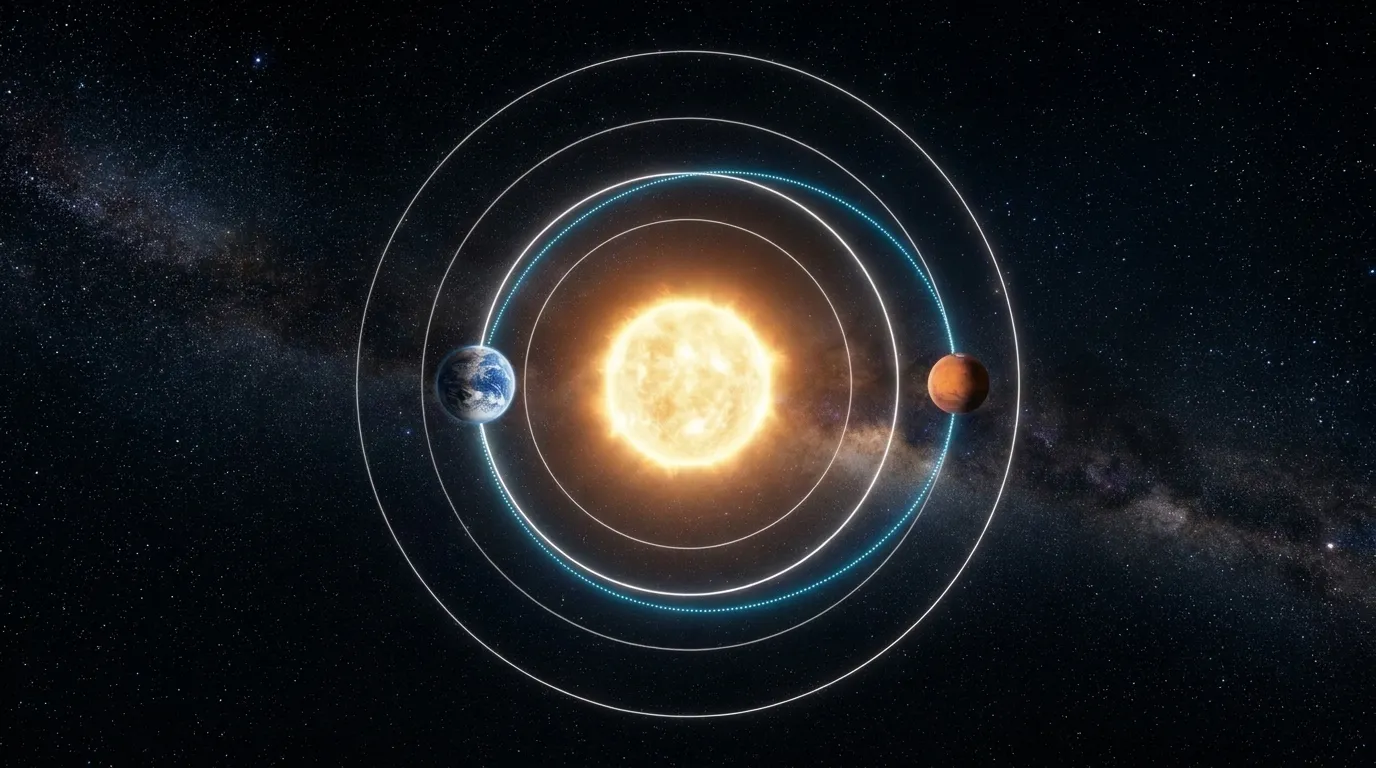
To cross the void between Earth and Mars as efficiently as possible, navigation engineers use a special elliptical trajectory called a Hohmann transfer orbit. Proposed in 1925 by German engineer Walter Hohmann, this route takes advantage of Earth's own orbital velocity around the Sun as an initial boost. The spacecraft does not travel in a straight line toward Mars, but rather performs an engine burn to widen its elliptical orbit around the Sun, so that the farthest point of this new ellipse coincides exactly with the Martian orbit. It is a game of billiards on a cosmic scale, where the objective is to launch the space projectile not to where Mars is at the moment of liftoff, but to the exact point where the Red Planet will be found about 259 days later.
This maneuver demands millimeter precision. To understand it with an everyday analogy, traveling to Mars is similar to trying to jump from a moving carousel (Earth) onto another concentric carousel that rotates slower and at a greater distance (Mars). If you jump at the wrong time, you will fall into the void and never reach your destination. Orbital physics shows us that the Hohmann transfer is the route that consumes the lowest amount of energy and fuel possible, but in return it imposes a fixed trajectory and an unalterable travel time of almost nine months. Modifying this route to shorten the trip would require such a massive amount of fuel that the ship would be too heavy to lift off from Earth.
The synodic period and the inexorable 26-month appointment
Because Earth orbits the Sun faster than Mars —taking 365 days compared to the Red Planet's 687 days—, the distance and relative position between both worlds varies constantly. In order to enter the Hohmann transfer orbit, the planets must be in a very specific geometric configuration: Earth must be approximately 44 degrees behind Mars on its path around the Sun. This perfect alignment occurs at regular intervals determined by the synodic period of both celestial bodies, which in the case of Earth and Mars is approximately 780 days, that is, about 26 months.
Curiously, this geometric restriction is absolute. If a space agency or a private company fails to have its spacecraft, its life support systems, or its liftoff licenses ready in time for the opening of this window, the mission is not delayed by a few days or weeks: it is canceled entirely and must be rescheduled for the next window, more than two years later. Missing a launch window to Mars is equivalent to missing the only train passing through a remote station and knowing that the next one will not arrive for another two long years. This inexorable temporal appointment dictates the pace of Martian exploration and forces the planning of cargo logistics and crewed missions with exceptional anticipation and multigenerational patience.
The Delta-v abyss and the limits of fuel
In space, distance is not measured in kilometers, but in a physical magnitude known as Delta-v (the total change in velocity required to perform orbit change maneuvers). Escaping Earth's gravity and entering the Hohmann transfer orbit requires a Delta-v of several kilometers per second. Since every drop of fuel a ship carries adds mass that in turn requires more fuel to accelerate, engineers must design missions at the limit of thermodynamic efficiency. The laws of orbital physics remind us that, with current chemical propulsion technology, trying to travel outside the optimal launch window would require a Delta-v expenditure so high that the ship would have to consist of 99% fuel tanks, making any payload unfeasible.
The conquest of the Red Planet requires us to accept the rules of the game imposed on us by the Sun's gravity. We cannot impose our temporal will on the cosmos; we must adapt to its celestial rhythms and learn to read its silent gravitational highways if we want to become a truly interplanetary species. Patience and mathematical rigor are the true engines of tomorrow's exploration. Until our next cosmic lesson, fellow travelers.
Related
Related news and articles
- 📄 The Mars Farming Challenge: Why Space Agriculture Is More Complex Than Science Fiction 25 JUL 2026
- 📄 The Forgotten Sea: Did a Giant Ocean Really Exist in the North of Mars? 21 JUL 2026
- 📄 Is Starship Realistic? SpaceX's Plan to Colonize Mars Under Scientific Scrutiny 14 JUL 2026
- 📄 Is Terraforming Possible? Restoring Mars' Atmosphere and Liquid Water 11 JUL 2026
Marspedia terms
Enjoyed it? Keep exploring
Volver al Blog