
1. The Umbilical Cord of Time
For millennia, human beings did not need atomic clocks or pocket calendars to understand the passage of time; looking at the sky was enough. The ceaseless cycle of light and darkness bound our biology to the rotation of a small blue planet, synchronizing our circadian rhythm to an exact 24-hour waltz. Our bodies are so intrinsically programmed by this celestial clock that the entire structure of our modern civilization rests upon it. The working hours of massive stock exchanges, the times of planting and harvesting in agriculture, the fiscal years, and our most sacred holidays are nothing more than human projections of how the Earth dances around its star.
But what happens when humanity uproots itself and settles permanently on a world where the sun dictates different rules? Mars, the dusty next home of our species, does not respond to Earth's cadence. Trying to force our Gregorian calendar and our exact 24-hour clocks onto its reddish surface would be a guaranteed recipe for psychological, operational, and logistical chaos.
To detach from Earth means to cut the umbilical cord of time. This is precisely where the architecture of Horizonte Marciano comes into play, designing not merely a measurement algorithm, but the true temporal heartbeat upon which future human colonies will walk. When founding a new civilization, the first thing to be built is not the foundations of the habitats, but the gears of the clock that will govern them.
2. The Sol: Anatomy of a Martian Day
On Earth, a solar day is strictly defined as the time it takes the planet to complete one rotation on its own axis relative to the Sun's position. On Mars, this same gravitational ballet occurs, but in a slightly more lethargic manner, dictated by a smaller planet with different rotational inertia. A Martian solar day—officially termed in astrophysics as a "Sol"—lasts 24 hours, 39 minutes, and 35 seconds in standard Earth time.
At first glance, those 39 minutes of difference might seem like a mathematical triviality, a mere delay that barely alters an afternoon. However, on a biological and operational level, those minutes are a devastating trap. When the NASA space agency landed the iconic Pathfinder probe and its small Sojourner rover in 1997, mission control engineers on Earth made an unprecedented decision: they would live on "Mars time" to keep their shifts synchronized with the robot's daylight.
The human toll was brutal. Every Earth day, the team's shift started 39 minutes further into the future. After a couple of weeks, the control staff found themselves eating breakfast cereal at three in the morning and going to sleep when the sun was shining at its highest point in the California sky. Their biological rhythms collapsed, proving that the human body is not designed to ignore the light of day.
For the future inhabitants of Horizonte Marciano, this cycle will no longer be a temporary experiment spanning a few weeks, but their lifelong reality. Their bodies will have to adapt to a slightly more paused rhythm, slowing down their internal clock. Since we could not force Mars to spin faster to accommodate our habits, the developers of this calendar created the inverse system: the colony's technology and life-support systems would have to mold themselves to the miraculous persistence of those extra 39 minutes.
3. The Architecture of Time: The MTC and the Prime Meridian
To manage interconnected time on Earth, global networks, flights, and internet servers use UTC (Coordinated Universal Time), whose beating heart starts somewhat arbitrarily at the Greenwich Meridian in London. Mars lacks British empires, yet it requires a unified geographical point with the same urgency. The core of Horizonte Marciano employs MTC (Coordinated Mars Time) as its absolute standard.
The internal logic of this temporal system is beautifully parallel to Earth's in order to avoid alienating the colonists. The Martian clock still divides its day into 24 hours, and each of those hours is fractured into 60 minutes. The masterful difference lies in the expansion of time: every "Martian" second ticks fractionally slower (about 2.7% slower) than a conventional "Earth" second. This design choice guarantees that, at 12:00 noon on the base's computer clocks, the Sun is always cresting at its geographical zenith. But if on Earth our time emanates from London, where does the "Greenwich" of Mars hide?
The anchor point of this new time is embedded in the Airy-0 crater. It is a small, desolate depression barely half a kilometer in diameter, located within a larger crater in the vast equatorial region known as Sinus Meridiani. Just as Greenwich was chosen by human consensus during the 19th century, Airy-0 is the contemporary geodesic landmark that establishes the 0° longitude of Mars. From the silence of this crater, the MTC algorithm dictates the relentless rhythm of the hours, propagating its time zones toward the four cardinal points of the Red Planet.
4. An Elliptical Journey: The Martian Year and Asymmetrical Seasons
If the slowed rotation of Mars challenges our biological wristwatches, its massive orbit completely shatters our conception of wall calendars. Orbiting further from the Sun comes at a price: Mars takes approximately 687 Earth days to complete a full journey around our star. Translated into the local currency of time, this equates to a grueling 668 Martian Sols forming a regular year.
But the Red Planet hides another secret in its celestial mechanics, one far more dangerous than the simple length of its year. The orbit of our planet Earth is almost a perfect circle, which causes our four seasons to have highly similar durations, evenly distributed. Mars, on the other hand, was nudged eons ago into a highly elliptical orbit. When, in its cosmic journey, it reaches its closest point to the Sun (perihelion), it travels at an exponentially greater speed than when it drifts through the loneliness of its furthest point (aphelion).
As a direct result of this orbital geometry, Martian seasons are brutally asymmetrical and chaotic. Spring in the vast Martian northern hemisphere drags on for more than 193 endless Sols, while its autumn passes like a fleeting sigh, barely surpassing 142 Sols. To manage precarious greenhouse agriculture and forecast extreme weather periods, the engineers of Horizonte Marciano refuse to rely blindly on months for these purposes. Instead, they use an astronomical metric known as Ls (Solar Longitude).
Unlike a month, which is ultimately a mathematical construct to organize weeks, Ls measures the actual position of Mars on its orbital arc, from 0° to 360°, with the northern spring equinox at exactly Ls 0°. This is the true and most vital metric of survival on Mars; the one that warns colonists when the ice will begin to sublimate, and when the planet is about to unleash the monstrous global dust storms that can shroud the entire world in darkness for weeks.
5. The Equation of Time and the Martian Analemma
Imagine a patient colonist driving a vertical metal rod into the very equator of Mars and scrupulously marking the position of the cast shadow with a stone every single Martian day at exactly noon (at 12:00 MTC on the clock). They would discover a captivating astrophysical phenomenon.
On Earth, if we were to repeat this experiment over the course of a year, the shadow would draw a stylized "figure-8" shape, which astronomers call an analemma. On Mars, due to the fierce eccentricity of its orbit described in the previous chapter (whose influence wildly overpowers its modest 25.2° axial tilt), the shape the Sun draws in the Martian sky is radically different: a gigantic, asymmetrical cosmic teardrop.
The operational implications of this teardrop are enormous. It means that "solar noon" (the physical instant when the Sun crosses its highest point) almost never coincides with "clock noon" (the 12:00 MTC displayed on screens). This disparity, which is sometimes negligible and sometimes massive, is known in navigation circles as the Equation of Time.
During certain dizzying periods of the Martian year, as the planet accelerates near perihelion, the true sun can drastically run ahead of or fall behind the astronaut's wristwatch. The calculation routines pulsing at the algorithmic core of Horizonte Marciano have been programmed to model this dance of shadows with mathematical precision, adjusting the predictions for sunrises and sunsets. Thanks to this constant adjustment, it ensures that rover expeditions, communication antenna algorithms, and the solar panels of vital life-support bases operate with pinpoint efficiency, no matter the whims of the analemma.
6. The Horizon Solution: The Birth of a Calendar and Month Distribution
If we attempted to maintain the classic 12-month Earth system on a planet that requires 668 Sols to complete its orbital cycle, the result would be psychologically unviable. We would end up dealing with endless months of 55 or 56 days. Such a vast month would destroy the human metric of productivity; it would alter the perception of payroll, delivery deadlines, greenhouse harvest cycles, and the simple, comforting sensation of forward temporal progression to which our species has clung for millennia. To build a prosperous society on Mars, the passage of time had to be redesigned.
Dividing 668 Sols in a balanced manner required abandoning our terrestrial attachment to the dozen and seeking, mathematically, the greatest possible symmetry against an eccentric world. The solution proposed by the Horizonte Marciano framework was as disruptive as it was brilliant in its simplicity: if the year is nearly twice as long as Earth's, we do not need longer months, but more of them. Specifically, eighteen months.
By dividing 668 Sols by 18, the resulting mathematical average is 37.11 Sols per month. And it is exactly within that fraction that the magic number emerged, the cornerstone that would support the foundations of interplanetary civilization: the number 37. The number 37 is not an arbitrary figure pulled from a mathematical hat. Under the Horizonte architecture, the Martian year is structured upon a solid foundation where the vast majority of months have exactly 37 Sols. On a psychological level, a 37-day month is easily assimilable by the human mind. It allows industrial, agricultural, and economic management cycles to be organized swiftly, almost identical to how we operate on Earth.
However, programming a calendar demands relentless accuracy. If the 18 months had exactly 37 Sols, the year would end with 666 Sols. Because the standard Martian year consists of 668 Sols, two Sols were left orphaned, floating in the void. To seal the calendar's equilibrium, the Horizonte Marciano algorithm distributes the length of the months through an unbreakable rule:
- Sixteen months of the year always retain their standard base of 37 Sols.
- To compensate for the mathematical deficit and reach the 668 Sols of a normal year, the algorithm permanently adds one fixed Sol to the fifth month (Galle) and the fourteenth month (Ravi). Therefore, these two key months always, without exception, have 38 Sols.
Even leap-year adjustments—those extra Sols that prevent long-term calendar drift—are programmed to be inserted surgically and predictably into specific months. For instance, in odd-numbered years (which add one extra Sol), it is the tenth month (Mariner) that absorbs the additional day, bumping it from 37 to 38 Sols. Similarly, in the exceptional years that are multiples of 11, it is the first month of the year (Acidalia) that assumes that extra adjustment Sol. With this elegant and unwavering mathematical distribution embedded in the code, the design team solved the intricate logistical problem of organizing the future of life on Mars.
7. The Dance of Synchrony: The Interplanetary Bridge
With a standard month of 37 Sols firmly established, the calendar seemed to have resolved the habitability dilemma. However, while calibrating computer systems to synchronize Coordinated Mars Time (MTC) with Earth's Coordinated Universal Time (UTC), telemetry engineers discovered a fascinating byproduct of our calendrical choice: an astronomical bridge that intimately linked both worlds.
Because a Martian Sol is approximately 39 minutes longer than an Earth day, the clocks of both planets live in a state of constant divergence. If at 08:00 AM on a Monday the clocks align on both planets, by Wednesday the drift will exceed an hour and a quarter. Inevitably, when it is daylight on one planet, it will be nighttime on the other. But this drift is cyclical. Eventually, the faster-spinning hands of the Earth clock make so many extra revolutions that they "catch up" to the Martian clock.
This phenomenon is known on the platform as the Time Coincidence Period. Celestial mechanics dictates that the clocks of both planets synchronize exactly every 36.37 Martian Sols (which equates to about 37.37 Earth days). This is the hidden magic within the Horizonte Marciano algorithm: because all regular months have 37 Sols (and a couple boast 38), and the coincidence cycle occurs every 36.37 Sols, it is mathematically guaranteed that every single Martian month will always feature a "Coincidence Day."
This Coincidence Day is crucial. It is the exact moment in the month when Earth administrations and Martian colonies can synchronize critical operations, bureaucracy, and budgets without wrestling with time-conversion nightmares. Furthermore, because the cycle (36.37) is slightly shorter than a standard month (37.0), the Coincidence Day slowly creeps forward on the calendar. Occasionally, this triggers The Double Coincidence: a month kicks off with its Coincidence Day falling on Sol 1 and, therefore, experiences a second Coincidence Day just before the month concludes, embracing both worlds twice on a single calendar page.
8. Mathematics for Millennia: Leap Years
Just as Earth takes 365.24 days to orbit the Sun, forcing us to use leap years every four years, the true Martian year is not a perfect whole number either: it lasts exactly 668.59 Sols. If Horizonte Marciano utilized strict, absolute years of 668 Sols, that remainder of ~0.59 Sols per year would accrue a lethal drift. In a short amount of time, the calendar would fall completely out of sync with the seasons, and the terrifying winter dust storms would end up listed on the calendar as "summer."
To tame that fractional remainder and anchor time to the planet's actual climatology, the calendar's logical core implements a leap-year system of astonishing precision. According to this algorithm, the Martian year oscillates between 668, 669, and occasionally 670 Sols, governed by three unbreakable rules:
- The Odd Year Rule: If the Martian year is an odd number, 1 leap Sol is automatically added (assigned to the month of Mariner). This absorbs a large chunk of the drift (the 0.50), almost systematically intercalating a 668-Sol year with a 669-Sol year.
- The Decade Rule (+1): If the year is exactly divisible by 11, 1 additional Sol is added (assigned to the month of Acidalia). This manages the tiny remaining residue of ~0.09 Sols. And here, something extraordinary occurs: if a year is a multiple of 11 and, at the same time, odd (like year 33 or 55), both rules apply simultaneously, creating a Super Leap Year of 670 Sols.
- The Millennium Rule: To perfect the orbit not just on a decadal scale, but on the scale of human history, the system dictates that if the year is divisible by 800, it will also add 1 extra Sol.
Driven by this calculation engine, the calendar is not just a tally of days; it becomes a perpetual mechanism of cosmic clockwork, designed to operate with Swiss precision for the next several millennia without requiring human intervention.
9. The Homage in Nomenclature: Geography and History
A calendar is much more than an algorithm; it is the cultural canvas upon which a civilization paints its identity. On Earth, our months pay an antiquated tribute to Roman deities and dead caesars. In Horizonte Marciano, the 18 months of the calendar were forged to honor the planet's imposing geographical landmarks and the robotic and historical pioneers who made its colonization possible. And they do so under a masterful linguistic design: they are arranged strictly in alphabetical order, and in the Spanish-speaking version of the database, they all end phonetically in a masculine 'o' to unify their cadence, while in English they retain their original Latin roots.
The first geographical block kicks off with the imposing region of Acidalia (Month 1, for Acidalia Planitia), jumping immediately to our robotic legacy with Curiosity (Month 2, honoring the mythical rover). The sky demands its place of honor with Deimos (Month 3, the smaller of Mars's moons), before we return to the violent volcanic past with Elysium (Month 4). The fifth month, boasting a fixed 38 Sols, is Galle (for astronomer Johann Galle and the crater of the same name), followed by the vast highlands of Hesperia (Month 6, Hesperia Planum).
The core of the year continues to honor the terrain with Isidis (Month 7, the impact basin Isidis Planitia) and the monumental icy crater of Korolev (Month 8). They are followed by Lunae (Month 9, Lunae Planum) and the gigantic, legendary tribute that is Mariner (Month 10, for the Mariner probes and the scar of Valles Marineris). Then, Nili (Month 11, Nili Fossae) gives way once again to the robotic epic with Opportunity (Month 12, the indefatigable rover).
The orbit reclaims the spotlight with Phobos (Month 13, the inner moon), followed immediately by the second 38-Sol month: Ravi (Month 14, for the outflow channels of Ravi Vallis). Historical honors return with Schiaparelli (Month 15, a tribute to Giovanni Schiaparelli, the astronomer whose supposed canals inspired humanity) and the monumental Tharsis (Month 16, the colossal volcanic plateau). Finally, the Martian year bids farewell with two absolute titans: the boundless plains of Utopia (Month 17) and the legendary Viking (Month 18, the ultimate tribute to the Viking missions that inaugurated our survival upon the red dust).
Epilogue
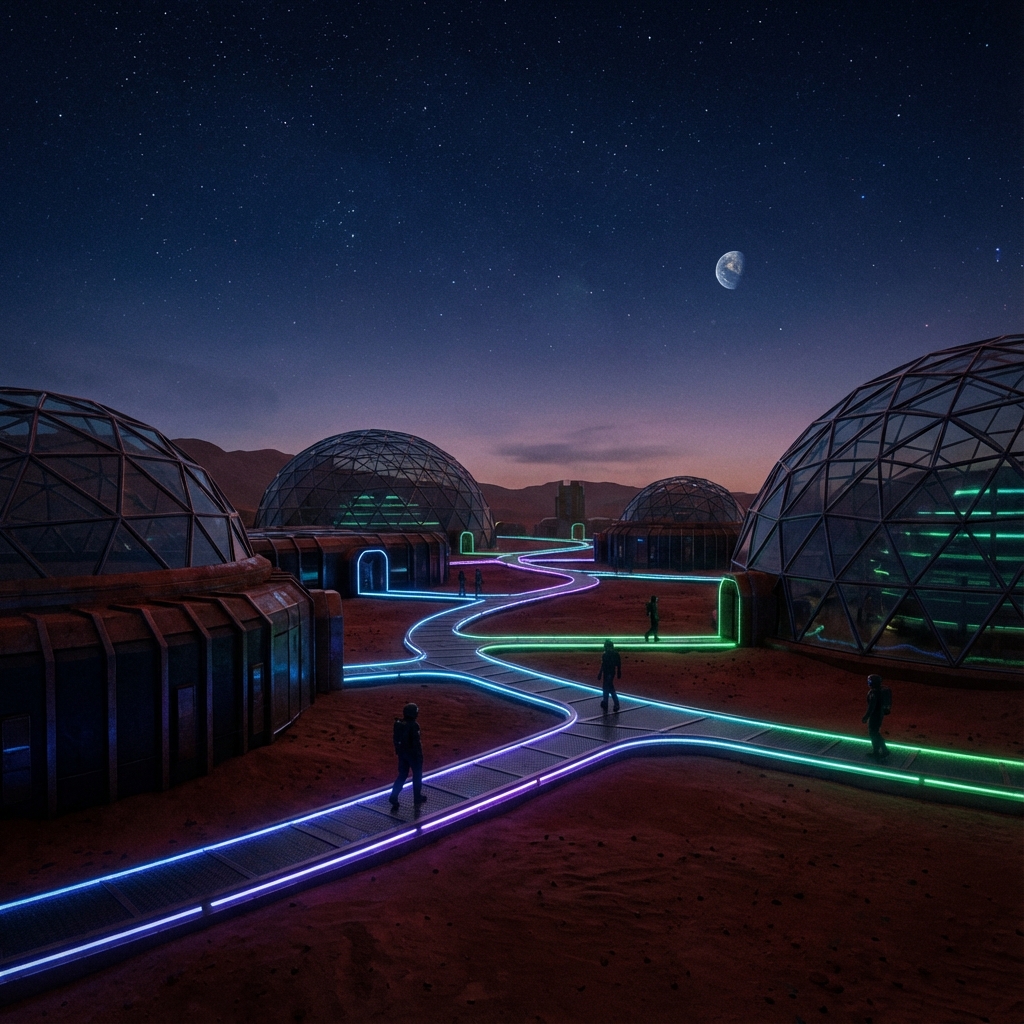
There will come a day, in the not-too-distant future, when a child is born beneath a massive glass dome, surrounded by a desert of red dunes under a sky of copper and salmon hues. When that child attends school and asks about their age, they will never think of 365-day cycles or the distant orbit of a blue planet that is barely a bright speck in their night sky. Their concept of time, the anticipation of their birthdays, the arrival of storm seasons, and the organization of their family's work months will be governed by the intricate, invisible machinery we have broken down here.
The algorithmic calendar of Horizonte Marciano is not simply a feat of programming prowess or a cold mathematical equation designed to square orbital anomalies. It is the fundamental infrastructure upon which Martian culture will rest. By designing the rigorous MTC time zones, structuring 18 mathematically balanced months, and meticulously synchronizing the astronomical dance of leap years and interplanetary coincidences, we have built something far more enduring than the titanium beams of the habitats: we have built time itself.
Measuring and mastering time is the ultimate act of a civilization claiming its place in the universe. By winding this cosmic clock, humanity is officially declaring that it is no longer a prisoner of a single world.
Related
Missions
- 🛰️ Sojourner
- 🛰️ Curiosity
- 🛰️ Opportunity
Related news and articles
- 📄 The Mars Farming Challenge: Why Space Agriculture Is More Complex Than Science Fiction 25 JUL 2026
- 📄 The Forgotten Sea: Did a Giant Ocean Really Exist in the North of Mars? 21 JUL 2026
- 📄 The Mars Launch Window: Why We Can't Travel to the Red Planet Whenever We Want 18 JUL 2026
- 📄 Is Starship Realistic? SpaceX's Plan to Colonize Mars Under Scientific Scrutiny 14 JUL 2026
Marspedia terms
Enjoyed it? Keep exploring
Volver al Blog