ExoMars Trace Gas Orbiter (TGO)
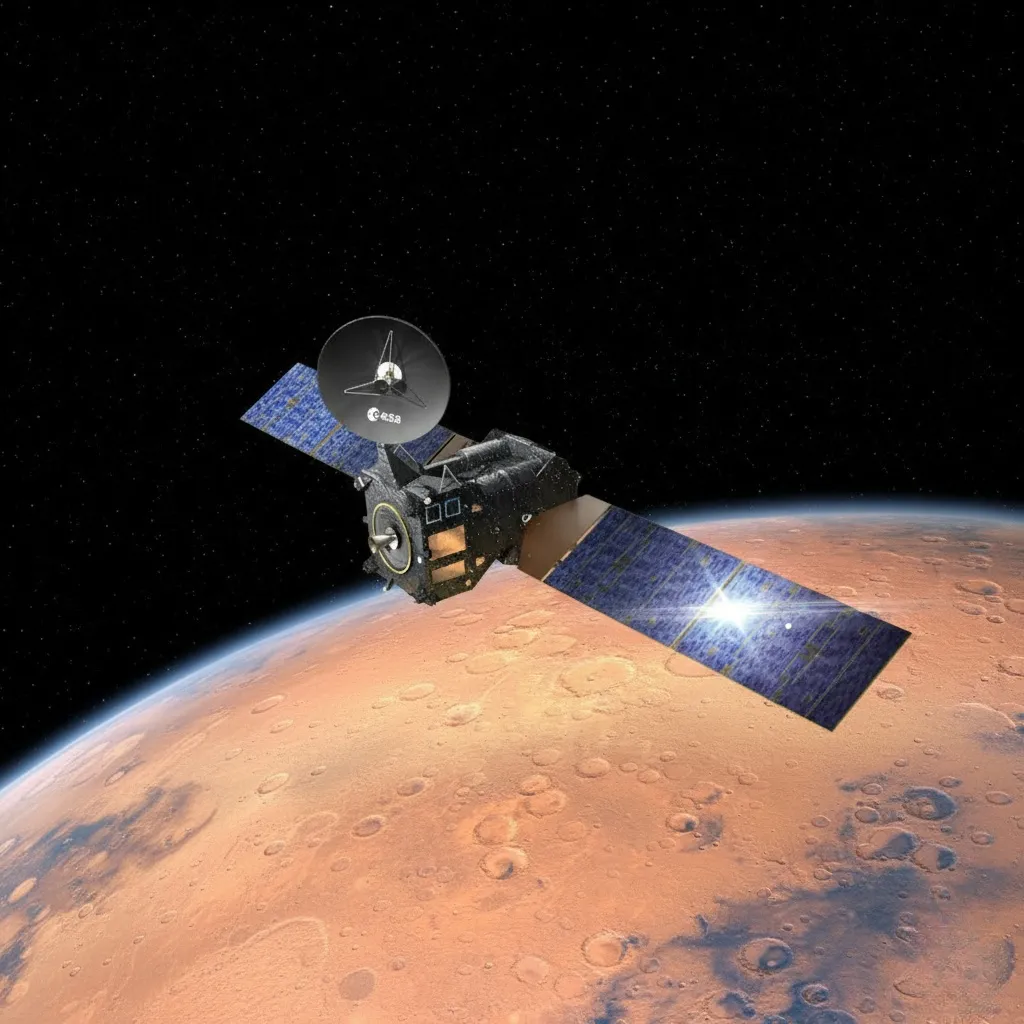
The ExoMars TGO mission (2016) is an ESA/Roscosmos orbiter focused on detecting trace gases. Following successful aerobraking in 2018, it operates in a circular science orbit. It has detected subsurface water and serves as the primary communication relay for all active rovers on Mars.
Agency

Country

Type
Orbiter
Status
Launch
March 14, 2016
Technical Analysis of the ExoMars Trace Gas Orbiter (TGO) Mission
- Mission Designation: ExoMars 2016 Trace Gas Orbiter
- Operating Agencies: European Space Agency (ESA) and Roscosmos
- Launch Date: March 14, 2016, 09:31 UTC
- Launch Vehicle: Proton-M / Briz-M
- Launch Site: Baikonur Cosmodrome, Site 200/39, Kazakhstan
- Current Status: Operational in scientific Martian orbit
1. Mission Objectives
The TGO mission is the first phase of the ExoMars program, designed to investigate trace gases in the Martian atmosphere that may indicate active biological or geological processes.
Scientific Objectives:
- Perform a detailed inventory of trace gases (methane, water vapor, nitrogen, etc.) with higher sensitivity than previous missions.
- Map the distribution of hydrogen in the shallow subsurface (up to 1 meter) to locate water ice deposits.
- Characterize spatial and temporal variations of atmospheric thermal structure and dust.
- Identify potential surface sources of trace gases using high-resolution imagery.
Engineering Objectives:
- Deliver and release the entry, descent, and landing demonstrator module (Schiaparelli).
- Validate aerobraking maneuvers to transition into the final circular science orbit.
- Provide data relay infrastructure for surface assets (rovers and landers).
2. Spacecraft Specifications (TGO Bus)
The orbiter features a cubic central structure optimized for the stability of remote sensing instruments.
- Total Launch Mass: 4,332 kg (including propellant and the 577 kg Schiaparelli module).
- Dimensions: Central bus of 3.2 m x 2 m x 2 m; solar arrays with a 17.5 m span.
- Propulsion: Bi-propellant system with a 424 N main engine for orbital insertion and critical maneuvers.
- Power: Two solar arrays (20 m²) generating approximately 2,000 W at Mars, backed by two lithium-ion battery modules (5,100 Wh).
- Communications: 2.2 m X-band High Gain Antenna (HGA); NASA Electra UHF-band transceivers for proximity link with rovers.
3. Scientific Instrumentation
The 113.8 kg scientific payload consists of four primary instrument suites:
- NOMAD (Nadir and Occultation for MArs Discovery): Three spectrometers (two IR and one UV) for atmospheric composition analysis via solar occultation and nadir.
- ACS (Atmospheric Chemistry Suite): Three infrared spectrometers designed to map gases, dust, and clouds, extending NOMAD's spectral range.
- CaSSIS (Colour and Stereo Surface Imaging System): High-resolution camera (4.6 m/pixel) with stereo capability for digital elevation modeling.
- FREND (Fine Resolution Epithermal Neutron Detector): Epicedmi neutron detector to map hydrogen in the Martian soil with high spatial resolution.
4. Launch Vehicle and Trajectory
The launch was executed using the Proton-M system with a Briz-M upper stage.
- Ascent Sequence: Three Proton-M stages placed the payload into a parking orbit.
- Trans-Mars Injection: The Briz-M stage performed four scheduled burns to reach the required escape velocity toward Mars.
- Aerobraking: A critical year-long phase (2017-2018) where TGO skimmed the upper atmosphere to lower its apoapsis without additional fuel consumption.
5. Outcome Analysis and Technical Conclusion
TGO is considered an absolute technical success for ESA and Roscosmos. It achieved orbital insertion on October 19, 2016, and completed aerobraking with nominal precision. It currently serves as the primary communications satellite at Mars, relaying over 60% of data from NASA and ESA rovers. Scientifically, it has provided strict methane limits, detected water in Valles Marineris, and observed hydrogen chloride for the first time on Mars.
Mission Milestones
Launch
Sol 3 of Korolo, Year 33
219 days
of travel
Arrival at Mars
Sol 30 of Phobo, Year 33
Operations Start
Sol 30 of Phobo, Year 33
3373 sols
of operations so far