Mars Reconnaissance Orbiter (MRO)
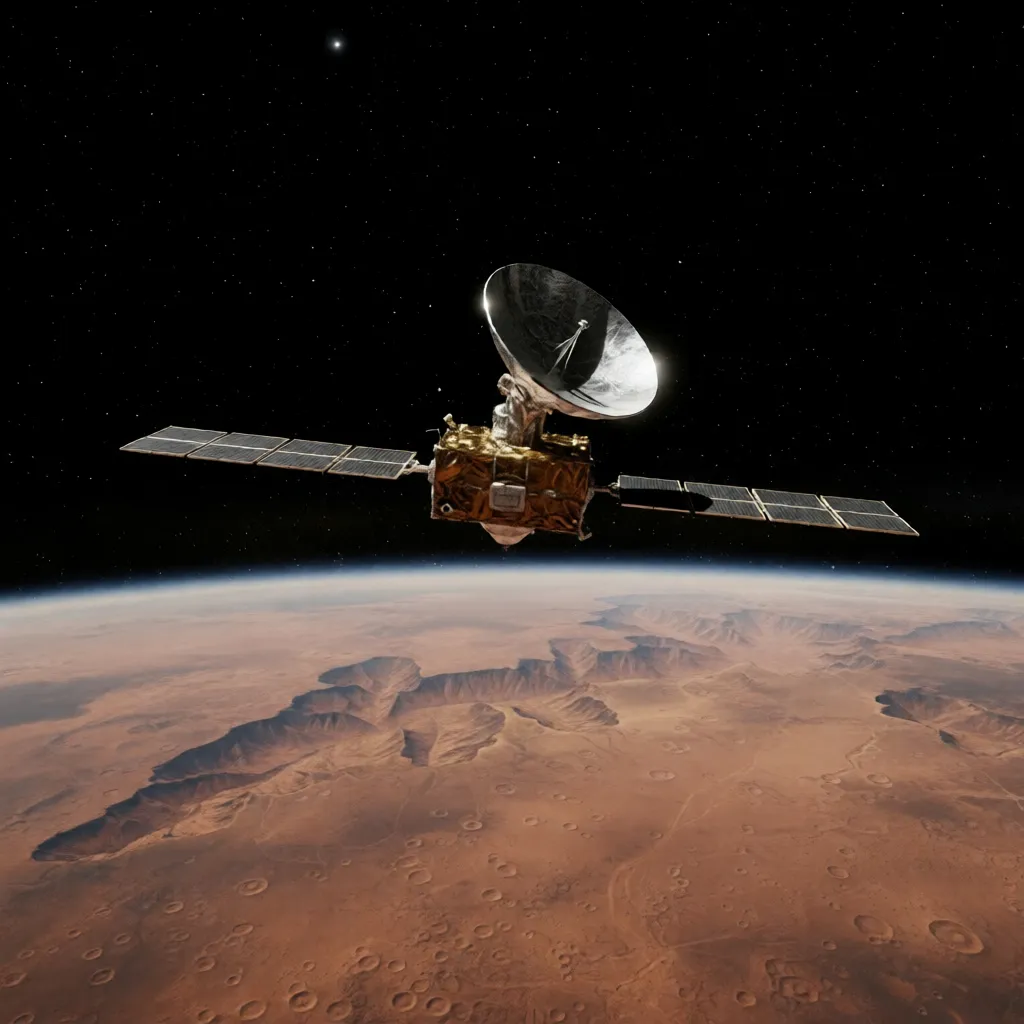
NASA's MRO mission, launched in 2005, has successfully operated for over 15 years. Using instruments like HiRISE and SHARAD, it has discovered vast subsurface ice deposits at mid-latitudes and serves as the primary communications relay for surface rovers.
Agency

Country

Type
Orbiter
Status
Launch
August 12, 2005
Technical Analysis of the Mars Reconnaissance Orbiter (MRO) Mission
- Mission Designation: Mars Reconnaissance Orbiter (MRO)
- Operating Agency: NASA / Jet Propulsion Laboratory (JPL)
- Launch Date: August 12, 2005
- Mars Arrival Date: March 10, 2006
- Launch Vehicle: Atlas V-401 (AV-007)
- Mission Status: Active (Extended Operations Phase)
- Launch Site: Cape Canaveral Space Force Station, SLC-41
1. Mission Objectives
The MRO mission serves as an advanced reconnaissance platform for NASA's Mars Exploration Program, acting as both a primary surveyor and a high-capacity communication relay.
Scientific Objectives:
- Detailed mineralogical mapping to identify surface and subsurface deposits linked to water.
- Characterization of atmospheric thermal structure and the distribution of dust and water vapor.
- Investigation of geological stratigraphy to reconstruct Martian climate history.
Engineering Objectives:
- Identification and certification of safe landing sites for future landers and rovers using ultra-high-resolution imagery.
- Provision of the high-speed data relay services required by surface assets like Curiosity and Perseverance.
2. Spacecraft Specifications
The spacecraft architecture was engineered to support a massive scientific payload and sustained high-bandwidth transmissions.
- Total Mass: 2,180 kg at launch (including 1,149 kg of propellant).
- Power: Two solar arrays measuring 9.5 square meters each, generating up to 2,000 W of power.
- Communications: A 3-meter diameter High Gain Antenna (HGA) utilizing X-band and Ka-band frequencies to achieve up to 6 Mbps data rates.
- Propulsion: Hydrazine monopropellant system with 20 thrusters, including 6 main 170 N engines used for Mars Orbit Insertion.
3. Scientific Instrumentation
MRO carries the most sophisticated suite of remote sensing instruments ever sent to another planet:
- HiRISE (High Resolution Imaging Science Experiment): Telescopic camera achieving surface resolutions as fine as 30 cm per pixel.
- SHARAD (Shallow Radar): Sounding radar capable of detecting water ice and subsurface geological features up to 1 km deep.
- CRISM (Compact Reconnaissance Imaging Spectrometer): Visible/IR spectrometer for identifying hydrated minerals such as clays and carbonates.
- MCS (Mars Climate Sounder): Atmospheric sounder measuring vertical profiles of temperature and pressure.
- MARCI (Mars Color Imager): Wide-angle camera providing daily global weather maps and dust storm tracking.
- CTX (Context Camera): Grayscale imagery at 6 m resolution to provide wide-area context for HiRISE observations.
4. Results and Technical Conclusion
Since its orbital insertion on March 10, 2006, MRO has returned over 450 terabits of scientific data, far exceeding the combined output of all previous interplanetary missions. It has successfully mapped vast mid-latitude ice deposits and provided direct evidence of active surface processes. Technically, its exceptional longevity—now spanning nearly 20 years—highlights the robustness of its engineering design and its role as a critical pillar of NASA's interplanetary communications infrastructure.
Mission Milestones
Launch
Sol 28 of Ravo, Year 27
210 days
of travel
Arrival at Mars
Sol 10 of Curioso, Year 28
Operations Start
Sol 10 of Curioso, Year 28
7145 sols
of operations so far