Mars 4
Launched by the USSR in 1973 aiming to orbit Mars. Due to an onboard computer failure (chip degradation), the retrorockets failed to fire for orbital insertion. The spacecraft performed an unplanned flyby on February 10, 1974, at 1,844 km, returning images and detecting the night-side ionosphere of the planet for the first time.
Agency

Country

Type
Orbiter
Status
Launch
July 21, 1973
Technical Analysis of the Mars 4 Mission
- Mission Designation: Mars 4
- Internal Designation (USSR): 3MS No.52S
- Operating Agency: Ministry of General Machine Building (MOM) / NPO Lavochkin
- Launch Date: July 21, 1973, 19:30:59 UTC
- Launch Vehicle: Proton-K / Blok D (8K82K)
- Launch Site: Baikonur Cosmodrome, Site 81/23
- Status: Orbital Insertion Failure / Successful Flyby (Partial)
1. Mission Objectives
The Mars 4 mission was designed as the lead element of an ambitious Soviet armada of four spacecraft (Mars 4, 5, 6, and 7) launched during the 1973 window. Its specific objectives were:
Engineering and Operations:
- Insert into an areocentric orbit (around Mars) to serve as a data relay satellite for the Mars 6 and Mars 7 landers.
- Validate the M-73 (3MS) spacecraft platform.
- Test autonomous navigation systems for planetary approach.
Scientific:
- Perform photographic mapping of the Martian surface.
- Analyze the composition and structure of the Martian atmosphere.
- Study the planet's magnetic field and plasma environment.
- Measure surface temperature and soil properties via radiometry.
2. Spacecraft Specifications (3MS Platform)
The spacecraft utilized the unified M-73 platform, developed by NPO Lavochkin following the transfer of the planetary program from Korolev's OKB-1.
- Launch Mass: 3,440 kg (fueled).
- Dry Mass (in orbit): ~2,270 kg.
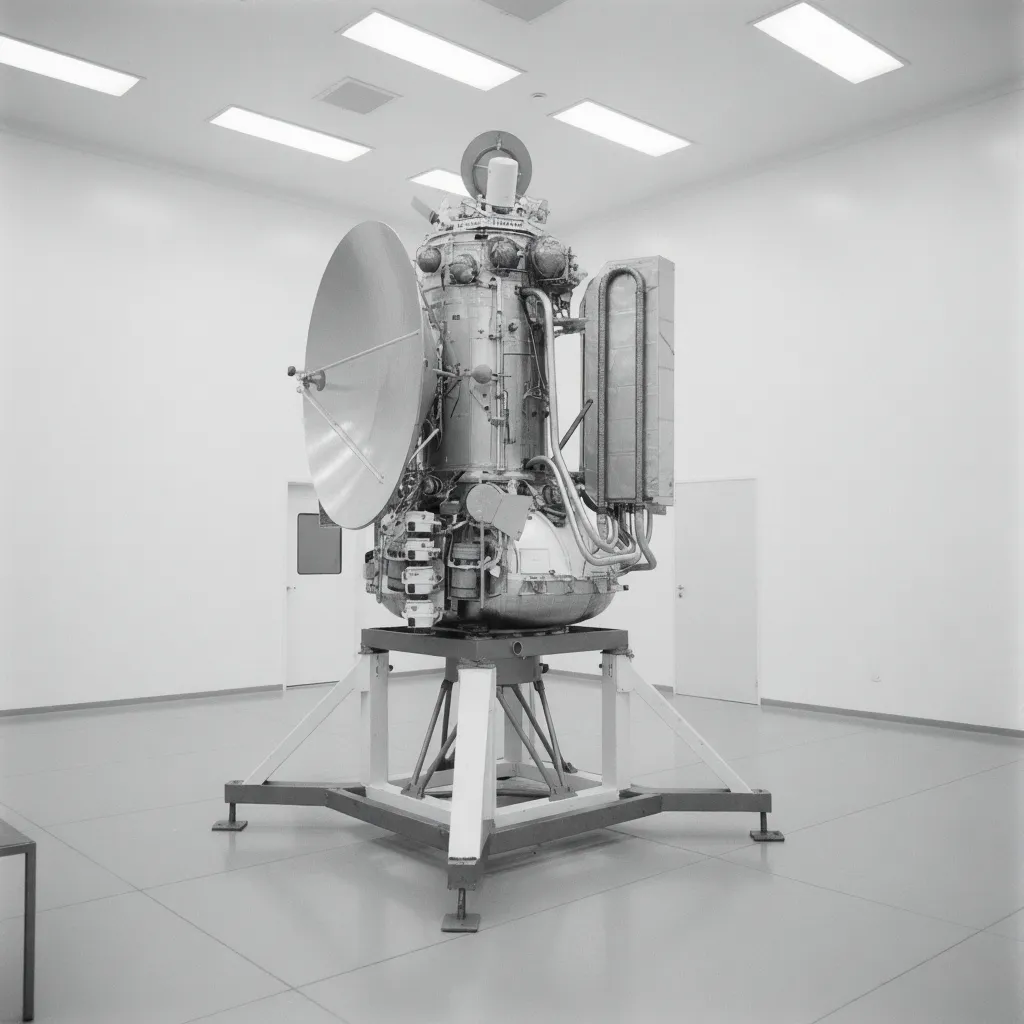
- Architecture: A cylindrical main structure housing propulsion tanks, with a pressurized toroidal compartment at the base for avionics.
- Power: Two solar panels mounted on opposite sides of the cylinder, with a backup battery system.
- Propulsion: KTDU-425A main engine for trajectory corrections and orbital braking, fueled by UDMH and Nitrogen Tetroxide.
- Communications: A high-gain steerable parabolic antenna and several omnidirectional low-gain antennas.
3. Scientific Instrumentation
The scientific payload was designed for a comprehensive orbital survey:
- Imaging System (Vega): Two television cameras (wide-angle and telephoto, 52mm and 350mm respectively) with color filters.
- Infrared Radiometer: For surface thermal measurements (8-40 microns).
- Photometers: Multiple units to measure light scattering in the atmosphere and detect water vapor (1.38-micron band).
- Gamma-Ray Spectrometer: To determine surface elemental composition.
- Magnetometer: To study the planetary and interplanetary magnetic fields.
- Plasma Traps and Electrostatic Analyzer: To study the solar wind and ionosphere.
- Radio Occultation: Dual-band RF experiment to profile atmospheric density.
4. Insertion Failure Analysis and Outcome
The mission proceeded nominally during the interplanetary cruise phase, performing trajectory corrections. However, the mission's fate was sealed prior to arrival.
- Root Cause (Hardware Failure): During the voyage to Mars, a critical degradation occurred in the onboard computer. Later investigations revealed that the transistors (type 2T312) used in the M-73 series electronics had a manufacturing defect: the use of aluminum instead of gold in the contacts caused oxidation and circuit failure.
- The Event (February 10, 1974): Upon reaching the vicinity of Mars, the computer failed to initiate the retrorocket firing sequence. As a result, the main engine never ignited to brake the spacecraft.
- Flyby: Instead of entering orbit, Mars 4 flew past the planet at a minimum distance of 1,844 km from the Martian surface at 15:34 UTC.
- Data Recovery: Despite the failure, controllers activated the instruments in flyby mode. The spacecraft took 12 high-quality images (a swath of photographs) and made the first confirmed detection of the ionosphere on the night side of Mars.
5. Technical Conclusion
Mars 4 failed in its primary objective to become an orbiter and communications relay, which severely compromised the subsequent Mars 6 and 7 lander missions that relied on it for data relay. Technically, the mission demonstrated the platform's capability for precision navigation (passing extremely close to the planet) but underscored the quality control crisis in the Soviet electronics industry of the era. The data obtained during the fleeting flyby provided valuable atmospheric information, classifying the mission as a partial scientific success.
Mission Milestones
Launch
Sol 36 of Phobo, Year 10
203 days
of travel
Arrival at Mars
Sol 11 of Acidalo, Year 11