
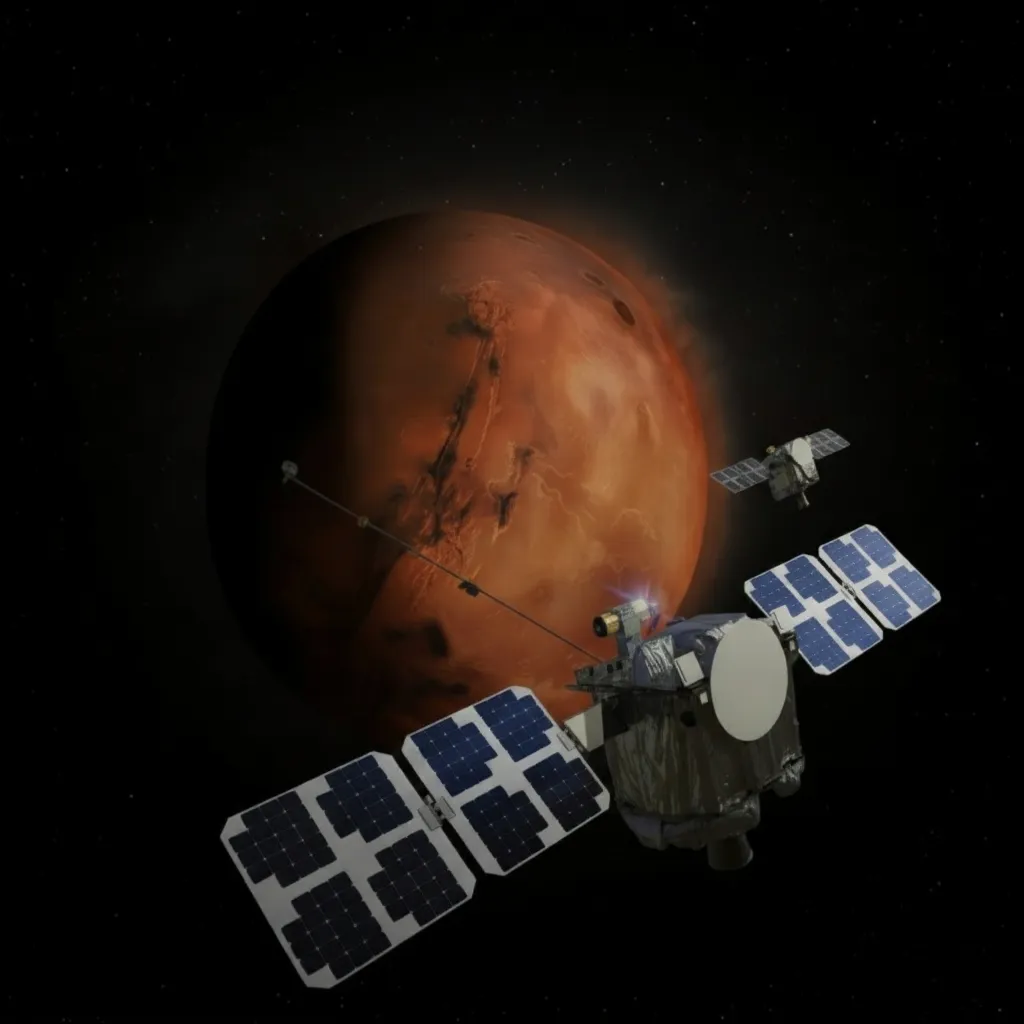
ESCAPADE
Successfully launched on November 13, 2025, aboard the New Glenn rocket, NASA's ESCAPADE mission (SIMPLEx program) deploys twin orbiters, Blue and Gold, toward Mars. Currently en route to point L2 for a gravity assist maneuver, the mission aims to reach Mars in 2027. They will use their coordinated sensors to study the magnetosphere in stereo and determine how the solar wind stripped the planet of its atmosphere and water.
Agency

Country

Type
Orbiter
Status
Launch
November 13, 2025
Technical Analysis of the ESCAPADE Mission (Escape and Plasma Acceleration and Dynamics Explorers)
- Mission Designation: ESCAPADE ("Blue" and "Gold" Probes)
- Operating Agency: NASA (SIMPLEx Program) / UC Berkeley (SSL)
- Spacecraft Manufacturer: Rocket Lab
- Launch Date: November 13, 2025
- Launch Vehicle: New Glenn (Blue Origin)
- Launch Site: Cape Canaveral Space Force Station, Florida
- Current Status: In transit to Lagrange Point L2 (Loiter Phase)
1. Mission Objectives
The fundamental goal of ESCAPADE is to decipher the physical processes that led to the loss of Mars' primitive atmosphere. The mission seeks to answer this enigma through:
- Simultaneous Measurement (Stereoscopy): Obtaining the first multi-point measurements of Mars' hybrid magnetosphere to distinguish between temporal variability (changes in solar wind) and spatial variability.
- Solar Wind Interaction: Studying how the flow of charged particles from the Sun interacts with crustal magnetic fields and the planet's induced field.
- Atmospheric Escape Quantification: Measuring current rates of ion erosion and sputtering fragmentation.
- Space Weather: Improving the prediction of solar storms at Mars to protect future crewed missions.
2. Spacecraft Specifications (Blue and Gold)
The mission architecture is based on the redundancy and coordination of two identical spacecraft:
- Platform: Based on Rocket Lab's Photon satellite bus, adapted for deep space.
- Configuration: Two twin orbiters ("Blue" and "Gold") operating as a mutual "insurance policy"; if one fails, the other can fulfill the primary scientific objectives.
- Program: SIMPLEx (Small Innovative Missions for Planetary Exploration), focused on high scientific return with low cost (< 80 million USD) and higher risk tolerance.
- Orbital Dynamics: Ability to alter their relative orbits for "string of pearls" campaigns (close following) and "complementary orbits" (separation for cause-effect correlation).
3. Scientific Instrumentation
Each spacecraft houses an identical suite of instruments developed to characterize plasma and fields:
- EMAG (Magnetometer): Maps the magnetic field structure and the hybrid magnetosphere.
- EESA (Electrostatic Analyzer): Measures the energy and direction of ions and electrons, from both the incoming solar wind and the escaping atmosphere.
- ELP (Langmuir Probe): Determines the density and temperature of cold plasma in the Martian ionosphere.
- VISIONS (Visible/Infrared Observation System): Optical cameras to detect Martian auroras and monitor the spacecraft's thermal state.
4. Flight Profile and Ballistic Trajectory
ESCAPADE utilizes innovative orbital mechanics to overcome mass and fuel limitations:
- Launch: Successful on November 13, 2025 (following a 24-hour delay due to a G4 geomagnetic storm).
- Transfer Phase to L2: The spacecraft are currently heading to the Sun-Earth Lagrange Point 2.
- Loiter Maneuver: They will remain in a "kidney bean-shaped" orbit at L2 for approximately 12 months until November 2026.
- Trans-Mars Injection: They will return to Earth for a gravity assist maneuver (slingshot) that will propel them toward Mars.
- Mars Orbital Insertion: Scheduled for September 2027.
5. Technical Conclusion
The ESCAPADE mission represents a paradigm shift in interplanetary exploration. By decoupling from rigid launch windows through the use of the L2 point and utilizing low-cost commercial platforms (New Glenn and Rocket Lab), the mission validates a flexible and economical logistical model. Scientifically, it will provide the first true three-dimensional view of Martian atmospheric dynamics, resolving spatial-temporal ambiguities that have limited previous orbiters like MAVEN.
Mission Milestones
Launch
Sol 23 of Marinero, Year 38
154 days
of travel so far