Viking 1 (Lander)
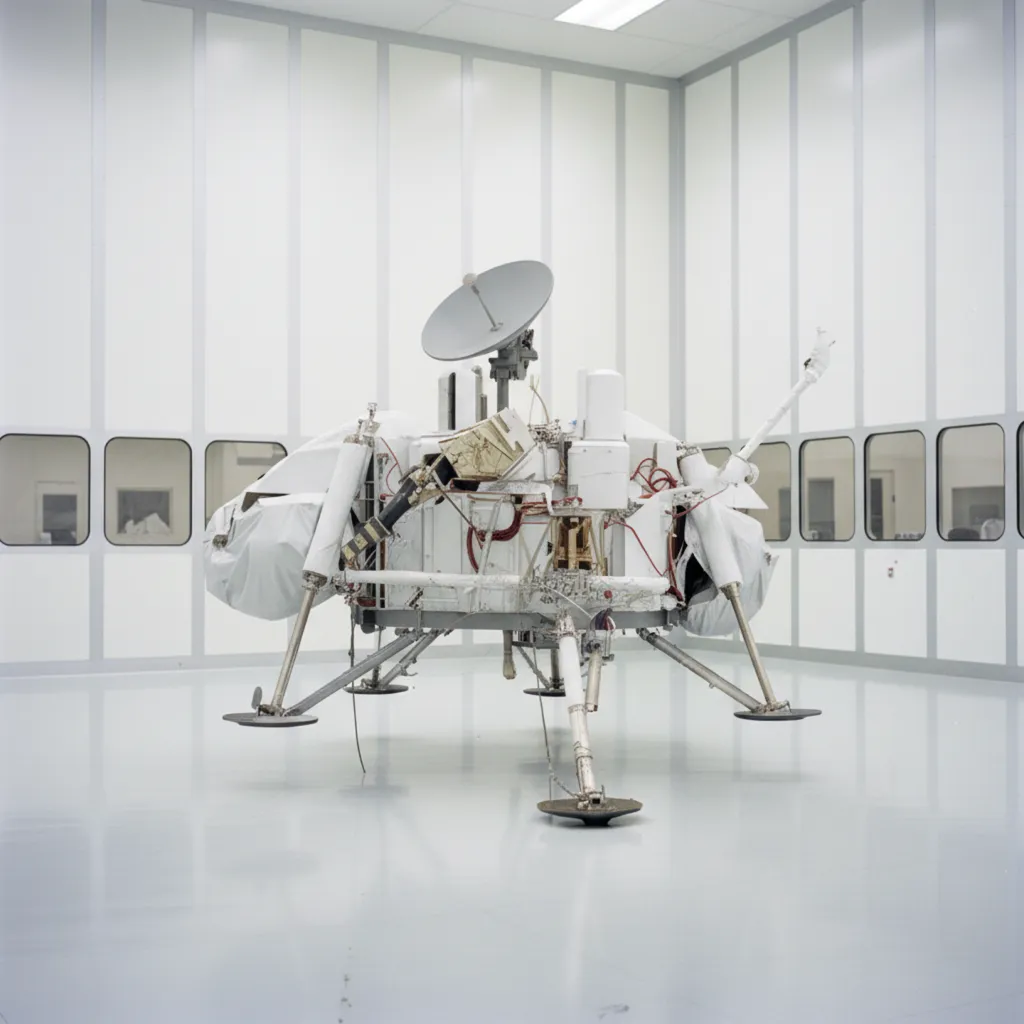
NASA's Viking 1 mission, launched in 1975, was a historic milestone. Comprising an orbiter and a lander, it achieved the first successful, long-duration US landing on Mars on July 20, 1976. While the orbiter mapped the planet, revealing river valleys, the lander conducted the first in-situ experiments to search for life, yielding ambiguous results that redefined Martian exploration.
Agency

Country

Type
Lander
Status
Launch
August 20, 1975
Technical Analysis of the Viking 1 Mission
- Mission Designation: Viking 1
- Operating Agency: NASA (Jet Propulsion Laboratory - JPL, Langley Research Center - LaRC)
- Launch Date: August 20, 1975
- Launch Vehicle: Titan IIIE-Centaur
- Launch Site: Launch Complex 41, Cape Canaveral
- Mars Arrival (Orbital Insertion): June 19, 1976
- Landing (Lander): July 20, 1976
- Landing Site: Chryse Planitia (Plains of Gold)
1. Mission Objectives
Viking 1, along with its twin Viking 2, represented NASA's flagship Mars mission of the 1970s. Its primary objectives were a monumental leap in exploration:
- Obtain high-resolution images of the Martian surface from orbit for mapping and geological characterization.
- Characterize the structure and composition of the atmosphere and surface of Mars, including meteorological measurements.
- Perform the first successful, long-duration controlled landing on the Martian surface.
- The primary objective: To directly search for evidence of existing microscopic life in the Martian soil.
2. Spacecraft Specifications
The Viking 1 spacecraft was a two-component mission, with a total launch mass of approximately 3,530 kg.
2.1. Viking Orbiter 1
- Mass: 2,328 kg (at launch, including 1,445 kg of propellant).
- Architecture: Based on the Mariner 9 platform. An octagonal, 16-sided structure.
- Power: Eight 1.57 m x 1.23 m solar panels, providing 620 watts of power in Mars orbit. Two 30 A·h nickel-cadmium (NiCd) batteries.
- Propulsion: A bipropellant liquid-fuel rocket engine capable of 1,323 N of thrust for orbital insertion and maneuvers.
- Communications: 1.5 m parabolic high-gain antenna (HGA) and a low-gain antenna (LGA). Acted as a UHF communications relay for the lander.
2.2. Viking Lander 1
- Mass: Approximately 657 kg (mass on the surface, without the aeroshell or descent fuel).
- Architecture: A three-legged aluminum triangular base, designed to protect the instruments. Landing was achieved via an aeroshell (heat shield), parachute, and terminal monopropellant hydrazine retrorockets.
- Power: Two Radioisotope Thermoelectric Generators (RTGs), using plutonium-238, providing 70 watts of continuous power.
- Communications: Steerable high-gain antenna (HGA) for direct-to-Earth link (S-band) and a UHF relay link via the Orbiter.
3. Scientific Instrumentation
3.1. Orbiter Instruments
- Visual Imaging Subsystem (VIS): Two high-resolution vidicon cameras. They mapped 85% of the surface (in combination with Mariner 9) and helped certify the landing site.
- Mars Atmospheric Water Detector (MAWD): An infrared spectrometer to measure the distribution and abundance of water vapor in the atmosphere.
- Infrared Thermal Mapper (IRTM): A radiometer to measure surface temperatures, helping to create thermal maps and understand the soil's thermal inertia.
3.2. Lander Instruments
- Biology Experiments: The core of the mission. A 15.5 kg miniature biology laboratory designed to look for metabolic processes in the Martian soil. It contained three experiments:
- Gas Exchange (GEX): Looked for metabolic gases after adding nutrients to a soil sample.
- Labeled Release (LR): Injected nutrients tagged with radioactive carbon-14 to see if they were "consumed" and radioactive gas was released.
- Pyrolytic Release (PR): Searched for the incorporation of carbon (from radioactive CO2 or CO) into organic matter by photosynthesis or chemosynthesis.
- Gas Chromatograph-Mass Spectrometer (GCMS): A critical instrument designed to heat soil samples and identify organic molecules.
- Lander Imaging System: Two facsimile scan cameras that provided the first detailed panoramic views from the surface of Mars.
- Meteorology Station (ASI/MET): Sensors mounted on a boom to measure pressure, temperature, wind speed, and direction on the surface.
- X-Ray Fluorescence Spectrometer (XRFS): Analyzed the inorganic chemical composition of the soil, revealing it to be rich in iron and silicon.
- Seismometer: Designed to detect "Marsquakes" (although the Viking 1 seismometer failed to deploy correctly, the Viking 2 seismometer did work).
4. Launch Vehicle
The mission required one of the most powerful launch vehicles of the era, the Titan IIIE-Centaur.
- Stage 0: Two five-segment Solid Rocket Boosters (SRBs), providing the massive initial thrust.
- Stage 1: A liquid-fueled Titan core (LR87), using hypergolic propellants (N2O4 / Aerozine 50).
- Stage 2: A liquid-fueled Titan core (LR91), also hypergolic.
- Upper Stage (Stage 3): The high-performance Centaur D-1T stage, which used cryogenic propellants (Liquid Oxygen / Liquid Hydrogen - LOX/LH2). This stage performed the trans-Mars injection, sending Viking 1 on its trajectory to Mars.
5. Mission Results and Legacy
5.1. Engineering and Exploration Success
The mission was a resounding success. Orbiter 1 operated for 1,485 orbits, until August 17, 1980. Lander 1 far exceeded its 90-day design life, operating for 2,307 days (over 6 Earth years) until November 11, 1982.
The orbiters confirmed Mariner 9's findings of a wetter past, showing vast river valleys and evidence of massive floods. They also confirmed that the northern polar cap was composed of water ice.
5.2. The Biology Experiment Paradox
Viking 1's most complex legacy came from its life-seeking experiments:
- Positive Results: Several experiments, especially the 'Labeled Release' (LR), returned positive results that met the pre-launch criteria for life detection. They showed a rapid release of radioactive gas that was stopped if the sample was sterilized by heat.
- Negative Results: However, the GCMS instrument, considered the definitive control, found absolutely no organic molecules in the soil. Life as we know it is based on organic chemistry.
- Conclusion: This contradiction led most scientists to conclude that the positive results were not biological, but rather the result of exotic, unexpected soil chemistry involving potent oxidants (like perchlorates, discovered decades later by the Phoenix lander in 2008) that mimicked biological reactions and destroyed organic matter.
6. Technical Conclusion
Viking 1 fundamentally redefined our understanding of Mars, transforming it from a point of light into a tangible, complex world. It demonstrated the capability to land and operate long-duration missions on another planet. While it did not find conclusive evidence of life, the ambiguity of its results profoundly influenced Mars exploration strategy for the next 40 years, shifting the focus from seeking existing life to searching for signs of past habitability.
Mission Milestones
Launch
Sol 30 of Schiapo, Year 11
304 days
of travel
Arrival at Mars
Sol 30 of Galo, Year 12
Operations Start
Sol 22 of Hespero, Year 12
2243 sols
of operations