Mars 2 (Orbiter)
The Mars 2 mission (USSR, 1971) was a dual orbiter and lander mission. It arrived during a global dust storm. The orbiter successfully entered orbit, but its science was limited by the dust. The lander failed due to an incorrect entry angle and crashed, becoming the first human object to impact Mars.
Agency

Country

Type
Orbiter
Status
Launch
May 19, 1971
Technical Analysis of the Mars 2 Mission (M-71 No.171)
- Mission Designation: Mars 2
- Internal Designation (USSR): M-71 No. 171
- Operating Agency: USSR Academy of Sciences (Program managed by NPO Lavochkin)
- Launch Date: May 19, 1971 [cite: 273]
- Launch Vehicle: Proton-K / Blok-D (UR-500K) [cite: 273]
- Launch Site: Baikonur Cosmodrome
- Total Mass (Launch): 4,650 kg
1. Mission Objectives
Mars 2 was a dual-component (orbiter and lander) mission, the most ambitious by the USSR to date. Its objectives were:
Orbiter:
- To map the surface and clouds of Mars.
- To measure the temperature of the Martian surface.
- To study the topography, composition, and physical properties of the surface.
- To measure atmospheric properties, including upper atmosphere density.
- To analyze the solar wind, interplanetary magnetic fields, and the Martian magnetic field.
Lander:
- To achieve the first successful soft landing on Mars.
- To obtain images (panoramas) from the surface.
- To measure temperature, pressure, and wind velocity at the landing site.
- To analyze the chemical composition and mechanical properties of the Martian soil.
2. Spacecraft Specifications (M-71 Platform)
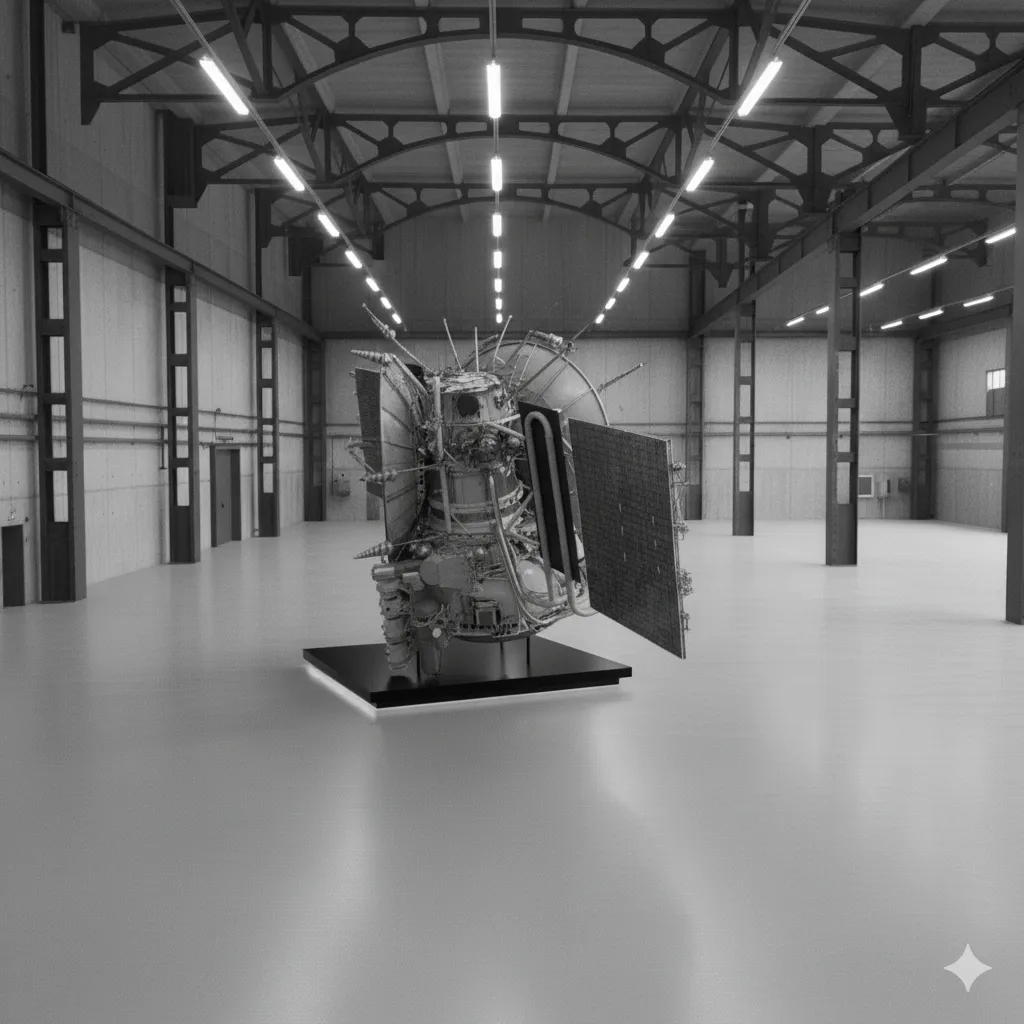
The spacecraft was a new-generation design consisting of a main orbiter to which a capsule-shaped lander module was attached.
Orbiter:
- Mass (Dry): Approx. 2,265 kg.
- Mass (Fueled): Approx. 3,440 kg (including propellant).
- Architecture: A cylindrical core containing propulsion tanks, a main engine (KTDU-425) for orbital insertion, and a pressurized instrument module.
- Power: Two large solar array panels.
- Communications: Parabolic high-gain antenna (HGA) and low-gain antennas.
Lander:
- Mass: Approx. 1,210 kg (including heat shield and propellant).
- Architecture: A 2.5-meter diameter sphere containing the landing system and the surface probe.
- Landing System: Aerodynamic heat shield, a main parachute, a secondary braking parachute, and solid-fuel retro-rockets for the final landing.
- Survival: Designed to use the orbiter module as a communications relay.
3. Scientific Instrumentation
Orbiter Payload:
- Two cameras (wide-angle and narrow-field telephotometers).
- Infrared Radiometer (for temperature measurement).
- Infrared scanning photometer (for CO2).
- Ultraviolet photometer (for H, O, Ar).
- Lyman-Alpha Spectrometer (to search for hydrogen in the upper atmosphere).
- Triaxial Magnetometer.
- Plasma detectors (ion traps) and cosmic ray detector.
- Radio occultation experiment.
Lander Payload:
- Two telephotometer cameras (for panoramic views).
- Meteorological sensors (temperature, pressure, wind).
- Mass spectrometer (for atmospheric analysis).
- Instrument for chemical soil analysis (X-ray spectrometer).
- Penetrometer (to measure soil density).
4. Launch Vehicle
The mission utilized the three-stage Proton-K (8K82K) rocket, supplemented by a Blok-D fourth escape stage. The Proton-K placed the spacecraft and the Blok-D stage into a parking orbit. The Blok-D stage then performed the trans-Mars injection burn to send Mars 2 toward Mars.
5. Mission Outcome Analysis (Partial Success)
The Mars 2 spacecraft successfully completed the 6-month interplanetary journey. However, it arrived at Mars on November 27, 1971, in the midst of the largest dust storm ever recorded on the planet, which obscured the entire surface.
Orbiter Outcome: Success
- Orbital Insertion: The orbiter successfully performed its engine burn and entered an elliptical orbit around Mars on November 27, 1971.
- Scientific Operations: The Mars 2 orbiter (along with Mars 3) began its imaging program. However, due to the all-encompassing global dust storm, the scientific utility of the initial images was extremely limited. The missions returned a combined total of 60 images, mostly of a featureless, obscured surface.
Lander Outcome: Failure
- Separation: The lander module separated from the orbiter prior to orbital insertion.
- System Malfunction: The lander's entry system malfunctioned. [cite: 88] Investigation suggests a failure in the onboard computer or navigation system caused the capsule to miscalculate its trajectory.
- Atmospheric Entry: The craft entered the Martian atmosphere at an angle that was too steep. [cite: 88]
- Impact: The landing sequence failed catastrophically. The aerodynamic descent system could not compensate for the overly steep trajectory, and the parachute did not deploy correctly. The lander did not use its retro-rockets and crashed onto the surface.
6. Technical Conclusion
Mars 2 is classified as a partial success. [cite: 273] The orbiter successfully achieved orbital insertion, a significant milestone, although its scientific mission was severely compromised by the dust storm. The lander failed due to a guidance system malfunction during entry, [cite: 88] resulting in a destructive impact. Despite its landing failure, the Mars 2 lander inadvertently became the first human-made object to impact the surface of Mars.
Mission Milestones
Launch
Sol 5 of Nilo, Year 9
192 days
of travel
Arrival at Mars
Sol 6 of Tharso, Year 9
Operations Start
Sol 6 of Tharso, Year 9
261 sols
of operations