Kosmos 419
The Soviet Kosmos 419 mission, launched on May 10, 1971, was an attempt to be the first Mars orbiter. It failed in Earth orbit when the Blok D upper stage failed to ignite. The cause was a programming error: the ignition timer was set for 1.5 years instead of 1.5 hours. It re-entered the atmosphere two days later.
Agency
Country

Type
Orbiter
Status
Launch
May 10, 1971
Technical Analysis of the Kosmos 419 Mission
- Mission Designation: Kosmos 419
- Internal Designation (USSR): 3MS No.170
- Operating Agency: Soviet Space Program (NPO Lavochkin)
- Launch Date: May 10, 1971
- Launch Vehicle: Proton-K/D
- Launch Site: Baikonur Cosmodrome
1. Mission Objectives
The primary objective of Kosmos 419 was geopolitical and scientific: to become the first space probe to orbit Mars. The mission was a fast-tracked attempt to beat the American Mariner 8 and Mariner 9 missions, which were launching in the same transfer window.
Engineering:
- To validate the third-generation interplanetary spacecraft platform (3MS series).
- To test Mars orbital insertion.
- To establish the first artificial satellite of Mars.
Scientific (Planned):
- To study the atmosphere and surface of Mars from orbit.
- To measure magnetic fields and characteristics of the Martian environment.
2. Probe Specifications (3MS Platform)
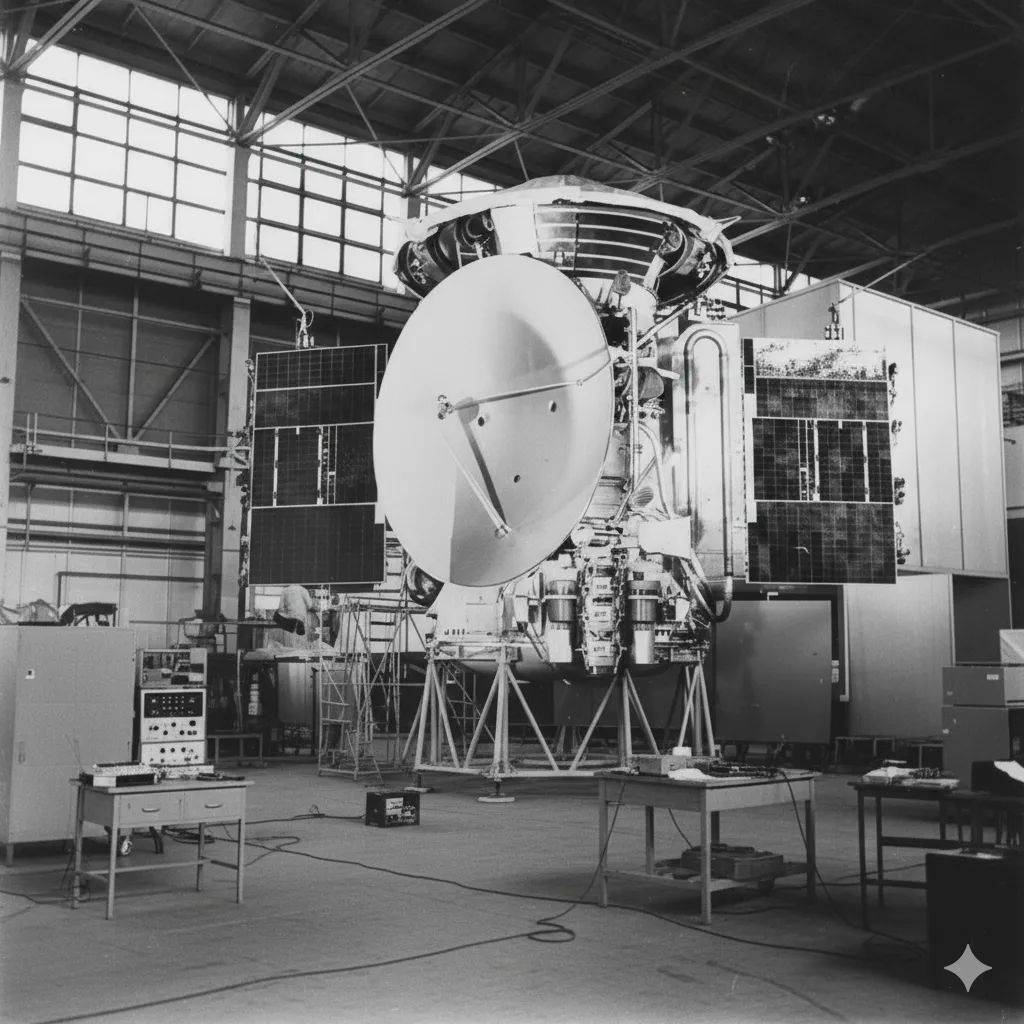
Kosmos 419 was a 3MS-type probe (Mars-71), a variant of the M-71 platform. Unlike its sister missions Mars 2 and Mars 3 (launched days later), 3MS No.170 was an orbiter-only mission and did not include a lander module.
- Total Mass: Approximately 4,650 kg (including fuel).
- Architecture: Based on the standard M-71 design, which consisted of a cylindrical orbital module housing the propulsion, avionics, and thermal control systems.
- Power: Two large solar panels mounted on opposite sides of the spacecraft bus.
- Communications: A parabolic High-Gain Antenna (HGA) for deep space communications.
- Propulsion: Main propulsion system for trajectory correction and Mars orbital insertion.
3. Scientific Instrumentation
Given that the probe failed to leave Earth orbit, its scientific instrument suite was never activated. It was expected to carry an instrument package similar to the Mars 2 and Mars 3 orbiters, which included cameras, spectrometers, and magnetometers.
4. Launch Vehicle and Escape Stage
The mission used the heavy-lift Proton-K three-stage launcher, supplemented by a Blok D fourth/escape stage.
- Stages 1-3 (Proton-K): Designed to lift the payload (probe + Blok D stage) into a low Earth parking orbit (LEO).
- Stage 4 (Blok D): An escape stage designed to ignite in LEO and perform the Trans-Mars Injection (TMI) burn, propelling the probe out of Earth orbit towards Mars.
5. Launch Failure Analysis
- Launch and Parking Orbit: On May 10, 1971, the Proton-K rocket functioned correctly, inserting the Kosmos 419 probe and the Blok D upper stage into the planned low Earth orbit.
- TMI Ignition Failure: The Blok D stage was scheduled to ignite its engine 1.5 hours after reaching LEO, which would allow the craft to begin its trajectory to Mars. The engine never ignited.
- Root Cause: An investigation determined the cause of the failure was a human error in programming the timer in the Blok D stage's control system. The timer for ignition was incorrectly programmed for 1.5 years instead of 1.5 hours.
- Failure Result: Unable to escape Earth's gravity, Kosmos 419 was stranded in a low, unstable orbit.
- Re-entry: The probe re-entered Earth's atmosphere and was destroyed two days later on May 12, 1971.
6. Technical Conclusion
Kosmos 419 was a total mission failure, classified as a "launch failure". Although the Proton vehicle performed, a simple programming error prevented the probe from leaving Earth orbit. The mission never received a planetary designation (like "Mars") and was instead given the generic "Kosmos" designation, used by the USSR to obscure failures in military or interplanetary missions. The failure allowed NASA's Mariner 9, launched days later, to become the first probe to successfully orbit Mars.
Mission Milestones
Launch
Sol 34 of Marinero, Year 9