Mariner 7
NASA's Mariner 7 mission, launched in March 1969, was a resounding success. Alongside its twin, Mariner 6, it flew by Mars in August 1969, sending back 126 images. Its key discovery was determining that the southern polar cap was composed primarily of frozen CO2, not water ice, altering the scientific view of the planet.
Agency

Country

Type
Flyby
Status
Launch
March 27, 1969
Technical Analysis of the Mariner 7 Mission
- Mission Designation: Mariner 7
- Internal Designation (NASA): Mariner-69G / Mariner Mars 69B
- Operating Agency: NASA (Jet Propulsion Laboratory - JPL)
- Launch Date: March 27, 1969
- Launch Vehicle: Atlas-Centaur (SLV-3C)
- Launch Site: Cape Canaveral, Launch Complex 36A
1. Mission Objectives
Mariner 7 was the second of a two-spacecraft mission (along with Mariner 6) designed to conduct the first dual flyby of Mars. The primary objectives were scientific and reconnaissance in nature:
Scientific:
- Study the composition of the Martian surface and atmosphere with remote sensors.
- Measure surface temperatures, specifically the southern polar cap.
- Determine atmospheric composition, searching for key gases via spectroscopy.
- Obtain high-resolution images of surface features for geological analysis.
Engineering:
- Validate second-generation planetary flyby technology.
- Demonstrate the feasibility of operating multiple spacecraft missions simultaneously.
- Test the spacecraft's reprogrammable command system in deep space.
2. Spacecraft Specifications (Mariner Mars 69 Platform)
The Mariner 7 probe was identical to its twin, Mariner 6. Its design was based on experience from previous missions.
- Total Mass: 413 kg (908 lbs)
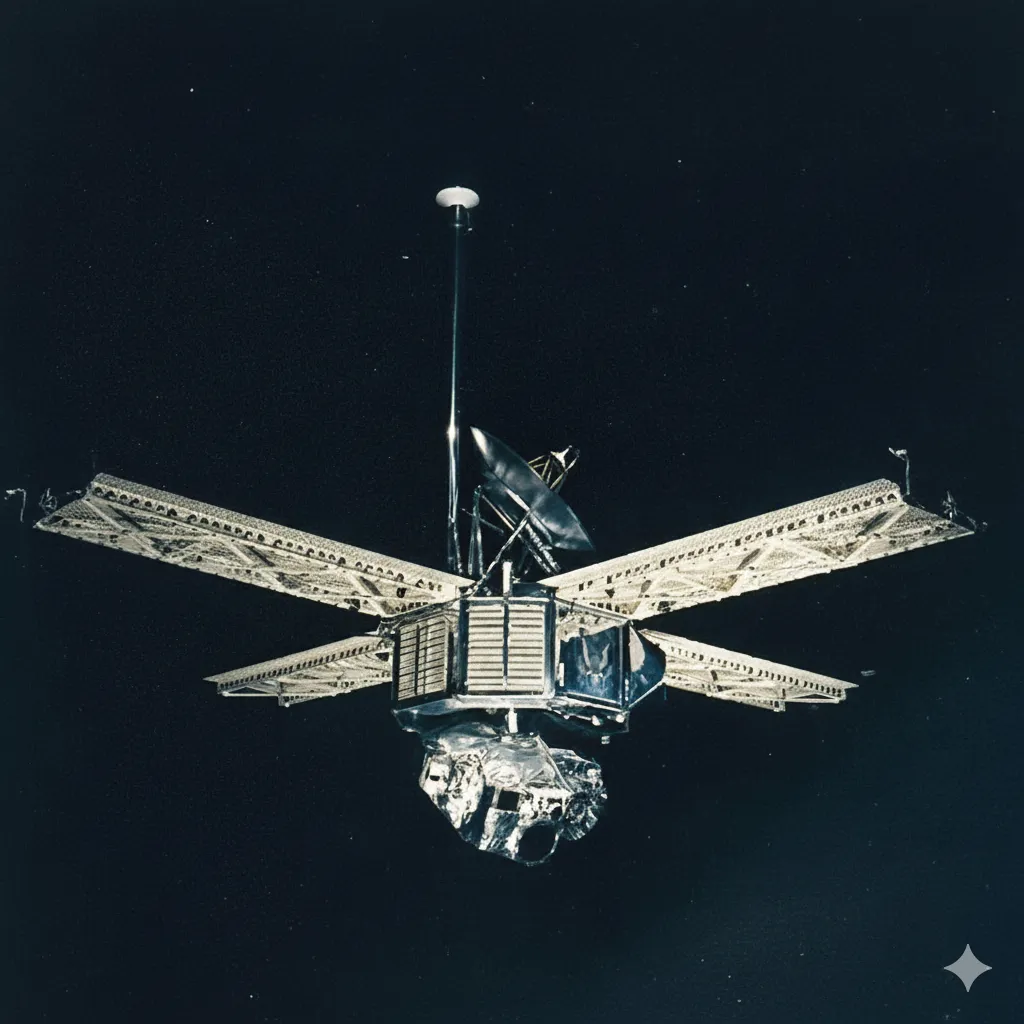
- Architecture: An octagonal magnesium bus (1.38 m diagonal) housing electronics, propulsion, and power systems. A pyramidal superstructure mounted on top held the science scan platform.
- Attitude Control: 3-axis stabilization. Orientation was maintained using sun sensors and a star tracker fixed on the star Canopus. Actuation was achieved via 2 sets of 6 cold nitrogen gas thrusters.
- Power: Four solar panels (215 cm x 90 cm each) with 17,472 solar cells. They provided 800 W near Earth and 449 W at Mars. A 1200 W-hr rechargeable silver-zinc battery was used for maneuvers and during occultations.
- Communications: A high-gain parabolic antenna (1 m diameter) and an omnidirectional low-gain antenna mounted on a mast.
- Propulsion: A 223 N (50 lbf) thrust monopropellant (hydrazine) rocket motor for a single midcourse trajectory correction (TCM).
- Data System: A programmable Central Computer and Sequencer (CC&S). Imaging data was stored on an analog tape recorder, while non-imaging science data was stored on a digital recorder.
3. Scientific Instrumentation
The 59 kg (130 lb) scientific payload was mounted on a movable scan platform beneath the main bus.
- TV Imaging System: Two television cameras:
- Camera A (Wide-Angle): 52 mm lens, for broad context coverage.
- Camera B (Narrow-Angle): 508 mm lens, for high resolution (down to 300 m).
- Infrared Spectrometer (IRS): To measure the chemical composition of the surface and atmosphere.
- Ultraviolet Spectrometer (UVS): To analyze the composition of the upper atmosphere.
- Infrared Radiometer (IRR): A two-channel sensor to precisely measure surface temperatures.
- S-Band Occultation Experiment: Used the spacecraft's radio signal as it passed behind Mars to measure atmospheric pressure, density, and temperature.
- Celestial Mechanics Experiment: Used spacecraft tracking to refine measurements of Mars's mass and the planet's ephemeris.
4. Launch Vehicle and Trajectory
The mission used NASA's reliable Atlas-Centaur launch vehicle.
- Launcher: General Dynamics Atlas SLV-3C (booster) with a Centaur-D upper stage.
- Launch Profile: The vehicle achieved a direct trans-Martian injection. No Earth parking orbit was used.
- Correction Maneuver (TCM): A successful trajectory correction maneuver was performed on April 8, 1969.
- In-Route Incident: On July 30, 1969, the spacecraft suddenly lost high-gain telemetry. Mission control successfully switched to the low-gain antenna. It is theorized the craft was struck by a micrometeoroid or a faulty battery vented gas, changing its attitude.
5. Mission Results
The mission was a resounding success, meeting all its primary objectives despite the in-route incident.
- Flyby: Mariner 7 flew past Mars on August 5, 1969, just five days after its twin, Mariner 6.
- Minimum Distance: The closest approach was 3,430 km (2,130 miles) above the Martian surface.
- Data Acquisition: The craft collected 93 "far-encounter" images and 33 "near-encounter" images (126 total). Combined with Mariner 6, the mission returned 201 images.
- Reprogramming: Following the Mariner 6 flyby, scientists used Mariner 7's programmable command system to retarget its instruments for more intensive coverage of the intriguing southern polar cap.
- Phobos Image: The mission provided the first-ever closeup photograph of a Martian moon (Phobos), revealing its dark, irregular shape.
6. Key Scientific Discoveries
The data from Mariner 6 and 7 transformed human understanding of Mars:
- South Polar Cap: The most significant discovery was that the southern polar cap was composed largely of frozen carbon dioxide (CO2) (dry ice), not water ice as previously assumed. The Infrared Radiometer measured temperatures of -123 °C (-190 °F), consistent with CO2 frost.
- Atmosphere: Occultation data confirmed the atmosphere was extremely thin (surface pressure of 3.5 to 7 millibars) and composed primarily of CO2.
- Surface: Images revealed a desolate, cratered landscape, much more akin to the Moon than to Earth, dashing hopes from the "canal" era. Regions of "chaotic terrain" were also identified.
- Mass and Shape: Tracking data refined measurements of Mars's mass and shape.
Mission Milestones
Launch
Sol 23 of Korolo, Year 8
130 days
of travel
Arrival at Mars
Sol 2 of Oppo, Year 8
Operations Start
Sol 2 of Oppo, Year 8