Mariner 6
Mariner 6, launched in February 1969, was a resounding NASA success. During its Mars flyby, the probe returned 75 images and crucial data. Its instruments revealed an atmosphere composed mainly of CO2, measured very low surface pressures, and, most importantly, determined the south polar cap was frozen carbon dioxide (dry ice), not water ice.
Agency

Country

Type
Flyby
Status
Launch
February 25, 1969
Technical Analysis of the Mariner 6 Mission
- Mission Designation: Mariner 6
- Internal Designation: Mariner-F / Mariner Mars 69A
- Operating Agency: NASA (Jet Propulsion Laboratory - JPL)
- Launch Date: February 25, 1969 (01:29:02 UTC)
- Launch Vehicle: Atlas-Centaur (AC-20 / SLV-3C)
- Launch Site: Cape Canaveral, Launch Complex 36B
1. Mission Objectives
The primary objectives for Mariner 6, along with its twin Mariner 7, constituted the first dual-spacecraft mission to Mars:
Scientific:
- Perform a close flyby of the equatorial and south polar regions of Mars.
- Study the composition of the Martian atmosphere, with special interest in searching for compounds that could indicate life.
- Measure the surface temperature of the planet.
- Obtain high-resolution images to characterize the surface geology and refine existing maps.
Engineering:
- Validate the performance of the Atlas-Centaur launch vehicle for interplanetary trajectories.
- Test and develop advanced technologies for future missions, including deep-space navigation and communications.
- Provide navigation data and operational experience for the Mariner 7 encounter, which would arrive five days later.
2. Spacecraft Specifications (Mariner-F Platform)
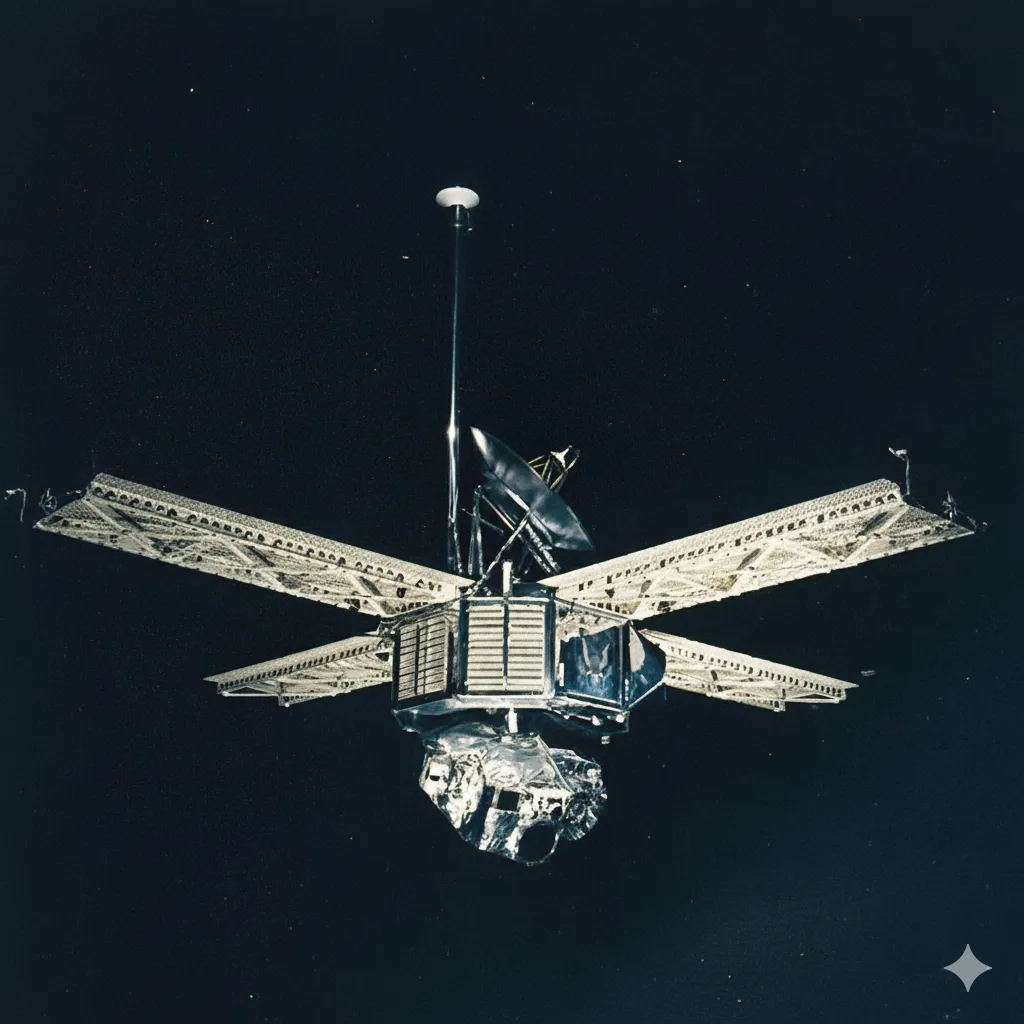
Mariner 6 was a three-axis stabilized spacecraft, significantly more advanced than Mariner 4.
- Total Mass (Dry): 381 kg (Other sources indicate ~411.8 kg)
- Science Payload Mass: 57.6 kg
- Architecture: An octagonal magnesium body (138.4 cm diagonal and 45.7 cm deep).
- Attitude Control: 3-axis stabilization system (referenced to the Sun and the star Canopus) using 3 gyroscopes, 2 sets of 6 cold nitrogen gas jets, a Canopus tracker, and solar sensors.
- Power: Four solar panels (215 x 90 cm each), with a total wingspan of 5.79 m. They supplied 800 W near Earth and 449 W at Mars. A 1200 Wh rechargeable silver-zinc battery served as backup.
- Communications: A high-gain parabolic antenna (1 m diameter) and a low-gain omnidirectional antenna mounted on a 2.23 m mast.
- Propulsion: A 223 N thrust rocket engine, fueled by monopropellant hydrazine, for trajectory correction maneuver (TCM).
- Science Platform: A two-axis scan platform mounted at the bottom of the spacecraft held the scientific instruments.
3. Scientific Instrumentation
The instrument suite was designed for a detailed atmospheric and surface analysis during the rapid flyby.
- TV Camera System: Two cameras (one narrow-angle and one wide-angle) which captured 49 far-encounter images and 26 near-encounter images.
- Infrared Spectrometer (IRS): Analyzed atmospheric and surface composition. It was crucial for detecting CO2, dry ice, and silicates.
- Infrared Radiometer (IRR): Measured the surface temperature of Mars.
- Ultraviolet Spectrometer (UVS): Studied the upper atmosphere, searching for emissions from hydrogen, oxygen, and other gases.
- S-Band Occultation Experiment: Used the spacecraft's radio signal as it passed behind Mars (as seen from Earth) to measure the density, pressure, and composition of the atmosphere.
- Celestial Mechanics Experiment: Used tracking of the spacecraft to refine measurements of Mars's mass and orbital parameters.
4. Launch Vehicle and Pre-Launch Incident
Mariner 6 utilized the Atlas-Centaur (SLV-3C) rocket, a more powerful configuration than the Atlas-Agena of previous missions, allowing for a heavier scientific payload.
Pre-Launch Incident:
The mission almost ended before it began. On February 14, 1969, during a countdown test, a faulty switch caused the helium pressure in the Atlas rocket (AC-20) to be released. The rocket, whose stainless steel "balloon" structure relies on internal pressurization to remain rigid, began to wrinkle and collapse on itself.
Two technicians, Bill McClure and Jack Beverlin, acted with extreme bravery, running to the fueled rocket and manually flipping a switch to repressurize the tank, saving the vehicle from total structural failure. The Mariner 6 probe was removed and placed on the backup rocket (AC-19), which was originally intended for Mariner 7.
5. Mission Development and Scientific Results
Mariner 6 was launched on a direct-ascent trajectory (no parking orbit) toward Mars. It performed a successful mid-course correction on March 1, 1969.
Flyby and Scientific Success:
- Flyby Date: July 31, 1969.
- Closest Approach: 3,429 km (2,131 miles) above the Martian surface.
- Key Discoveries:
- Atmospheric Composition: The spectrometers confirmed that the Martian atmosphere was overwhelmingly composed of carbon dioxide (CO2).
- Surface Pressure: The occultation experiment measured an extremely low surface pressure, between 6 and 7 millibars (less than 1% of Earth's), confirming the inhospitable environment.
- The Polar Cap: The most significant discovery came from the Infrared Spectrometer. As it passed over the southern polar cap (Hellas), the instrument did not detect the signature of water ice. Instead, it found a temperature and spectral signature consistent with solid carbon dioxide (dry ice).
- "Canals" Debunked: The high-resolution images showed a heavily cratered terrain and areas of "chaotic terrain," but found no evidence of the linear "canals" that had been theorized from Earth. These were resolved as alignments of craters and dark patches.
6. Technical Conclusion
Mariner 6 was a monumental success. Despite a near-disaster on the launch pad, the mission performed flawlessly in space and returned a dataset that fundamentally changed the scientific perception of Mars. It demonstrated that Mars was not an Earth-like world with water ice caps, but rather a cold, dry, CO2-dominated planet with an extremely thin atmosphere. Along with Mariner 7, it laid the scientific groundwork for the Viking program of the next decade.
Mission Milestones
Launch
Sol 30 of Isido, Year 8
156 days
of travel
Arrival at Mars
Sol 34 of Nilo, Year 8
Operations Start
Sol 34 of Nilo, Year 8