Mariner 4
Mariner 4, launched by NASA on November 28, 1964, was a monumental success. It performed the first successful flyby of Mars on July 14, 1965, returning 21 historic images. These revealed a desolate, crater-filled, Moon-like landscape with a much thinner atmosphere than expected, fundamentally altering the scientific perception of the Red Planet.
Agency

Country

Type
Flyby
Status
Launch
November 28, 1964
Technical Analysis of the Mariner 4 Mission
- Mission Designation: Mariner 4
- Alternate Designation: Mariner-Mars 1964
- Operating Agency: NASA (Jet Propulsion Laboratory - JPL)
- Launch Date: November 28, 1964
- Launch Vehicle: Atlas-Agena D (SLV-3A / 693D)
- Launch Site: Cape Canaveral Air Force Station, Launch Complex 12
1. Mission Objectives
The Mariner 4 mission was designed to conduct the first flyby of the planet Mars, with primary engineering and science objectives:
Engineering:
- To test and validate the capability of a spacecraft to operate in interplanetary space for a long period (approximately 8 months).
- To develop and operate navigation, attitude control, and communications systems at planetary distances.
- To evaluate the performance of the Atlas-Agena D launch vehicle for Earth-escape trajectories.
Scientific:
- To obtain and transmit the first close-up images of the Martian surface.
- To perform field and particle measurements in the interplanetary environment and in the vicinity of Mars.
- To search for a detectable planetary magnetic field, radiation belts, and measure atmospheric characteristics.
2. Spacecraft Specifications (Mariner Platform)
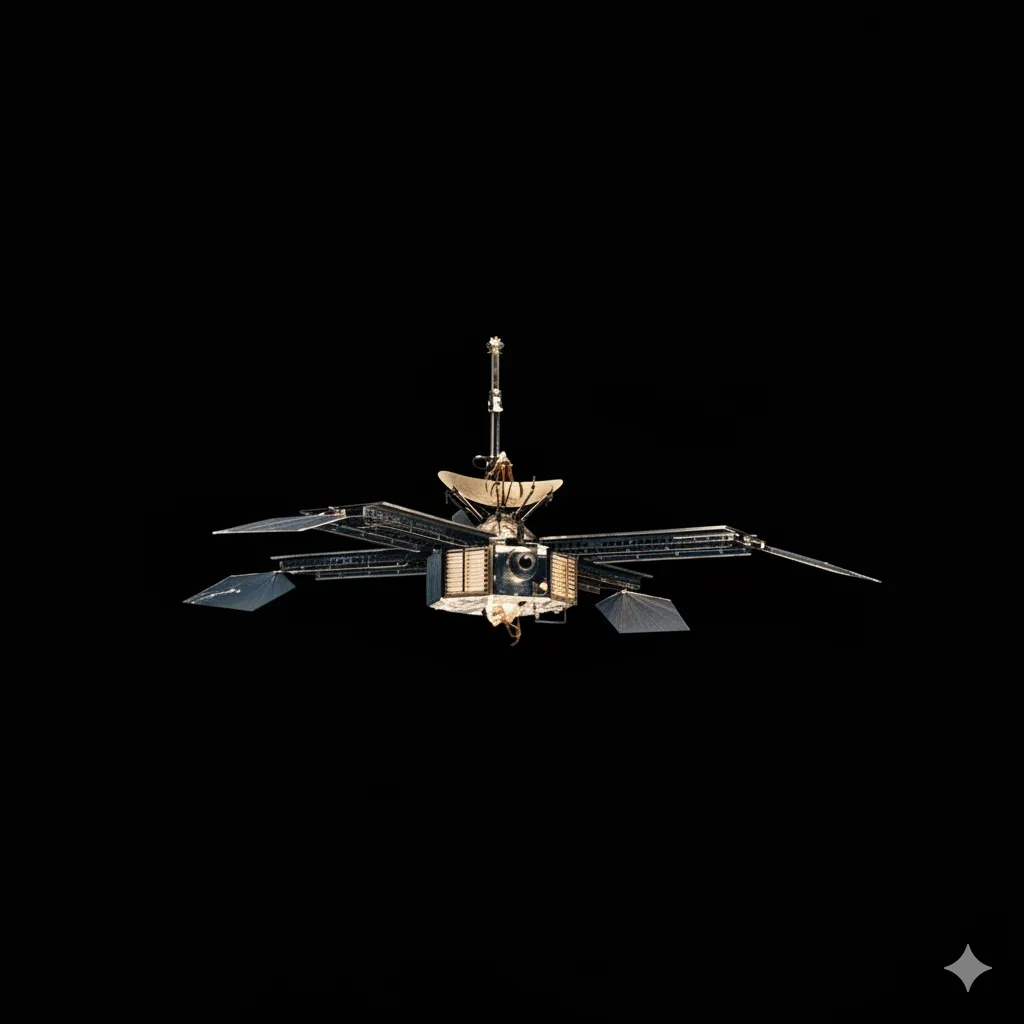
The Mariner 4 spacecraft was a 3-axis stabilized probe, based on the design of the Mariner 2 which traveled to Venus.
- Total Mass: 260.8 kg (575 lbs)
- Architecture: An octagonal magnesium frame (1.37 m diameter) housing electronics, propulsion, and control systems. A mast with antennas and a science scan platform extended from the body.
- Attitude Control: 3-axis stabilization system. Orientation was maintained by 12 cold nitrogen gas thrusters, using the Sun and the star Canopus as navigation references.
- Power: Four solar panels (17.37 x 9.0 m, with a total area of 7.06 m²) containing 28,224 solar cells. They provided 310 W at Mars. Supplemented by a 1200 Wh rechargeable silver-zinc battery.
- Communications: A fixed high-gain parabolic antenna (HGA) and an omnidirectional low-gain antenna (LGA). The data transmission rate was 8.33 bits per second for image playback.
- Propulsion: A 222 N (50 lbf) thrust monopropellant hydrazine engine for a single mid-course correction (TCM) maneuver.
3. Scientific Instrumentation
The scientific payload was designed for field measurements and imaging during the flyby.
- TV Camera System: A single slow-scan vidicon tube with a Cassegrain telescope. Designed to take between 21 and 22 black-and-white images.
- Helium Magnetometer: Mounted on a boom to measure the interplanetary magnetic field and search for a Martian field.
- Cosmic Ray Telescope: To measure high-energy radiation.
- Trapped Radiation Detector: To search for radiation belts similar to Earth's Van Allen belts.
- Cosmic Dust Detector: To measure the flux and direction of micrometeorites.
- Solar Plasma Probe: To measure the velocity, density, and direction of the solar wind.
- Radio Occultation Experiment: Used the spacecraft's radio signal as it passed behind Mars to measure atmospheric density and pressure.
4. Mission Result Analysis
The Mariner 4 mission was a monumental success and a landmark in the history of space exploration.
- Launch and Cruise: Following a successful launch on November 28, 1964 (after the failure of its twin, Mariner 3, whose shroud failed to jettison), Mariner 4 began its 7.5-month journey. It performed a successful mid-course correction maneuver.
- Mars Flyby: On July 14-15, 1965, Mariner 4 passed within 9,846 km (6,118 miles) of the Martian surface.
- Data Acquisition: During the flyby, the TV camera took 21 complete images (and a 22nd partial one) and stored them on a digital tape recorder. The other instruments collected data on the planet's environment.
- Transmission to Earth: After passing behind the planet, the spacecraft began the slow transmission of the images, which took several days to complete. The mission continued to transmit interplanetary data until October 1965, when the distance and antenna orientation prevented communication.
5. Key Scientific Discoveries
The discoveries of Mariner 4 fundamentally transformed the understanding of Mars:
- An Ancient, Cratered Surface: The images revealed a desolate landscape, covered in impact craters, more closely resembling the Moon than the Earth. This shattered romantic notions of canals and advanced life.
- Extremely Thin Atmosphere: The radio occultation experiment revealed that the atmospheric pressure at the surface was only 0.1% of Earth's, much thinner than believed, and composed mainly of carbon dioxide.
- Absence of Magnetic Field: The magnetometer detected no significant planetary magnetic field or radiation belts.
- A Cold, Dead World: Collectively, the data painted a picture of an ancient, geologically inactive, cold, and radiation-bombarded world, seemingly dead.
6. Technical Conclusion
Mariner 4 was the first completely successful interplanetary mission in history, providing the first-ever close-up images of another planet. Its engineering success in navigation, long-distance communication, and autonomous operation laid the foundation for all future missions. Scientifically, it redefined Mars, establishing the paradigm of an ancient, cratered world that would guide exploration for decades.
Mission Milestones
Launch
Sol 8 of Deimo, Year 6
228 days
of travel
Arrival at Mars
Sol 7 of Luno, Year 6
Operations Start
Sol 7 of Luno, Year 6