
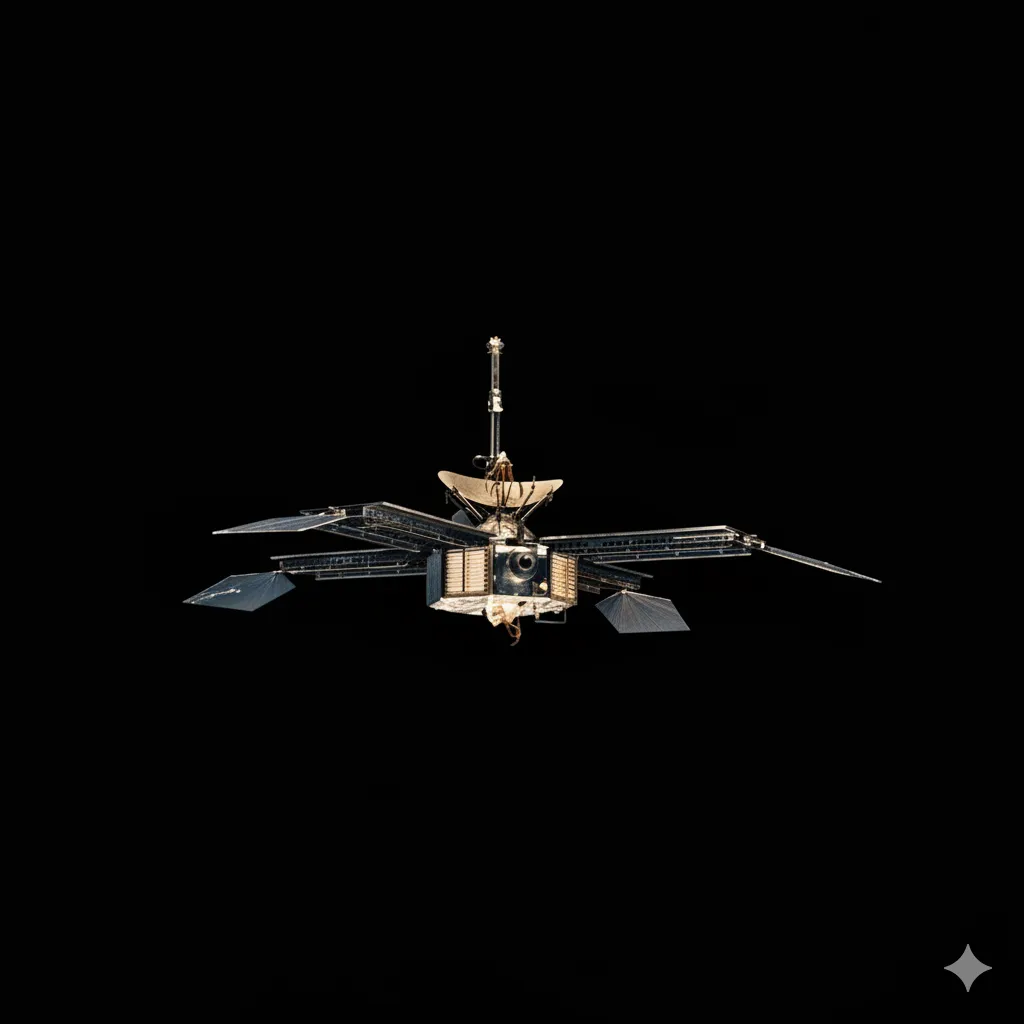
Mariner 3
Mariner 3 (1964) was NASA's first Mars flyby attempt. The launch was successful, but the fiberglass fairing protecting the probe failed to jettison. Trapped inside, the spacecraft could not deploy its solar panels. Its batteries died 8 hours later, leaving it inert in a solar orbit.
Agency

Country

Type
Flyby
Status
Launch
November 5, 1964
<h1>Technical Analysis of the Mariner 3 Mission</h1>
<div>
<ul>
<li><strong>Mission Designation:</strong> Mariner 3 (Mariner-Mars 1964)</li>
<li><strong>Internal Designation:</strong> Mariner-C</li>
<li><strong>Operating Agency:</strong> NASA (Jet Propulsion Laboratory - JPL)</li>
<li><strong>Launch Date:</strong> November 5, 1964</li>
<li><strong>Launch Vehicle:</strong> Atlas-Agena D</li>
<li><strong>Launch Site:</strong> Cape Canaveral, Launch Complex 13</li>
</ul>
</div>
<section>
<h2>1. Mission Objectives</h2>
<p>The objectives of the Mariner 3 mission were twofold, combining advanced engineering with planetary science:</p>
<h3>Engineering:</h3>
<ul>
<li>To validate the second-generation interplanetary spacecraft platform (Mariner-C).</li>
<li>To test deep space navigation and communication systems during an 8-month transit to Mars.</li>
<li>To execute the first-ever trajectory correction maneuver (TCM) en route to Mars.</li>
<li>To demonstrate three-axis stabilization (rather than spin-stabilization) using solar sensors and a Canopus star tracker.</li>
</ul>
<h3>Scientific:</h3>
<ul>
<li>To conduct the first flyby of Mars.</li>
<li>To obtain the first close-up images of the Martian surface (approximately 22 photos were expected).</li>
<li>To measure fields and particles in the interplanetary environment and in the vicinity of Mars.</li>
<li>To search for a Martian magnetic field.</li>
<li>To perform a radio occultation experiment to study the Martian atmosphere.</li>
</ul>
</section>
<section>
<h2>2. Spacecraft Specifications (Mariner-C Platform)</h2>
<p>The Mariner 3 probe was identical to its twin, Mariner 4. Its design was a significant advancement over the Venus missions.</p>
<ul>
<li><strong>Total Mass:</strong> 260.8 kg (575 lbs)</li>
<li><strong>Architecture:</strong> An octagonal magnesium main body (127 cm diagonally and 45.7 cm high), which housed electronics, propulsion, and control systems.</li>
<li><strong>Attitude Control:</strong> Three-axis stabilization system. It used 12 cold nitrogen gas thrusters controlled by solar sensors and a Canopus star tracker.</li>
<li><strong>Power:</strong> Four deployable solar panels (176 x 90 cm each) spanning 6.88 meters tip-to-tip. They contained 28,224 solar cells to generate 310 watts at Mars. They were supplemented by a 1200 Wh rechargeable silver-zinc battery.</li>
<li><strong>Communications:</strong> A high-gain parabolic antenna (116.8 cm diameter) and an omnidirectional low-gain antenna mounted on a 2.23 m mast. S-band transmitter.</li>
<li><strong>Propulsion:</strong> A 222 N thrust monopropellant (hydrazine) engine for the mid-course trajectory correction.</li>
</ul>
</section>
<section>
<h2>3. Scientific Instrumentation</h2>
<p>The scientific payload was mounted on the exterior of the octagonal frame and on a mobile scan platform.</p>
<ul>
<li><strong>Television Camera:</strong> A single vidicon-type camera designed to take 21 images (plus a partial 22nd) through red and green filters. Data was stored on a digital tape recorder.</li>
<li><strong>Helium Magnetometer:</strong> To measure the strength and direction of interplanetary and Martian magnetic fields.</li>
<li><strong>Solar Plasma Probe:</strong> To measure the characteristics of the solar wind.</li>
<li><strong>Trapped Radiation Detector:</strong> To measure charged particles (electrons and protons) in space.</li>
<li><strong>Cosmic Ray Telescope:</strong> To study high-energy particles.</li>
<li><strong>Ionization Chamber / Geiger Counter:</strong> To measure cosmic radiation.</li>
<li><strong>Cosmic Dust Detector:</strong> To register micrometeorite impacts.</li>
</ul>
</section>
<section>
<h2>4. Launch Vehicle</h2>
<p>The mission used the <strong>Atlas LV-3 Agena-D</strong> launcher, a two-and-a-half-stage rocket plus an upper stage:</p>
<ul>
<li><strong>Atlas Stage (LV-3):</strong> The main "balloon" stage (with very thin, pressurized steel walls) with three engines (two jettisonable boosters and a central sustainer).</li>
<li><strong>Agena-D Stage:</strong> A standardized and highly reliable upper stage, designed for multiple restarts, which performed the final trans-Mars injection after a brief parking orbit.</li>
</ul>
</section>
<section>
<h2>5. Failure Analysis</h2>
<ol>
<li><strong>Launch Sequence:</strong> On November 5, 1964, the launch and ascent of the Atlas-Agena D rocket proceeded nominally. The Agena stage successfully placed Mariner 3 on the escape trajectory toward Mars.</li>
<li><strong>Failure Event:</strong> The spacecraft system was supposed to separate from the Agena stage and jettison the payload fairing (the protective nose cone shroud) to expose the probe to space. The fairing failed to jettison.</li>
<li><strong>Root Cause:</strong> The fairing was a new design made of fiberglass. Post-failure investigations determined that internal pressure during ascent was not properly equalized, and the inner fiberglass structure collapsed or delaminated, preventing the separation mechanism from working.</li>
<li><strong>Failure Result:</strong> Trapped inside the shroud, Mariner 3 could not deploy its four solar panels. Without the ability to generate solar power, the spacecraft reverted to relying solely on its internal battery.</li>
<li><strong>Impact:</strong> Approximately 8 hours after launch, the probe's batteries were completely depleted. All communication was lost. The spacecraft, silenced and trapped, became an inert piece of metal, failing its mission but continuing in a useless solar orbit.</li>
</ol>
</section>
<section>
<h2>6. Technical Conclusion and Legacy</h2>
<p>The failure of Mariner 3 was a critical but quickly resolved setback. The failure analysis was "swift and decisive". In the following 23 days, JPL engineers identified the design flaw in the fiberglass fairing.</p>
<p>For the sister mission, Mariner 4, the fiberglass fairing was discarded and replaced with a vented, metal fairing of a proven design. This change ensured the success of Mariner 4, which launched just three weeks later and became the first successful mission to fly by Mars. The failure of Mariner 3 was a costly but vital engineering lesson about the risks of new materials in extreme environments.</p>
</section>
Mission Milestones
Launch
Sol 23 of Curioso, Year 6