Mars 1
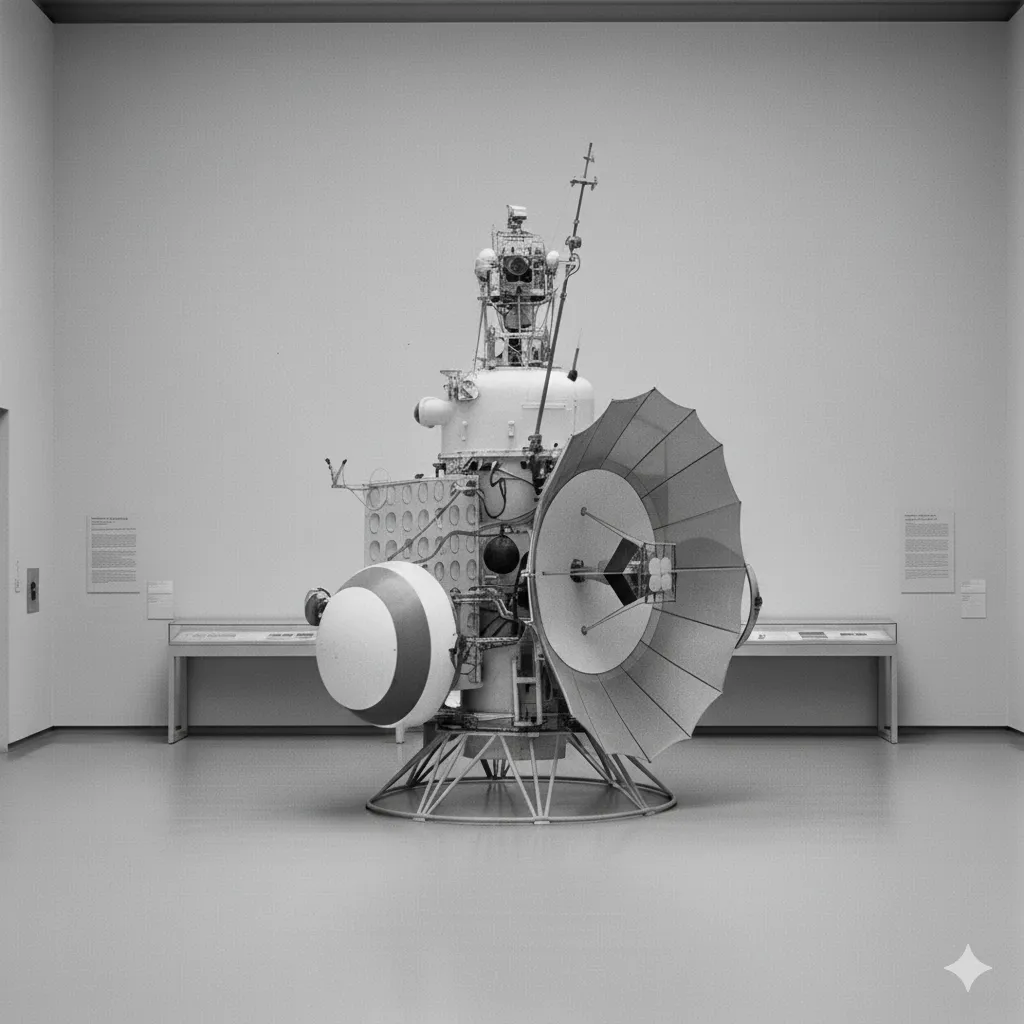
Mars 1, launched by the USSR in 1962, was the first probe on a successful trajectory to Mars. It held 61 communication sessions, gathering interplanetary space data. On March 21, 1963, contact was lost at 106 million km due to a faulty valve in the attitude control system , which prevented the antenna from pointing to Earth.
Agency

Country

Type
Flyby
Status
Launch
November 1, 1962
Technical Analysis of the Mars 1 Mission (2MV-4)
- Mission Designation: Mars 1
- Internal Designation (USSR): 2MV-4 No.4
- Western Designation: Sputnik 23 (Initially)
- Operating Agency: USSR Academy of Sciences
- Launch Date: November 1, 1962
- Launch Vehicle: Molniya 8K78
- Launch Site: Baikonur Cosmodrome
1. Mission Objectives
Mars 1 was designed as a flyby mission with the following primary objectives:
Scientific:
- Investigate the interplanetary environment between Earth and Mars, including measuring magnetic fields, solar wind, and cosmic radiation.
- Study the flux rate of micrometeoroids.
- Obtain images of the Martian surface during the flyby.
- Investigate the atmospheric structure of Mars and search for possible spectroscopic biosignatures.
Engineering:
- Validate the second-generation interplanetary spacecraft platform (2MV Series).
- Test long-range (interplanetary) communication systems.
- Demonstrate the trans-Mars injection capability of the Molniya launcher and the Blok-L upper stage.
2. Spacecraft Specifications (2MV-4 Platform)
The Mars 1 probe was an advanced spacecraft for its time, based on the modular 2MV platform designed for missions to Venus and Mars.
- Total Mass: 893.5 kg
- Architecture: A pressurized, cylindrical orbital module that housed avionics, thermal control, and batteries. This module was attached to a propulsion module.
- Dimensions: Approximately 3.3 meters in length and 1.1 meters in diameter (main bus).
- Power: Two large gallium-arsenide solar panels mounted on opposite sides of the orbital module, charging silver-zinc batteries.
- Attitude Control: Three-axis stabilization system. Orientation was maintained using a primary sun sensor, star sensors, and a system of cold nitrogen gas thrusters.
- Communications: One 1.7-meter diameter parabolic high-gain antenna (HGA) for long-distance communications, supplemented by omnidirectional low-gain antennas (LGA).
- Propulsion: A KDU-414 correction engine (liquid rocket motor) for mid-course trajectory maneuvers.
3. Scientific Instrumentation
The instrument package on Mars 1 was designed to study the interplanetary environment and make observations of Mars:
- Fluxgate Magnetometer: Mounted on a boom to measure interplanetary magnetic fields and search for a Martian field.
- Ion Traps and Plasma Detector: To measure the characteristics and spectrum of the solar wind.
- Radiation Counters: Including a scintillation counter and Geiger tubes to measure cosmic rays.
- Micrometeoroid Detectors: Piezoelectric sensors to register impacts.
- Spectroreflectometer: To search for hydrocarbon absorption bands on the Martian surface.
- Camera System: An imaging unit designed to take photographs of Mars during the flyby.
4. Mission Results
Mars 1 achieved a significant milestone by being the first spacecraft successfully launched on a trajectory toward Mars , following a series of previous Soviet launch failures[cite: 19, 21, 24, 30].
- Launch: The Molniya rocket and Blok-L upper stage performed nominally, injecting the probe onto an Earth-escape trajectory towards Mars.
- Interplanetary Cruise Phase: The spacecraft operated as planned for over four months. Communication with Earth was established 61 times.
- Scientific Data: During these sessions, Mars 1 gathered valuable data on the interplanetary environment. It provided the first measurements of the solar wind in deep space, confirmed the intensity of interplanetary magnetic fields, and measured micrometeoroid flux, finding it to be higher than expected.
5. Spacecraft Failure Analysis
- Failure Sequence: On March 21, 1963, when the probe was at a distance of 106 million kilometers from Earth, communication was lost.
- Root Cause: Post-mission analysis determined the most likely cause was a failure in the spacecraft's attitude control system. A faulty valve in the nitrogen gas system (used for orientation thrusters) had lost pressure.
- Failure Result: Without propellant gas, the spacecraft could not maintain its three-axis stabilization, which was critical for pointing the high-gain antenna toward Earth. The craft entered a state of gyroscopic (spin) stabilization.
- Impact: The antenna could no longer be oriented correctly, silencing the probe permanently. The primary mission of flying by Mars and taking images could not be completed.
- Final Fate: The silent probe continued on its trajectory, passing Mars on June 19, 1963, at an estimated distance of 193,000 km[cite: 38].
6. Technical Conclusion
The Mars 1 mission is considered a partial success. It marked a historic milestone as the first probe to be successfully sent on an interplanetary trajectory to Mars and returned fundamental scientific data about deep space. However, a technical hardware failure (an attitude system valve) prevented it from completing its primary objective of encountering Mars. The failure underscored the extreme difficulty of engineering long-duration systems for deep space missions.
Mission Milestones
Launch
Sol 13 of Acidalo, Year 5
230 days
of travel
Arrival at Mars
Sol 14 of Isido, Year 5