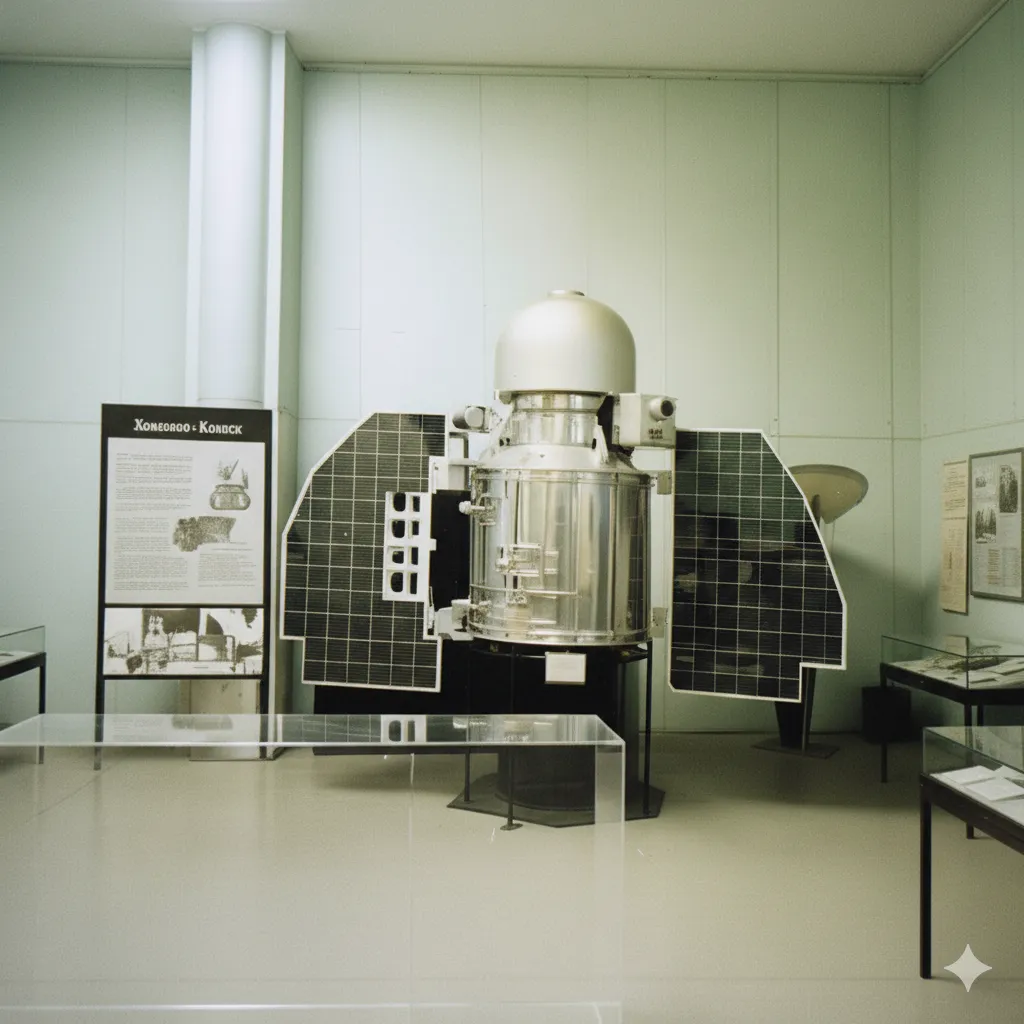
Mars 1M No.1
Mars 1M No.1 (Marsnik 1) was humanity's first attempt to reach Mars in 1960. The Soviet flyby mission failed during launch when the Molniya rocket's third stage suffered resonant vibrations , losing control and disintegrating before reaching Earth orbit.
Agency
Country

Type
Flyby
Status
Launch
October 10, 1960
Technical Analysis of the Mars 1M No.1 Mission (Marsnik 1)
- Mission Designation: Mars 1M No.1
- Internal Designation (USSR): Korabl 4
- Western Designation: Marsnik 1
- Operating Agency: USSR Academy of Sciences (Program managed by OKB-1)
- Launch Date: October 10, 1960
- Launch Vehicle: Molniya 8K78 (Series L1-4) [cite: 20]
- Launch Site: Baikonur Cosmodrome, Site 1/5
1. Mission Objectives
The primary objectives of the Mars 1M No.1 mission were fundamentally engineering and scientific in nature, designed for a flyby trajectory of Mars[cite: 20]:
Engineering:
- Validate the first-generation interplanetary spacecraft platform (1M Series).
- Test three-axis attitude control systems in deep space.
- Assess the feasibility of long-distance (interplanetary) communication.
- Test the performance of the new Molniya launch vehicle and the Blok-L escape stage.
Scientific:
- Obtain images of the Martian surface during the flyby[cite: 20].
- Measure the interplanetary magnetic field and search for a Martian magnetic field.
- Study the solar wind spectrum and cosmic rays outside Earth's magnetosphere.
- Detect the micrometeorite flux rate.
- Search for indications of organic matter using spectroreflectometry.
2. Probe Specifications (Mars 1M Platform)
The Mars 1M probe was the first deep space probe design developed by the OKB-1 bureau.
- Total Mass: 640 kg
- Scientific Payload Mass: 10 kg
- Architecture: A hermetically sealed, pressurized cylindrical module (0.9 m diameter, ~2 m height) housing the main avionics and batteries. This design was used to simplify thermal control.
- Attitude Control: Three-axis stabilization system. Orientation was determined by a primary sun sensor and secondary star sensors. Actuation was achieved via cold nitrogen gas thrusters and reaction wheels.
- Power: Two solar panels (total area of 2 m²) charging a set of silver-zinc batteries.
- Communications: A parabolic grid high-gain antenna (HGA) for telemetry and image transmission, supplemented by omnidirectional low-gain antennas (LGA).
- Propulsion: A trajectory correction (KDU) system based on a bipropellant engine (UDMH/Nitric Acid) designed for a single mid-course correction (TCM).
3. Scientific Instrumentation
The 10 kg instrument package included:
- Fluxgate Magnetometer: Mounted on a boom to minimize magnetic interference from the probe.
- Scintillation Counter and Gas-Discharge Counter: To measure cosmic ray radiation.
- Piezoelectric Micrometeorite Detector: To register particle impacts.
- Ion Trap: To measure solar wind characteristics.
- Spectroreflectometer: To analyze reflected light for absorption bands associated with hydrocarbons (an early attempt to search for biosignatures).
- Imaging System (TV Camera): Designed to activate during the flyby.
4. Launch Vehicle and Escape Stage
The mission required the development of a new variant of the R-7 launcher, the Molniya 8K78. This 4-stage vehicle consisted of:
- Stages 1 and 2 (Blok B, V, G, D and Blok A): The standard R-7 configuration.
- Stage 3 (Blok-I): A new, more powerful third stage, derived from the Vostok rocket's Blok-E stage, but using a more efficient RD-0107 engine.
- Stage 4 (Blok-L): A critical escape stage. It was designed to ignite in a parking orbit (LEO) to inject the probe onto a hyperbolic escape trajectory toward Mars.
5. Launch Failure Analysis
- Initial Sequence (T=0 to T=300 s): The launch occurred on October 10, 1960. Stages 1 and 2 of the Molniya vehicle performed nominally, separating correctly. The third stage (Blok-I) initiated its burn as planned.
- Failure Event (T+309 s): During the operation of the third stage, a catastrophic failure occurred in the flight control system.
- Root Cause: Post-flight analysis determined the primary cause to be resonant longitudinal vibrations (Pogo oscillations) that had not been anticipated during ground testing. These vibrations exceeded the tolerance limits of the stage's gyroscopic guidance system (STN-1).
- Result of Failure: The destabilized gyros transmitted erroneous commands, leading to a total loss of attitude control. The vehicle veered from its programmed trajectory. The third stage engine shut down prematurely[cite: 23].
- Impact: The rocket failed to achieve Earth parking orbit. The fourth stage (Blok-L) and the Mars 1M No.1 probe never had the opportunity to activate. The payload and upper stages were destroyed during atmospheric reentry over Eastern Siberia.
6. Technical Conclusion
The Mars 1M No.1 mission was a launch failure. The failure is directly attributed to an aeroelasticity phenomenon (Pogo oscillations) in the launcher's third stage, which induced a guidance system failure. The spacecraft and its systems were never tested in the interplanetary environment. The USSR did not publicly acknowledge the launch or its objective; US intelligence tracked the failed launch and designated it Korabl 4.
Mission Milestones
Launch
Sol 23 of Utopo, Year 3