
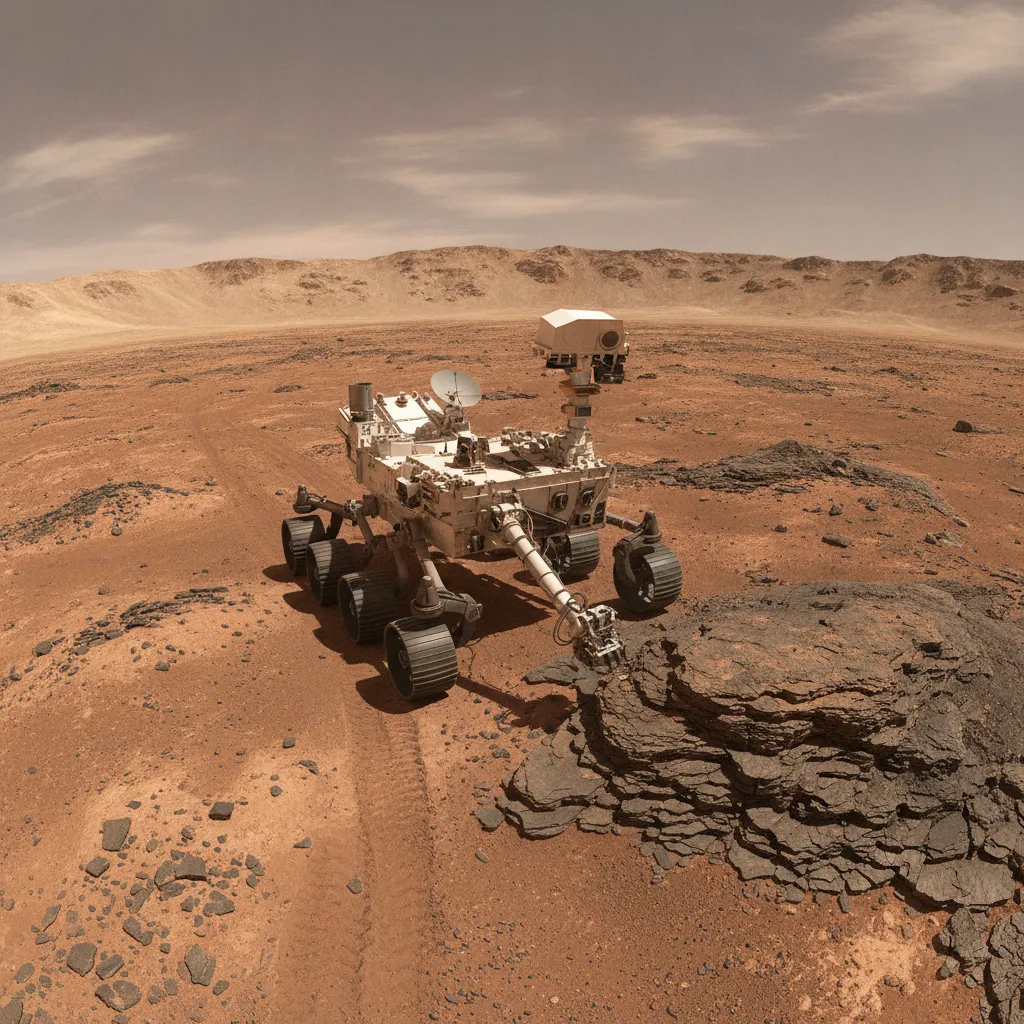


Technical Analysis of the Perseverance Mission (Mars 2020)
- Mission Designation: Mars 2020 (Perseverance)
- COSPAR Designation: 2020-052A
- Operating Agency: NASA / JPL
- Launch Date: July 30, 2020, 11:50:00 UTC
- Launch Vehicle: Atlas V 541 rocket (AV-088 configuration)
- Launch Site: Launch Complex 41 (SLC-41), Cape Canaveral, USA
- Landing Site: Jezero Crater (Octavia E. Butler Landing), Mars
- Landing Coordinates: 18.447° N, 77.402° E
- Mission Status: Mission Extended
1. Historical Context and Detailed Objectives
The scientific gap that the Perseverance mission aimed to fill included the detailed characterization of an ancient lacustrine environment on Mars and the search for biosignatures preserved in fluvial sediments. The primary objectives focused on:
Scientific:
- Search for signs of ancient microbial life in the geological formations of Jezero crater.
- Characterize the local geology and past climate of the planet in the ancient river delta.
- Collect, drill, and store rock and regolith samples in sealed titanium tubes for a future return to Earth.
Engineering:
- Validate technologies for future human exploration, including in-situ oxygen production.
- Demonstrate the capability of powered atmospheric flight on another planet using the Ingenuity helicopter.
2. Vehicle Architecture and Main Subsystems
The Perseverance rover has a dry mass of approximately 1025 kg and dimensions of 3 m in length, 2.7 m in width, and 2.2 m in height. The main power system is based on a Multi-Mission Radioisotope Thermoelectric Generator (MMRTG) fueled with plutonium-238, which supplies an initial electrical power of approximately 110 W, complemented by two lithium-ion batteries and electric double-layer capacitors (EDLCs). Communications are managed via UHF band and X-band in direct link with Earth or through relay orbiters. Mobility is supported by a six-wheel undercarriage with a rocker-bogie suspension.
3. Payload and Scientific Instrumentation
The scientific and instrumental payload is composed of the following systems:
- Mastcam-Z: stereoscopic zoom camera system for panoramic imaging and mineralogical analysis.
- SuperCam: spectrometer, camera, and microphone for remote chemical, mineralogical, and organic compound analysis.
- PIXL: X-ray fluorescence spectrometer and high-resolution camera for microscale elemental composition.
- SHERLOC: ultraviolet laser spectrometer and high-resolution camera to detect organic compounds and fine mineralogy.
- RIMFAX: subsurface radar to obtain images of the internal geological structure.
- MEDA: set of meteorological sensors to measure wind, pressure, temperature, humidity, and radiation.
- MOXIE: technological experiment to generate oxygen from atmospheric carbon dioxide.
- Cachecam, Hazcam, and Navcam: set of auxiliary cameras for sample storage control, hazard avoidance, and navigation.
4. Chronology and Mission Phases
Following its launch on July 30, 2020, the spacecraft completed its interplanetary cruise until landing in Jezero crater on February 18, 2021. During the spring of 2021, the deployment and historic flights of the Ingenuity helicopter took place. The formal scientific campaign kicked off in September 2021 with the extraction of the first rock cores. The mission exceeded 45 km of cumulative travel by the end of 2026, operating in its extended mission phase.
5. Results and Discoveries
Analyses have confirmed the existence of an ancient lake fed by a river delta system in Jezero crater. Numerous sedimentary and igneous rock cores have been extracted and hermetically sealed, highlighting findings such as the "Cheyava Falls" rock with signs of astrobiological interest. Likewise, MOXIE successfully demonstrated in-situ oxygen production, and the meteorological and acoustic instruments have provided unprecedented continuous records.
6. Legacy and Significance
Perseverance represents a fundamental milestone in the astrobiological exploration of Mars by establishing the first systematic depot of samples destined to return to Earth. Furthermore, the integration of technologies such as controlled flight in the Martian atmosphere and the utilization of in-situ resources lays the technical groundwork for future human missions to the red planet.
Related
Missions
- 🛰️ Ingenuity