
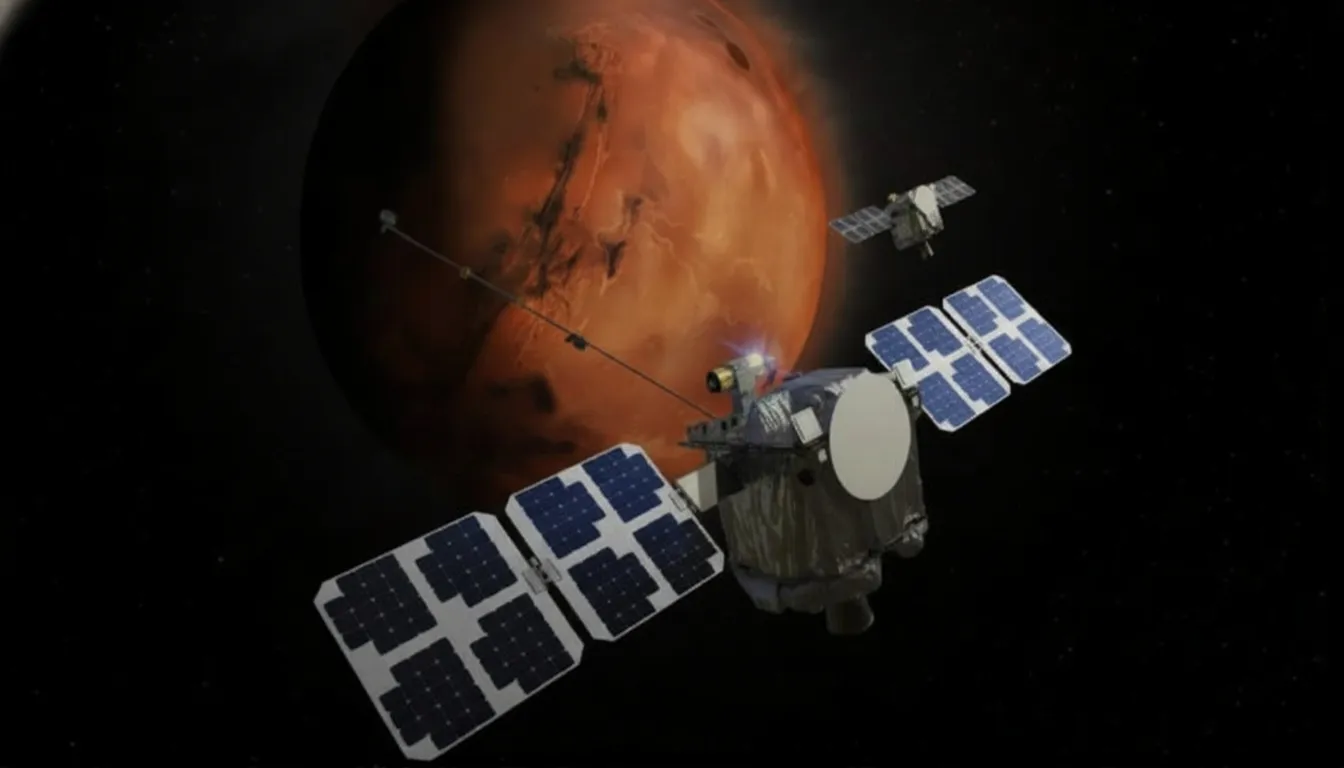


Technical Analysis of the ESCAPADE Gold (SIMPLEx-4B) Mission
- Mission Designation: ESCAPADE Gold
- Alternative Designation: SIMPLEx-4B (Escape and Plasma Acceleration and Dynamics Explorers)
- Operating Agency: NASA (in collaboration with the University of California, Berkeley)
- Launch Date: November 13, 2025, at 20:55:01 UTC
- Launch Vehicle: Blue Origin New Glenn rocket (7×2 configuration)
- Launch Site: Launch Complex 36A, Cape Canaveral Space Force Station, Florida, United States
- Mission Status: En route (interplanetary transit)
1. Historical Context and Detailed Objectives
The ESCAPADE mission represents a milestone in the twin exploration of Martian space dynamics. The scientific gap it aimed to fill revolved around the simultaneous, three-dimensional understanding of the Martian magnetosphere and the physical processes responsible for the historical loss of its atmosphere. Primary objectives focused on investigating how the solar wind interacts with the crustal magnetic field and the upper atmosphere, as well as assessing the planet's response to space weather through coordinated observation with its sister spacecraft, ESCAPADE Blue.
2. Vehicle Architecture and Main Subsystems
Each twin spacecraft has a launch mass of 535 kg (418 kg total dry mass for both, equivalent to 209 kg dry mass per unit). Their stowed dimensions are 1.20 × 1.65 × 1.09 m, and when deployed they reach 4.88 × 1.65 × 1.09 m. The power system uses solar panels providing a nominal power of 128 W in science mode and up to 288 W at the point furthest from the orbit (aphelion). Telecommunications are operated using X-band transponders. Mobility and propulsion are integrated into Rocket Lab's Photon platform, providing a delta-v greater than 2,500 m/s. The planned orbital parameters at Mars contemplate a periapsis of 160 km altitude and an apoapsis between 7,000 and 10,000 km, with an orbital inclination of 60 degrees.
3. Payload and Scientific Instrumentation
The payload is composed of three main instruments designed to characterize the plasma environment:
- EMAG (ESCAPADE Magnetometer): Magnetometer built by NASA's Goddard Space Flight Center to quantify and map Mars' magnetic field.
- EESA (ESCAPADE ElectroStatic Analyzers): Ion and electron electrostatic analyzers designed by the University of California, Berkeley to observe suprathermal particles.
- ELP (ESCAPADE Langmuir Probe Suite): Langmuir probe provided by Embry-Riddle Aeronautical University to measure thermal plasma densities and the solar wind environment.
4. Chronology and Mission Phases
The mission lifted off on November 13, 2025, at 20:55:01 UTC, successfully establishing communications the same day. Between December 2025 and January 2026, trajectory correction maneuvers were executed to establish a parking orbit around the Earth-Sun L2 Lagrange point. In March 2026, the spacecraft performed a test campaign crossing the Earth's magnetic tail one million kilometers from Earth. The next relevant milestone will be the Earth gravity assist flyby scheduled for November 2026, culminating with Martian orbital insertion programmed for September 2027 and the start of the main science phase in spring 2028.
5. Results and Discoveries
Being currently in the interplanetary cruise phase and transit to Mars, definitive scientific results on the three-dimensional magnetosphere will be obtained after orbital insertion. However, preliminary instrument tests carried out in the terrestrial environment during March 2026 allowed the collection of unprecedented data on magnetic reconnection and charged particles.
6. Legacy and Significance
ESCAPADE lays the foundation for the use of low-cost twin spacecraft architectures under the SIMPLEx program, allowing simultaneous multipoint measurements with high spatial and temporal resolution in the Martian thermosphere and magnetosphere.