
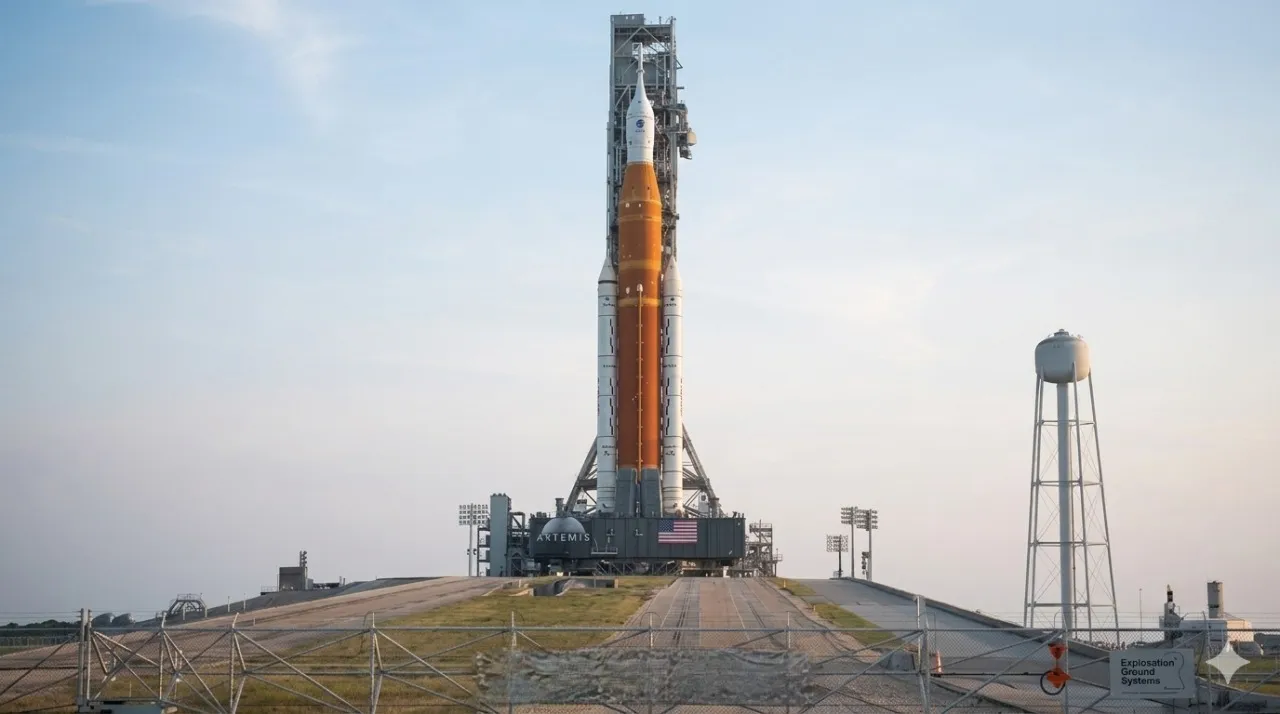
The return of the Artemis II mission on April 11, 2026, marked a milestone by consolidating the capabilities of the Space Launch System rocket —the colossal SLS— and the Orion capsule after their circumlunar journey. However, cosmic exploration is an unforgiving teacher that leaves no room for oversight. Post-flight inspections revealed that the spacecraft's heat shield experienced greater erosion than expected when braving atmospheric friction at nearly 40,000 km/h. Facing this scenario, the agency's new administrator, Jared Isaacman, took the reins with a strictly pragmatic vision. The Artemis III mission, originally conceived as the glorious human return to the surface of the Moon, has undergone a profound strategic adjustment and will no longer travel to our satellite. NASA will officially announce its four crew members next Tuesday, June 9, 2026, from Houston, unveiling a change of plans that prioritizes safety over spectacle.
A past analogy in Earth orbit
Under this new architecture, the mission will remain at an altitude of approximately 463 km in a low Earth orbit. Curiously, the maneuver directly evokes the strategy of the mythical Apollo 9 mission in 1969, which preferred to test the lunar module close to home before taking the great leap with Apollo 11. To put it simply, it is the equivalent of testing a complex high-mountain camping tent in your own backyard before setting off to summit Everest: if something fails with the zippers or the structure, it is much better to find out where rescuers are just minutes away rather than thousands of kilometers away in the vacuum. In this safe microgravity environment, the crew will validate Axiom's AxEMU surface suits and dock with commercial human landing systems from SpaceX and Blue Origin. This operational simplification allows dispensing with the upper propulsive stage on the SLS, reserving the valuable technical inventory for the true deep descents.
Geology and diplomacy in landing missions
This paradigm shift aligns with the Ignition program, an initiative of the Donald Trump administration that has paused the development of the Lunar Gateway orbital station to concentrate about 20 billion dollars directly on a permanent base at the lunar South Pole. With the landing delayed, the Artemis IV and Artemis V missions —scheduled for early and late 2028, respectively— become the true spearheads on the ground. Astronaut profiles will shift radically, moving from the test pilots needed in the orbital phase to field scientists. Here, figures like Dr. Lauren Edgar stand out, a planetary geologist with extensive experience in Martian missions and on the program's original science team, whose trained eye will be vital for identifying water ice in craters. She will be accompanied by veterans like Dr. Jessica Watkins, echoing the scientific legacy of the Apollo missions.
The international puzzle
The temporary cancellation of the Gateway has forced a restructuring of the complex technology barters and flight seats with international partners. Since Artemis III has become a purely operational test flight, NASA will maintain an exclusively American crew so as not to waste valuable flight quotas in low orbit. True space diplomacy will unfold on the surface of the Moon. The European Space Agency has guaranteed seats thanks to the supply of the Orion service module, projecting that a German astronaut will fly in orbit on Artemis IV and that the first European footprint will be left by a crew member on Artemis V. Meanwhile, the Japanese agency JAXA has secured an enviable position by developing the Lunar Cruiser, a pressurized rover that will function as a sophisticated space motorhome where astronauts can explore the South Pole without suits for a month. The price of progress is slow and bureaucratic, but the construction of this lunar neighborhood has already begun.
Related
Related news and articles
- 📰 The Strategic Shift Toward the Moon Base Reconfigures ESA's Alliances With NASA 15 JUN 2026
- 📰 ESCAPADE Prepares its Mars Trajectory Resumption After a Unique Orbital Loiter Phase 21 OCT 2026
- 📰 The Era of Interplanetary Alliances: The Aeolus Mission and NASA's New Paradigm on Mars 24 JUN 2026
- 📰 Perseverance's Martian Marathon and the Silent Revolution of Autonomous Artificial Intelligence 20 JUN 2026
Marspedia terms
Enjoyed it? Keep exploring
Back to all news