
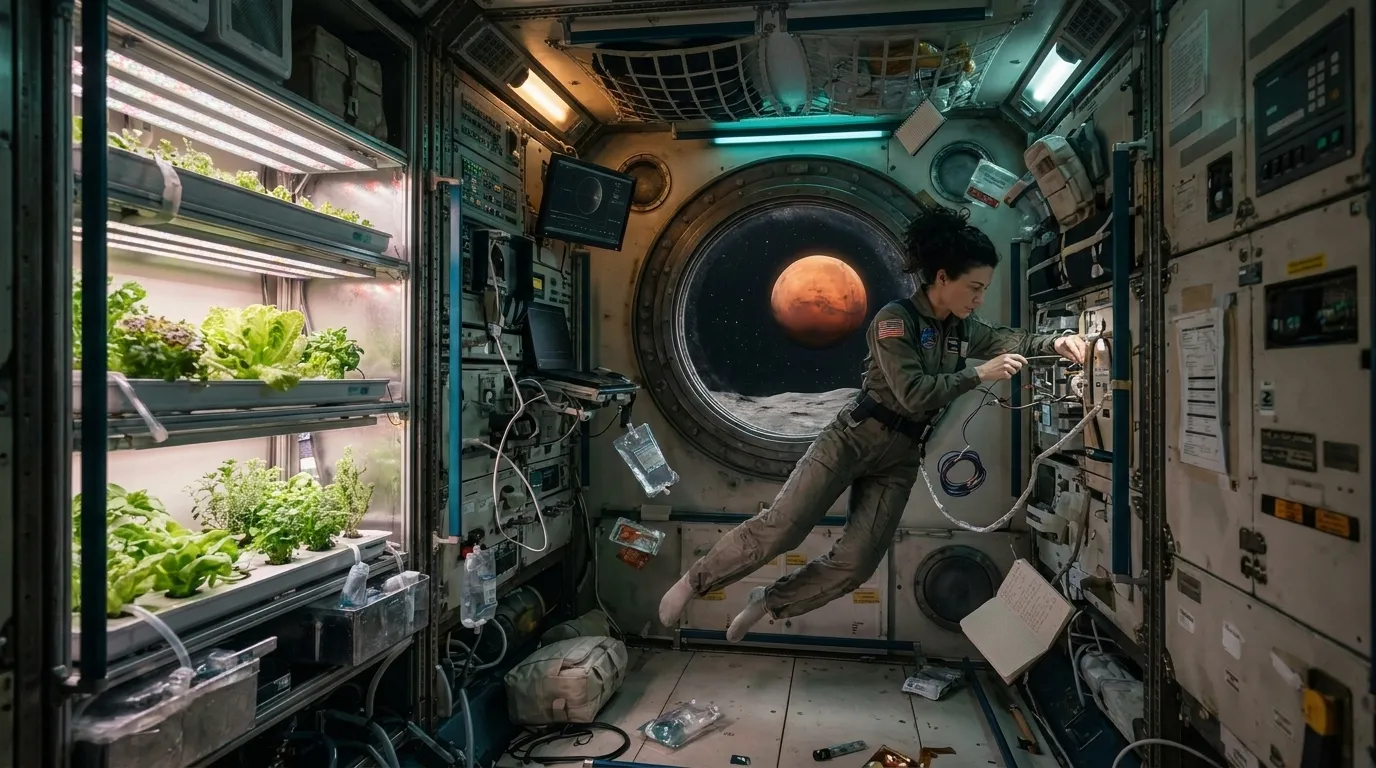
A floating notepad and loose wires on the floor. Definitive proof that keeping your workspace organized is twice as hard when the laws of physics decide that everything can suddenly fly away.
The conquest of the Red Planet represents humanity's greatest exploratory milestone, but before stepping onto its regolith, we must solve the great unknown of the journey. How will the long six-month journey to Mars affect the minds and bodies of astronauts? This transit is unlike anything experienced in low-Earth orbit missions. Confined to a habitable volume equivalent to a shipping container, a crew of explorers must coexist in the absolute void, facing a radical disconnection from everything that defines our ordinary terrestrial experience. The physics of deep space imposes relentless challenges ranging from subtle bone deterioration to the mental silence of interplanetary isolation.
The biological paradox of zero gravity and bone degradation
The human body is an evolutionary monument sculpted under the constant influence of Earth's gravity. Each of our systems, from blood flow to bone density, assumes that there is a constant downward pulling force. When we remove this force in deep space, physiology enters a state of biological bewilderment. Without the constant mechanical resistance of the ground, the brain pragmatically interprets that the skeletal structure is excessive and begins to dismantle it. This bone resorption process is comparable to a construction company deciding to remove the support beams of a building assuming they will no longer hold any weight. Astronauts can lose between one and one and a half percent of their bone mass for each month in microgravity, releasing large amounts of calcium into the bloodstream, which exponentially raises the risk of suffering painful kidney stones.
Muscles suffer a similar fate. Having to oppose no gravity to maintain posture or move around, muscle fibers begin to atrophy rapidly. To mitigate this degradation —which resembles the loss of volume experienced by a leg after being in a cast for weeks—, the crew must perform at least two hours of grueling daily physical exercise using harnesses and vacuum systems that simulate body weight. Furthermore, the absence of gravity completely alters fluid distribution. The body's blood and water migrate toward the upper half of the torso and the head, causing the well-known puffy face syndrome and chronically congesting the nasal sinuses. This fluid shift raises intracranial pressure, slightly flattening the back of the eyeball and deforming the optic nerve, a disorder known as Spaceflight-Associated Neuro-ocular Syndrome (SANS) that can cause permanent vision loss.
The sensory laboratory: space nutrition and the loss of taste
Nutrition in deep space goes far beyond simple caloric intake; it is a fundamental pillar for the crew's mental stability. However, the menu during the trip to Mars lacks any trace of fresh food. The astronauts depend entirely on freeze-dried rations and thermostabilized dishes sealed in multilayer plastic bags. To feed themselves, they must rehydrate their portions by injecting hot water through a pressurized dispenser. Although this process restores their food's liquid or pasty consistency, it completely destroys the crunch and texture of a fresh dish. This dietary monotony quickly becomes a source of psychological dissatisfaction.
Curiously, the pleasure of eating is drastically diminished by the space flight's own physiology. Having their nasal sinuses permanently inflamed due to the shift of body fluids, the sense of smell is reduced to minimal levels. Since most of what we perceive as flavor actually comes from smell, space food feels flat and tasteless to them, with a texture that astronauts often describe as wet cardboard. It is the same frustrating effect we experience when trying to savor our favorite food in the midst of a severe winter flu. To compensate for this sensory loss, space nutritionists must saturate dishes with extremely hot spices and acidic condiments. Despite these efforts, the crew often experiences an alarming loss of appetite and weight, compromising their energy levels to face the demanding scientific and operational tasks of the mission.
The abyss of isolation and the psychology of boredom
The human mind is, perhaps, the most sensitive structure to the environment of interplanetary confinement. Living for 180 days with the same five people in a closed space with no possibility of escape subjects human relationships to unprecedented strain. On Earth, in the face of any conflict, we can always go for a walk or change our environment. In the spacecraft, there is no way out. Studies conducted in long-duration analog environments, such as NASA's CHAPEA missions or the Mars-500 experiment, show that prolonged confinement amplifies small daily frictions and can trigger episodes of anxiety, depression, and a phenomenon known as the third-quarter effect, where crew motivation decays severely once past the midpoint of the mission.
The extreme distance from Earth also introduces a psychological obstacle unparalleled in history: the communication delay. As the spacecraft moves toward Mars, the distance causes radio signals traveling at the speed of light to take up to twenty minutes to travel from the vehicle to Earth and another twenty minutes to return. This makes real-time phone calls or chats with family members or the psychological support team completely impossible. The crew must learn to be psychologically autonomous, managing the deep loneliness produced by looking out the hatch and seeing that Earth is just a pale blue dot, almost invisible, floating in the immensity of the cosmic void. Chronic boredom and the lack of new external stimuli are fought through strictly structured schedules, but mental fatigue remains one of the greatest dangers to the mission's success.
Life support systems: the engineering of an artificial ecosystem
To survive this journey, the spacecraft must function as a closed ecosystem that recycles every last available resource. Next-generation Environmental Control and Life Support Systems (ECLSS) manage this titanic task. The air the astronauts breathe is continuously purified using zeolite filters that extract exhaled carbon dioxide, while oxygen is recovered through the Sabatier reaction, a chemical process that combines carbon dioxide with leftover hydrogen to generate water and methane. This recycling system is so strict that even the crew's urine and the ambient humidity generated by sweat and breathing are collected, purified, and converted back into drinking water of the highest purity, making the famous space maxim a reality: today's coffee comes from yesterday's urine.
This total dependence on technology generates added psychological pressure. Any minor failure in the life support system exposes the crew to a suffocating death or carbon dioxide poisoning. Maintaining this delicate biological balance requires that astronauts perform constant preventive maintenance tasks, transforming their daily routine into a technical struggle for survival. The conquest of the Red Planet will require us to redefine not only our aerospace engineering, but the way we understand our own biology and coexistence in the universe. The journey is long and the abyss is deep, but human curiosity will always find a way to cross it. Until our next cosmic lesson, fellow travelers.