
.png)

COSPAR ID: 2020-047A
Official Name: Emirates Mars Mission (EMM) - Hope Probe (Al Amal)
Responsible Space Agency: United Arab Emirates Space Agency (UAESA) / Mohammed bin Rashid Space Centre (MBRSC)
Launch Date and Time: July 19, 2020, 21:58:14 UTC
EDL / Orbital Insertion Date and Time: February 9, 2021, 15:57 UTC (Mars Orbital Insertion - MOI)
Science Orbit Coordinates / Parameters: Supersynchronous elliptical orbit ranging from 19,970 km (periapsis) to 42,650 km (apoapsis), with a 25-degree inclination relative to the Martian equator
Launch Vehicle: Mitsubishi Heavy Industries H-IIA (Flight F42)
Current Mission Status: Operational in extended mission phase (approved until December 2028)
1. Historical Context and Detailed Objectives
The Emirates Mars Mission, realized through the Hope orbiter, emerged from a strategic state plan in 2014 aimed at transforming the United Arab Emirates' economic structure into an advanced technical knowledge-based economy. Developed in collaboration with the Laboratory for Atmospheric and Space Physics (LASP) at the University of Colorado Boulder, the University of California, Berkeley, and the University of Arizona, the platform sought to fill a critical observational gap in planetary sciences: the simultaneous and global understanding of Mars' atmospheric dynamics across all diurnal and seasonal timescales.
The primary scientific objectives are divided into three fundamental pillars. First, to characterize the meteorological state of the lower atmosphere by tracking the distribution of ice clouds, dust storms, and thermal profiles. Second, to interconnect these tropospheric conditions with the structure of the middle thermosphere, mapping the local abundance of oxygen and hydrogen. Third, to quantify the escape rates of these neutral gases into deep space to discern the physical mechanisms behind the loss of the Martian atmosphere. As a secondary objective, the mission serves as an infrastructure of opportunity to characterize minor bodies within the Martian system, specifically the moon Deimos.
2. Spacecraft Architecture and Primary Subsystems
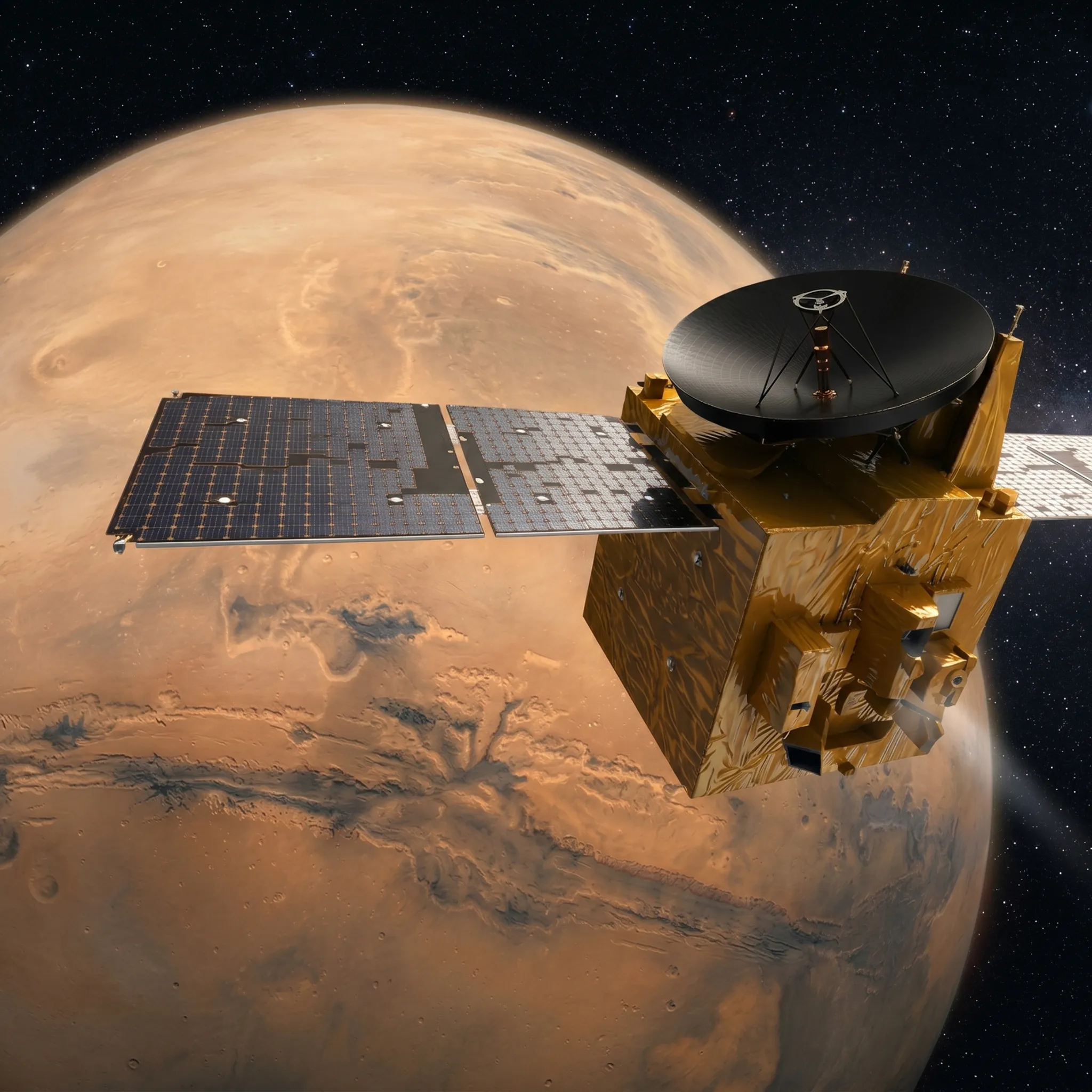
The Hope probe features a main structure composed of aluminum honeycomb sandwich panels with carbon fiber faces, configuring a prism measuring 2.37 meters wide by 2.90 meters long. At launch, the total mass of the spacecraft stood at 1,350 kilograms, of which 550 kilograms correspond to the dry structural mass and the remaining 800 kilograms to the monopropellant fuel (hydrazine).
The main propulsion system utilizes six 120-Newton thrust engines mounted on the lower base, assisted by eight 5-Newton thrusters belonging to the reaction control system for fine attitude control and momentum desaturation of its four reaction wheels. Orbital determination is executed using a redundant pair of high-precision star trackers and digital sun sensors. Electrical power generation is achieved via two trackable solar panels that produce 1,800 watts near Earth and drop to approximately 600 watts in Mars orbit due to the attenuation of the heliocentric solar constant; this power charges a lithium-ion battery system, supporting a nominal spacecraft consumption of 477 watts.
The telecommunications subsystem consists of a Frontier Radio transponder operating in X-band coupled to a 1.5-meter diameter high-gain parabolic antenna and three low-gain omnidirectional antennas. Telemetry data transfer rates vary dynamically depending on the alignment distance to Earth: reaching a maximum of 1.6 megabits per second during conjunction and dropping to 250 kilobits per second at points of maximum orbital separation during opposition.
3. Payload and Scientific Instrumentation
Emirates eXploration Imager (EXI)
This is a high spatial resolution multiband camera operating with a dual optical telescope and a six-position filter wheel. Three of these filters cover the ultraviolet spectrum (220, 260, and 320 nanometers) and three cover the visible spectrum (RGB bands centered at 635, 546, and 437 nanometers). Its physical principle is the photometry of radiance reflected by the planetary disk. To understand how it measures atmospheric ozone in the ultraviolet, think of polarized sunglasses that selectively block specific glares; EXI detects which wavelengths are absorbed by ozone, deducing its exact concentration. The detection range offers a pixel resolution from 2 to 8 kilometers per pixel. It was manufactured by LASP in collaboration with MBRSC with the purpose of mapping water ice, dust optical depth, and column-integrated ozone abundance.
Emirates Mars Infrared Spectrometer (EMIRS)
This is a Fourier transform infrared interferometric spectrometer operating in the mid-infrared range, covering wavelengths from 6 to 100 micrometers with selectable spectral samplings of 5 and 10 inverse centimeters. Its physical principle is based on thermal emission spectroscopy: every object with temperature emits infrared photons that reveal its composition and thermal state. A helpful analogy is a remote industrial infrared thermometer, capable of deducing an engine's heat without touching it; EMIRS analyzes the thermal signature of the ground and atmospheric layers to infer temperatures. Developed by Arizona State University and MBRSC, its purpose is to obtain vertical thermal profiles of the troposphere (0 to 50 kilometers) and calculate the thermal inertia of the regolith.
Emirates Mars Ultraviolet Spectrometer (EMUS)
This is a far-ultraviolet imaging spectrograph that utilizes a concave mirror focused onto a Rowland circle and a photon-counting detector with a cesium iodide photocathode. It operates in the 100 to 170 nanometer spectral range with three mechanical slits that modify the spectral resolution to 1.3, 1.8, and 5.0 nanometers. It functions by detecting solar resonance and fluorescence emissions from neutral gases in the upper atmosphere. Its everyday analogy is the operation of office fluorescent tubes, where an excited gas emits invisible light at specific wavelengths when interacting with electrons. Manufactured by LASP, its purpose is to quantify dayglow and the escape rates of exospheric hydrogen and oxygen through four coordinated three-dimensional scanning strategies.
4. Launch Vehicle and Flight / EDL Profile
Orbital injection into the Type-1 interplanetary transfer trajectory was performed using the H-IIA liquid-propellant rocket from Tanegashima. Following a seven-month cruise phase during which three trajectory correction maneuvers (TCM) were completed to refine the approach vector, the probe reached Mars' gravitational well on February 9, 2021.
As this was not a surface landing mission, the critical Entry, Descent, and Landing phase was replaced by an autonomous Mars Orbital Insertion (MOI) maneuver. At 15:30 UTC, the probe synchronously fired its six 120-Newton thrusters for 27 consecutive minutes, reducing the spacecraft's relative velocity from 121,000 kilometers per hour to 18,000 kilometers per hour (transitioning from a regime equivalent to Mach 25 in the upper atmosphere to gravitational capture). During this massive braking event, the propulsion subsystem burned approximately 60% of the total hydrazine fuel on board. No thermal anomalies or reaction wheel guidance failures were recorded, successfully inserting the spacecraft into an initial provisional 40-hour orbit before its automatic transition to the supersynchronous science orbit with a 55-hour revolution period.
5. Operational Development and Scientific Results
The active science phase officially began on May 23, 2021. Thanks to the dynamic decoupling of the high elliptical orbit, which allows a complete meteorological sweep of all planetary time zones in 9-to-10-day cycles, EMIRS successfully characterized the structure of the 6-hour and 4-hour thermal tides. Physical modes revealed that these waves are evanescent and dissipate their energy mechanically in the lower troposphere, inducing cyclic surface pressure peaks at approximately 08:00 and 20:00 local solar time.
In the field of wind dynamics, the EXI camera systematically documented 50 independent lee wave cloud events during Martian Year 36. These clouds form through the adiabatic cooling of water vapor as it moves over sharp topographic obstacles like the massive Tharsis volcanic calderas, showing a strong seasonal concentration during northern hemisphere winter, a period characterized by extreme wind shear rates.
The mission's frontier breakthroughs include the first morphological characterization of the Sinuous Discrete Aurora (SDA) by the EMUS instrument at the 130.4-nanometer wavelength. This colossal, twisting luminous band of emission extends for thousands of kilometers across the nightside due to the interaction of energetic solar wind electrons accelerating through the central current sheet of the Martian magnetotail. Additionally, the patchy proton aurora was discovered on the dayside, providing a geographic map of localized magnetic instability zones where solar protons directly impact the upper thermosphere.
In March 2023, orbital adjustments enabled close flybys of Deimos at distances of 100 kilometers, capturing the first-ever multispectral data of its far side. The flat reflectance spectrum measured by EXI and the thermal signatures from EMIRS revealed a regolith composed of basalts similar to the Martian crust, challenging the captured Type-D asteroid theory in favor of a co-orbital impact origin. Finally, in October 2025, Hope leveraged its lateral orbital positioning relative to the Sun to spectroscopically intercept the interstellar comet 3I/ATLAS at 0.2 astronomical units, measuring carbon monoxide outgassing and fragmentation rates during its perihelion passage.
6. Conclusion and Technical Legacy
The Hope probe has demonstrated the engineering feasibility of high-altitude elliptical science orbits for the continuous synoptic analysis of planetary atmospheres, an operational approach that serves as a baseline for the meteorological modeling of terrestrial planets. The success in managing autonomous systems during the MOI maneuver and deep-space operations has provided the design foundation for systems, navigation algorithms, and radiometric calibration for the upcoming Emirates Mission to the Asteroid Belt (EMA), scheduled for 2028 using the MBR Explorer spacecraft. The mission's legacy consolidates the access of emerging nations to deep-space exploration under international standards of methodological rigor.
Related
Missions
- 🛰️ Opportunity
Events
- 📅 Launch of Hope (Al Amal) 19 JUL 2020 · 21:58 UTC · SOL 26 OF MANGALO OF YEAR 35
- 📅 Mars Arrival of Hope (Al Amal) 9 FEB 2021 · 15:57 UTC · SOL 2 OF ACIDALIO OF YEAR 36
Marspedia terms
- 📖 Regolith
- 📖 EDL
- 📖 Spectrometer
- 📖 Deimos
- 📖 Apoapsis
- 📖 Periapsis
- 📖 Solar Wind
- 📖 COSPAR