
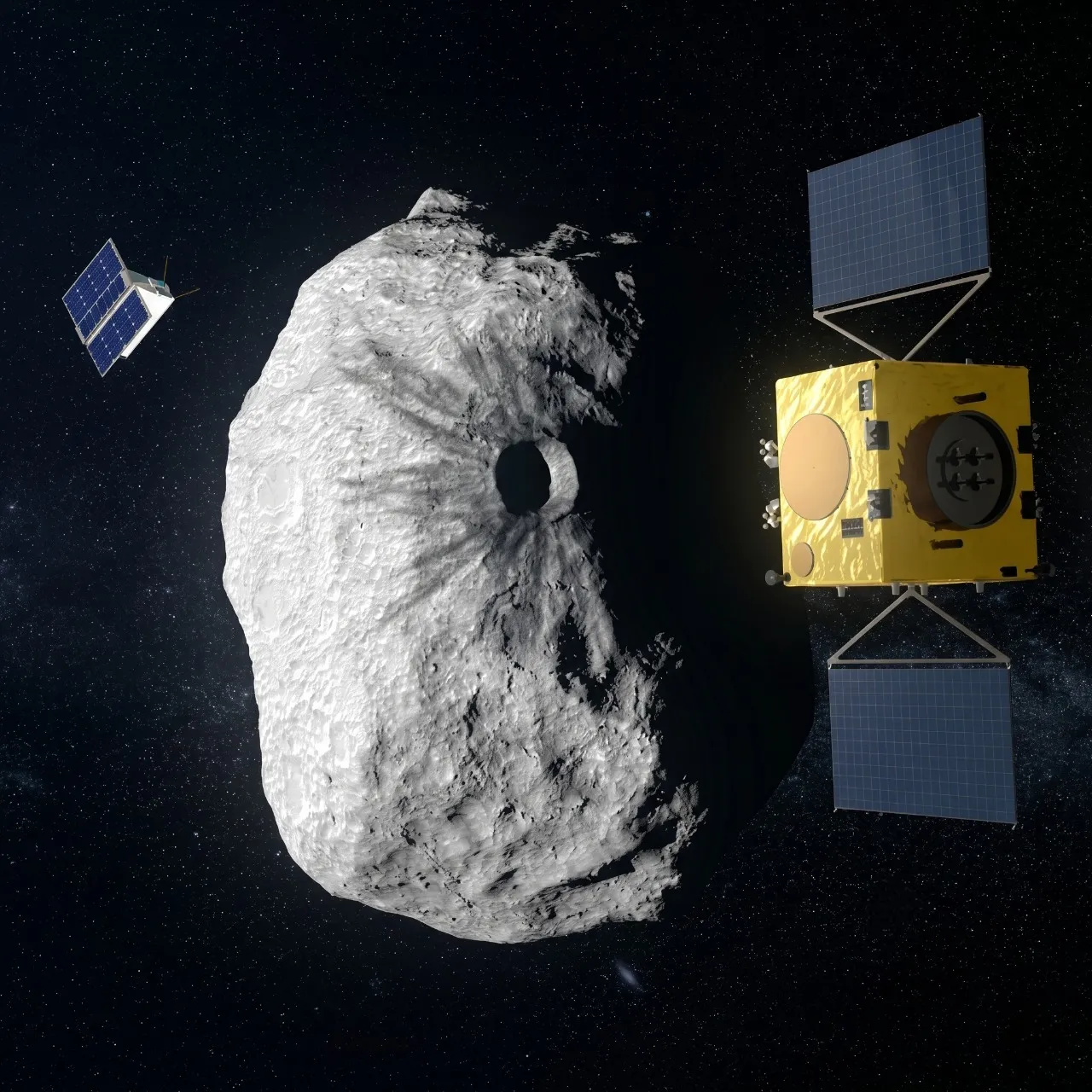


COSPAR ID: 2024-184A
Official Name: Hera Spacecraft (ESA Planetary Defense Mission)
Responsible Space Agency: European Space Agency (ESA)
Launch Date and Time: October 7, 2024, 14:52:11 UTC
Mars and Deimos Flyby Date and Time: March 12, 2025 (Closest approach to Deimos at 12:07 UTC; closest approach to Mars at 12:51 UTC)
Encounter Geometry / Coordinates: Hyperbolic flyby trajectory; minimum altitude of 5,000 km above the Martian surface and between 300 km and 1,000 km relative to the moon Deimos.
Launch Vehicle: Falcon 9 Block 5 (SpaceX)
Current Mission Status: Post-Mars flyby heliocentric cruise phase, en route to the 65803 Didymos binary asteroid system.
1. Historical Context and Detailed Objectives
The genesis of the Hera mission is part of the international effort to consolidate real planetary defense capabilities against potential asteroid impacts. As the European component of the international Asteroid Impact and Deflection Assessment (AIDA) collaboration, which also included NASA's Double Asteroid Redirection Test (DART) kinetic impactor mission, Hera was designed to complement the data obtained after DART intentionally collided with the asteroidal moon Dimorphos in September 2022. The lack of a close-up observer during the impact left critical questions open regarding linear momentum transfer, internal structural response, and the final morphology of the resulting crater.
The scientific gap that Hera aims to mitigate lies in the lack of in-situ physical characterization of a binary asteroid system. The primary objectives of the mission focus on performing high-resolution mapping of Dimorphos, measuring its mass with centimeter-level precision through gravitational perturbations on the spacecraft, and determining the mechanical and thermal properties of its subsurface. Secondary objectives include deep-space testing of autonomous navigation technologies based on optical features and performing opportunistic science during its heliocentric cruise phase, with the flyby of the Martian system serving as a strategic milestone for instrumental validation.
2. Vehicle Architecture and Main Subsystems
The Hera space platform, developed under the industrial leadership of OHB System AG, features a compact cube configuration measuring 1.6 by 1.6 by 1.7 meters. The primary structure is based on aluminum honeycomb sandwich panels integrated into a central carbon-fiber reinforced polymer (CFRP) tube. This combination optimizes structural rigidity against launch loads while keeping the dry mass of the platform at approximately 350 kg, allowing for a total wet mass at launch of between 1,128 kg and 1,214 kg depending on final propellant filling margins.
The propulsion subsytem is a regulated bi-propellant chemical type, utilizing nitrogen tetroxide (MON) as the oxidizer and monomethylhydrazine (MMH) as fuel, stored in titanium tanks pressurized with helium gas at 400 bar. The thrust architecture unifies all its engines to a nominal value of 10 Newtons, distributed into six orbit control thrusters (OCT) on the lower base and sixteen reaction control thrusters (RCT) at the corners of the platform. To understand this thruster unification, we can think of a racing car that uses identical small motorcycle engines both to accelerate on the straights and to correct the trajectory in the corners in a coordinated manner; this simplifies the distribution plumbing and allows the control software to isolate failures and compensate for the loss of a main engine by modulating the pulses of the perimeter thrusters in real time.
Power generation relies on two deployable solar wings totaling 14 square meters of advanced silicon cells, capable of managing the power required by the Power Conditioning and Distribution Unit (PCDU) and charging the lithium-ion batteries. The telecommunications subsystem integrates an X-band deep space transponder (X-DST) connected to a 1.13-meter diameter high-gain antenna (HGA), operating at frequencies of 7.1 to 7.2 GHz for the uplink and 8.4 to 8.5 GHz for the downlink. Additionally, it features an S-band inter-satellite link (ISL) transceiver at 2.2 GHz for two-way communication with the Juventas and Milani CubeSats, operating at a 40% duty cycle to mitigate thermal stress.
3. Payload and Scientific Instrumentation
Asteroid Framing Camera (AFC)
Designed by Jena-Optronik, the AFC features two identical and redundant units. It uses a 1020 by 1020 pixel monochrome panchromatic sensor with refractive optics optimized for the visible spectrum between 400 and 900 nanometers. Its field of view is 5.5 by 5.5 degrees, providing an angular resolution of 93.7 microradians per pixel. Its physical principle resembles the eye of a trained hawk focusing on a moving prey; it captures still images with an ultra-short exposure time to avoid blurring caused by the high speed of the spacecraft, allowing validation of optical navigation algorithms.
Thermal Infrared Imager (TIRI)
Provided by the Japanese space agency JAXA, TIRI is a 3.924 kg instrument based on an uncooled microbolometer detector of 1024 by 768 pixels. It operates in the thermal range of 8 to 14 micrometers and features an eight-position filter wheel including six narrow-band channels for silicate spectroscopy. Its operation is analogous to a kitchen infrared thermometer but on a planetary scale; it measures the heat emitted by the surface of a celestial body without touching it, detecting temperature differences of less than 0.1 Kelvin at a sampling frequency of 25 Hz to deduce the porosity and roughness of the regolith.
HyperScout-H Hyperspectral Imager
Developed by cosine Remote Sensing, this 5.145 kg spectrometer employs a three-mirror anastigmat (TMA) reflective optical telescope with a focal length of 41.25 mm. Its 2048 by 1088 pixel sensor is coated with Fabry-Pérot interference filters in a 5 by 5 macro-pixel matrix, decomposing light into 25 narrow spectral bands between 650 and 950 nanometers. It works in a similar way to how a prism decomposes sunlight into a rainbow, but dividing each point of the image into very fine bands to identify the chemical signature of surface minerals with an angular spatial resolution of 132 microradians per pixel.
Radio Science Experiment (RSE)
Integrated into the onboard radio subsystems in collaboration with Thales Alenia Space Italia and Tekever, the RSE uses X-band and S-band links to measure Doppler variations with a frequency stability given by an Allan deviation of up to 2 times 10 to the minus 15 at 1,000 seconds. Its principle is equivalent to the pitch shift we perceive in an ambulance siren as it approaches or moves away; any minimal variation in the spacecraft's speed caused by the gravitational pull of the asteroid alters the frequency of the radio signal received on Earth, allowing the mass of the celestial body to be calculated with a Doppler velocity noise of just 0.6 micrometers per second.
4. Launch Vehicle and Flight / EDL Profile
Hera's orbital injection was performed with nominal precision on October 7, 2024, via a Falcon 9 Block 5 launcher, placing the probe on an Earth escape trajectory with an asymptotic departure velocity of 5.6 km/s. To refine the entry corridor into Mars' gravitational well, the ESA flight dynamics team at ESOC segmented the deep space maneuver (DSM-1) into three distinct phases: a long 100-minute burn on October 23, 2024, to provide a velocity change of 146 m/s, a 13-minute correction burn on November 6, 2024, of approximately 20 m/s, and a final micro-correction on November 21, 2024, of a few centimeters per second.
The flight profile called for a hyperbolic flyby of Mars without atmospheric penetration (no Entry, Descent, and Landing or EDL phase). On March 12, 2025, the probe crossed the Martian system at a relative velocity of 9 km/s. The closest approach to the outer moon Deimos occurred at 12:07 UTC at a planned distance of between 1,000 km and 300 km, while the Martian periapsis occurred at 12:51 UTC at an altitude of 5,000 km above the planet's surface. This gravity assist maneuver altered the spacecraft's heliocentric velocity vector without consuming propellant, redirecting it toward Didymos' aphelion and avoiding the escape energy increase above 6 km/s that a backup launch window in 2026 would have required.
5. Operational Development and Scientific Results
During the few hours of the March 12, 2025 flyby, the ESOC control center successfully activated Hera's scientific payload, simulating the operational scenarios that will be executed at Didymos. The primary target of observation was the far side of Deimos, a region that is tidally locked away from Mars and is free from thermal interference and reflected albedo from the Red Planet. Instruments designed for close-range proximity, such as the PALT laser altimeter (operational limit of 20 km) and the radars on the JuRa and GRASS CubeSats, remained inactive in a safe configuration.
Scientific operations proceeded without critical anomalies in the spacecraft's subsystems. The AFC1 camera captured sharp monochrome image sequences of Deimos silhouetted against the bright disk of Mars, allowing verification of bias levels, sensor linearity, and optical navigation algorithms in a real environment. The TIRI instrument, operating at a frequency of 25 Hz and applying raw image integration to raise digitization resolution from 14 to 16 bits, obtained multi-channel thermal emission maps in the 8 to 14 micrometer range, tracking variations in the thermal inertia of Deimos' crust. Meanwhile, HyperScout-H employed the "de2" demultiplexing mathematical algorithm to process the macro-pixel matrix without loss of spatial resolution, delivering continuous spectral curves across 25 channels between 650 and 950 nanometers that confirm mineralogical profiles consistent with silicates and carbon compounds weathered by the solar wind.
6. Conclusion and Technical Legacy
The successful flyby of the Martian system by the Hera probe represents an operational milestone that validates the robustness of European aerospace engineering in interplanetary missions. From a navigation perspective, the precise execution of the DSM-1 maneuvers and the Mars gravity assist demonstrated the reliability of FDIR software architectures to correct thrust asymmetries and stabilize the platform along high-energy trajectories. Preserving the accumulated velocity budget for the Didymos approach phase in December 2026, where approximately 300 m/s split into eight progressive braking maneuvers will be required, ensures the feasibility of orbital insertion in microgravity environments.
On the scientific front, data collected from the far side of Deimos closes gaps in the understanding of Martian satellites and serves as an ideal instrumental baseline for absolute radiometric calibration of Hera's payload. Furthermore, this set of spectral and thermal data provides a valuable comparative reference frame for JAXA's Martian Moons eXploration (MMX) mission, optimizing target selection prior to its arrival in the Martian system. In this way, the technical calibration at Deimos consolidates the minor body characterization methodologies that will be indispensable for Earth's future planetary defense infrastructures.
Related
Events
- 📅 Launch of Hera 7 OCT 2024 · 14:52 UTC · SOL 2 OF RAVIO OF YEAR 37
- 📅 Mars Arrival of Hera 12 MAR 2025 · 12:07 UTC · SOL 6 OF DEIMO OF YEAR 38
- 📅 End of mission: Hera 12 MAR 2025 · 12:51 UTC · SOL 6 OF DEIMO OF YEAR 38